



As a provider of bookkeeping and accounting services to your clients, you may already be helping them with QuickBooks Online Payroll. Yet, there are many facets to human resources that go beyond just processing payroll.
Small business clients are often overwhelmed by having too many tools, too little integration, and too much time lost to administrative overhead. Payroll lives in one system, time tracking in another, benefits in a third, and HR paperwork scattered across email threads and shared drives.
The result is a disorganized situation that costs clients money, creates compliance risk, and frustrates employers and employees. For you, it creates not only a source of revenue, but an advisory opportunity as well.
In early May, Intuit unveiled QuickBooks Workforce, a comprehensive, AI-native human capital management (HCM) solution built directly into QuickBooks, marking the most significant evolution of HCM capabilities since QuickBooks Online debuted 25 years ago.
The Problem QuickBooks Workforce Solves
Small- and mid-market businesses typically rely on anywhere from seven to 25 different tools to manage their workforce, generating an estimated $120,000 in annual software costs and an enormous amount of manual data entry. Information spread across disconnected apps doesn’t integrate, sync, or provide a real-time picture business owners need to make better decisions.
QuickBooks Workforce consolidates all of this into a single hub. Embedded directly in QuickBooks Online, QuickBooks Online Advanced, and Intuit Enterprise Suite, QuickBooks Workforce covers the entire employee lifecycle from recruiting and hiring through payroll, benefits, performance management, and offboarding, and connects to the client’s financial data in real time. According to the 2026 Enterprise Technology Benchmark Report, nearly 75% of businesses surveyed by Intuit agreed that consolidating tools onto a unified platform is the fastest path to profitability, a finding that resonates with advisors who witness this with their clients.
QuickBooks Workforce is powered by agentic AI, and a conversational interface—”Let’s chat”—enables business owners to interact with the system in plain language, while behind the scenes, virtual AI agents handle recurring tasks automatically. The Payroll Agent, for example, collects and validates time data, flags inconsistencies, and runs payroll on behalf of the owner, reducing what Intuit says amounts to nearly four hours of administrative work per week.
A 360-Degree View of HCM: From Hire to Retire
QuickBooks Workforce covers the end-to-end employee experience across several key areas:
- Hiring, onboarding, and offboarding: An integrated workflow manages every step of the employee journey. Employers can post job listings, track applicants, send offer letters, and generate onboarding documents such as I-9s and W-4s digitally. When an employee departs, offboarding steps are coordinated in the same system, reducing compliance risk.
- Payroll and time tracking: Payroll, time tracking, and time off management are combined in a single integrated hub where data syncs automatically with accounting records. AI-powered automations organize and validate inputs, boosting accuracy and eliminating redundant data entry.
- Time off management: Employers can create and customize time off policies — vacation, sick leave, bereavement, and more — with configurable accrual rules, balance caps, and carryover settings. Employee requests flow through the system and approved hours sync automatically with payroll.
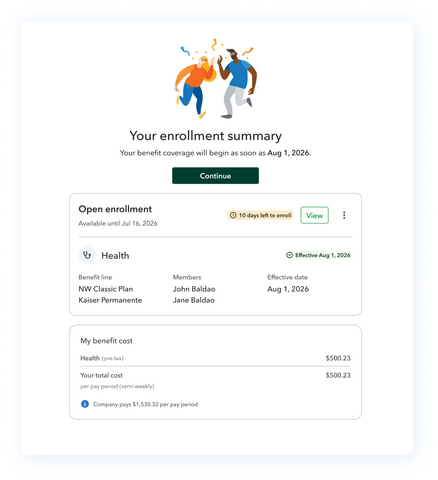
- Benefits administration: A centralized benefits hub allows businesses to manage carriers and plan options, while employees use a self-service portal to enroll in or update their medical, dental, vision, and life insurance coverage.
- QuickBooks 401(k) by Vestwell: Through an integration with Vestwell’s retirement platform, businesses can offer 401(k) plans that sync directly with payroll data, streamlining administration and supporting compliance.
- Performance management: Structured performance reviews, goal-setting tools, and continuous feedback cycles give employers and employees alike the visibility needed to support career development and build stronger teams.
- HR workflows and automation: Custom workflows can automatically assign tasks to the right employees — from onboarding checklists to equipment requests — eliminating manual follow-up and keeping HR processes organized and trackable.
- Document management: A built-in document hub supports creation, e-signatures, storage, and management of digital records. A custom template builder speeds up document creation for HR policies, acknowledgments, and compliance paperwork.
Three Tiers Match Client Needs
QuickBooks Workforce builds on the foundation of QuickBooks Payroll, which currently serves 18 million US workers, making it the country’s leading payroll provider for small businesses, and expands its capabilities through the integration of GoCo’s HCM technology. The platform is offered in three tiers:
- Workforce Payroll (formerly QuickBooks Payroll Core): Designed for smaller businesses, Workforce Payroll delivers full-service payroll including auto payroll, next-day direct deposit, 1099 e-filing, and access to Intuit’s expert support team. It also includes basic team management tools such as employee records and profiles and an employee portal. Optional add-ons include health benefits, 401(k) plans, Earned Wage Access, workers’ compensation administration, and background checks through Checkr. This tier gives solo practitioners and small-team employers a solid, compliant foundation without unnecessary complexity.
- Workforce Premium (formerly QuickBooks Payroll Premium): The middle tier targets growing businesses with an expanding employee base. In addition to everything in Workforce Payroll, it includes mobile time tracking, same-day direct deposit, and expert review of setup and configuration. On the HR side, Workforce Premium adds new hire onboarding, workflow management, time-off request management, recruiting tools, and employee offboarding capabilities. For clients in growth mode — adding headcount, opening new locations, or formalizing HR processes for the first time — this tier represents a significant step up in capability.
- Workforce Elite (formerly QuickBooks Payroll Elite): The top tier is tailored for mid-market businesses and firms managing larger, more complex workforces. Workforce Elite includes all Premium features plus enhanced time tracking with geofencing and project-level tracking, tax penalty protection up to $25,000, and done-for-you setup completed by an Intuit expert. The HR suite adds access to a personal HR advisor powered by Mineral Inc. and a full performance management module. For clients that have grown beyond basic payroll and need enterprise-caliber workforce management without the enterprise price tag, Workforce Elite is a compelling option.
Existing QuickBooks Payroll subscribers will be automatically transitioned to their corresponding Workforce tier at no additional cost when the platform becomes generally available in the coming weeks. Clients who are not yet on QuickBooks Payroll can add QuickBooks Workforce to their existing QuickBooks Online subscriptions.
The Advisory Opportunity: Why HR Is Now Your Business
For CPAs and accountants, the launch of QuickBooks Workforce is more than a product update; it is an opening to advisory conversations. The convergence of HCM and financial data in a single platform creates opportunities that many firms are already building, or want to build to expand their practice.
Overhead or labor is often the largest single expense line for service-based small businesses, yet many clients manage that cost center with minimal visibility and little strategic oversight. They run payroll, comply with basic employment law, and hope for the best.
It’s obvious what’s wrong with this picture: if you can advise a client with data-driven guidance where you connect labor costs to profitability, flag competitive benefits issues, and identify patterns that affect the company’s margins, your relationship and integrity will transform into being a truly trusted advisor.
QuickBooks Workforce makes that transformation significantly easier. Because the platform sits inside QuickBooks, the workforce data your clients generate, including payroll run history, time and attendance records, benefits costs, and headcount trends, is already connected to the financial data you use to advise them. You don’t need to export spreadsheets or piece together reports from separate systems.
Consider the conversations this enables:
- When a client is considering a new hire, you can model the full cost of salary, payroll taxes, benefits premiums, and workers’ comp against projected revenue and cash flow, all within the same platform.
- When a client is struggling with turnover, you can examine compensation benchmarks and benefits gaps alongside their income statement.
- When a client’s labor costs are running high, you can drill into time tracking data to identify inefficiencies before they become a crisis.
There is also a competitive dimension. Firms that can guide clients through benefits administration, retirement plan setup, compliance requirements, and performance management are significantly harder to replace than firms that only produce financial statements and tax returns. The clients most at risk of departing are those who see their CPA as a once-a-year relationship. The clients most likely to deepen their engagement and provide warm to hot referrals, are those who feel their accountant understands the full picture of their business, including how they manage their people.
For firms thinking about how to position this with clients, the conversation is straightforward: payroll compliance meets a company’s basic needs, but “workforce” strategy is all about understanding labor costs, managing benefits, and building HR processes.
QuickBooks Workforce gives you the tool. The advisory insight you bring to the relationship is what makes it irreplaceable.
The Bottom Line
QuickBooks Workforce is the most significant expansion of Intuit’s small-business HCM offering in the platform’s history. By integrating the full employee lifecycle directly into QuickBooks, Intuit has created a unified ecosystem that eliminates disparate tools and programs.
For your clients, it means less time spent on administrative work and more visibility into the workforce costs that drive their profitability. For your firm, it means a deeper connection to the business decisions your clients make every day and a stronger foundation for the kind of strategic advisory work that differentiates a great accounting firm.
QuickBooks Workforce will be generally available to eligible QuickBooks Online, QuickBooks Online Advanced, and Intuit Enterprise Suite customers in the United States very soon. Existing QuickBooks Payroll subscribers will receive automatic access to the new features based on their current subscription tier.
Sign in to get access to this free resource, and all of our whitepapers and reports.

Download this content today!
Register Now Already registered? Click here to Log In