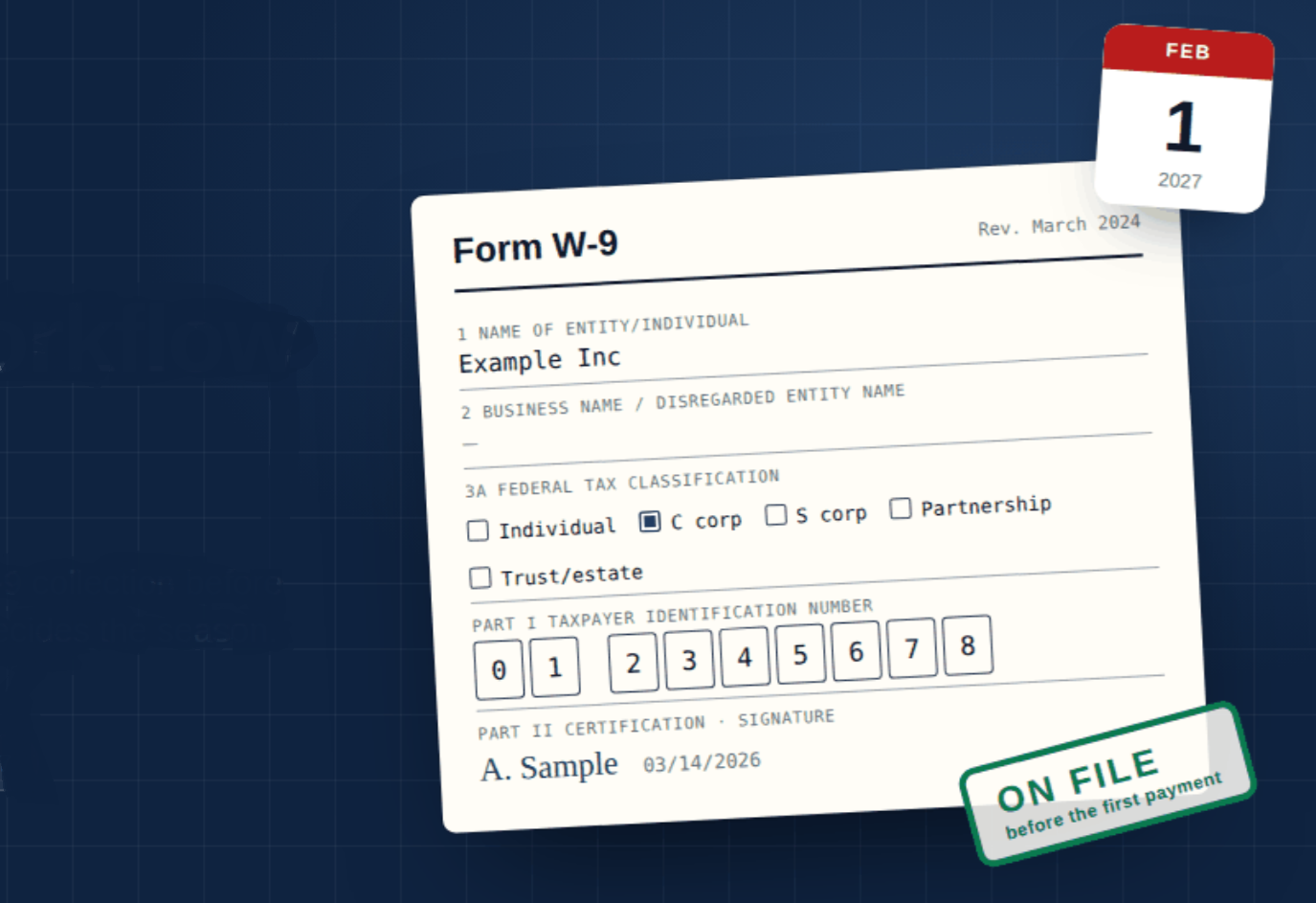




The annual 1099 rush is often described as a deadline problem. It is more accurately a data-management problem.
In January, firms commonly receive an accounts-payable report containing vendors that were added throughout the year without a completed Form W-9, a confirmed mailing address, a reliable payee classification, or a clear description of what was paid. Staff then have to identify potentially reportable payments, obtain sensitive taxpayer information, untangle vendor records, communicate with clients, and prepare returns against a fixed deadline.
That sequence is backwards.
The process should begin when the vendor relationship begins—not when the calendar changes. Form W-9 is used by a person required to file an information return to obtain the payee’s correct name and taxpayer identification number (TIN). A valid W-9 or acceptable substitute must include the payee’s name and TIN and be signed and dated under penalties of perjury by the payee or an authorized signer. (Source: IRS, Instructions for the Requester of Form W-9)
This is not merely a document-management detail. The quality of the W-9 workflow affects whether the business has usable tax data when reporting decisions must be made, whether the legal name used for reporting is consistent with the TIN, whether the firm can investigate exceptions before filing season, and whether client staff spend January chasing vendors instead of approving filings.
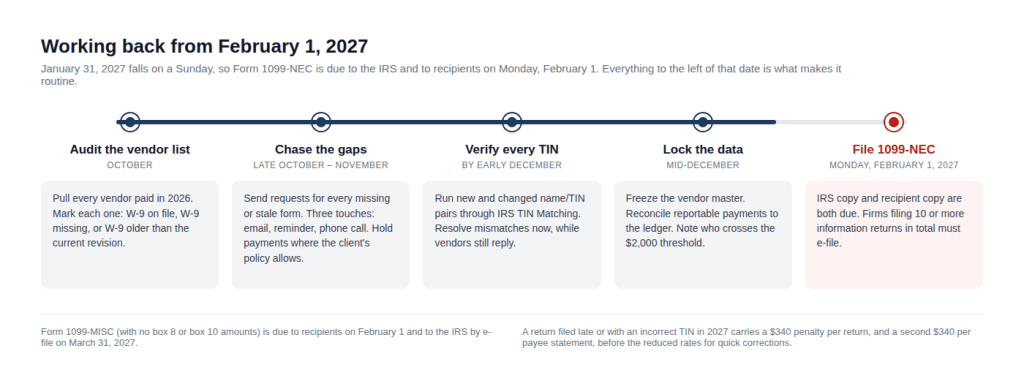
For Form 1099-NEC, the general IRS due date for filing with the IRS is Jan. 31. The deadline is the same whether the return is filed on paper or electronically. (Source: IRS, Instructions for Forms 1099-MISC and 1099-NEC)
A deadline that early requires a workflow that is substantially complete before December ends.
Why W-9 collection belongs in onboarding
The best time to request a W-9 is before the first potentially reportable payment. At that point, the vendor is completing setup, the client has the greatest practical leverage to obtain the information, and the finance team can create a clean record from the start.
A late request creates predictable problems: the vendor may no longer respond promptly; the original contact may have left the business; the client may not remember what the payment was for; the vendor may have been entered under a short name, nickname, or DBA rather than the legal tax name; and an inaccurate record may have been copied into multiple systems.
Collecting a W-9 early does not mean every vendor will receive a Form 1099. The reporting analysis remains fact-specific. It can depend on the payment type, amount, recipient classification, payment method, exceptions, and applicable IRS instructions. However, collecting complete tax data early gives the firm a reliable foundation for that later determination.
The IRS explains that backup withholding requirements can apply when, among other things, a payee fails to provide a TIN, the IRS notifies the payer that a TIN is incorrect, or the payee fails to make a required certification. (Source: IRS, Instructions for the Requester of Form W-9)
For CPA firms, the operational rule is straightforward: do not treat a W-9 as a January document request. Treat it as a vendor-onboarding requirement.
Firms can use a secure workflow to collect W-9 forms online. A centralized process can send a vendor a secure request, monitor request status, avoid collecting tax data through scattered email attachments, and preserve a signed record for the client’s files.
A CPA firm workflow that works
A dependable process separates data collection, payment classification, exception management, and filing preparation. Those are related tasks, but they should not be blended into one rushed January activity.
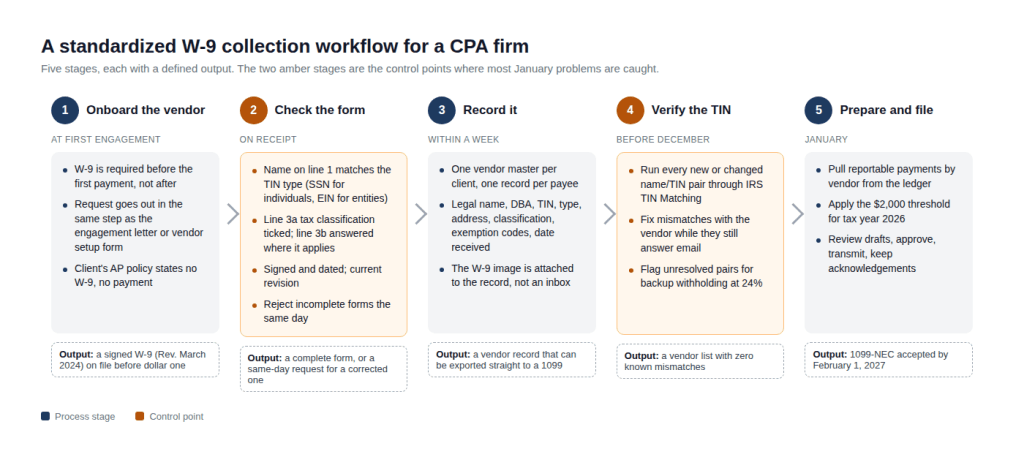
1. Establish vendor-onboarding requirements: Before payment, the client should obtain and review the payee’s legal tax name, business or DBA name if applicable, mailing address, TIN and TIN type, federal tax classification, signed certification where required, vendor contact information, description of services or payment purpose, and the date the W-9 was requested, received, and reviewed.
2. Create a tax-ready vendor record: The vendor profile should distinguish between the name used operationally and the name used for tax reporting. Maintain separate fields for legal tax name, DBA or business name, TIN type, recipient mailing address, entity classification, W-9 status, payment category, and exception status.
3. Review payment coding during the year: A completed W-9 is necessary vendor information; it is not a final determination that a particular payment must be reported. Depending on the facts, review nonemployee compensation, rents, royalties, medical and health-care payments, attorney payments, prizes and awards, and other payments covered by the 1099 instructions.
The IRS instructions explain that payments made by payment card or through certain third-party-network transactions generally are not reported by the payer on Forms 1099-NEC or 1099-MISC; instead, reporting may be handled by the payment settlement entity on Form 1099-K. (Source: IRS, Instructions for Forms 1099-MISC and 1099-NEC)
4. Turn missing information into an exception queue: Do not manage missing W-9s and unresolved vendor records through informal reminders. Each issue should have a defined status, owner, and next action.
5. Use controlled access and secure handling: Form W-9 contains sensitive information. Firms should use a secure collection and storage process, limit access to staff with a legitimate need, and avoid leaving W-9s in unrestricted email inboxes or shared folders.
Name and TIN accuracy before filing
The name associated with a TIN deserves special attention. Many vendor records use a trade name, a shortened company name, or the name of a contact person. Those operational labels can be helpful, but they should not displace the certified legal information needed for tax reporting.
For example, a bookkeeping file may list “Northside Creative,” while the W-9 lists “Jordan R. Smith” as the legal name and “Northside Creative” as the business name. The firm should review whether the name and TIN used in reporting are consistent with the payee’s certified information.
TIN matching can be a useful pre-filing quality-control step. The IRS offers TIN matching through its e-services program for eligible payers and authorized agents. The program allows certain name-and-TIN combinations to be compared with IRS records before information returns are submitted. (Source: IRS, Instructions for the Requester of Form W-9)
TIN matching does not decide whether a payment is reportable, determine the correct 1099 form or box, validate every aspect of a vendor relationship, or replace a completed W-9.
A sound sequence is to obtain a completed W-9; enter the legal name and TIN carefully; compare the vendor record with the W-9; check eligible records before filing; investigate a mismatch rather than assuming its cause; request corrected documentation when appropriate; and document the resolution before preparing returns.
Firms can use IRS TIN matching for 1099 payees, which supports individual or bulk checks and gives staff a way to identify verified, mismatch, and unverified records that require follow-up.
A mismatch is a prompt for review—not proof that a payee is acting improperly. It may result from a data-entry error, legal-name change, DBA-versus-legal-name confusion, entity-selection issue, or outdated W-9.
A practical year-end timetable
- January through September: Collect W-9s as new vendors are onboarded; maintain vendor profiles; use clear payment categories; review vendors paid without a W-9; and resolve high-value or recurring exceptions while vendor contacts are current.
- October: Run a preliminary report of vendors in potentially reportable payment categories. Identify missing W-9s, incomplete records, duplicate vendors, and unclear coding. Send targeted outreach and confirm the client contact authorized to answer classification questions.
- November: Verify recipient addresses and legal tax names. Review payee data for potential mismatches. Reconcile payment methods and escalate unresolved issues to the client’s controller, owner, or authorized signer.
- December: Complete the principal vendor-data cleanup before final payment activity makes the file more complex. Review totals and transaction descriptions, then confirm approvals, internal responsibilities, and filing preferences.
- January: Finalize payment reconciliation, prepare recipient statements and filing records, obtain client approval, and furnish and file by the applicable deadlines.
The IRS generally requires electronic filing for filers submitting 10 or more information returns in aggregate, subject to the rules applicable for the filing year. (Source: IRS, File Form 1099 Series Information Returns for Free Online)
Frequently asked questions
Q: Does every vendor need to complete a W-9?
A: Not every vendor will necessarily receive a 1099. However, requesting a W-9 from vendors that may receive reportable payments gives the business the information needed to make accurate reporting decisions later.
Q: Does a completed W-9 mean the vendor must receive a 1099?
A: No. A W-9 supplies the payee’s certified tax information. The reporting decision depends on the facts, including payment type, recipient classification, thresholds, payment method, exceptions, and current IRS guidance.
Q: What is the most important W-9 data point?
A: The correct legal name and the corresponding TIN are both critical. The requester needs a complete, valid record, not simply a nine-digit number.
Q: Does TIN matching replace the W-9?
A: No. Form W-9 is the payee’s certification. TIN matching is a separate comparison of submitted name/TIN data with IRS records for eligible users. Both steps can be part of a strong process, but they serve different functions.
Q: What should happen if a vendor refuses to provide a W-9?
A: The firm and client should document their requests, escalate the issue to an authorized decision-maker, and evaluate the reporting and backup-withholding implications using the applicable IRS guidance and the specific facts.
Q: What is the most effective improvement a CPA firm can make?
A: Make W-9 collection a required, trackable vendor-onboarding step. That gives the firm time to validate records, classify payments, resolve exceptions, and prepare year-end filings without turning January into a document chase.
IRS sources
- IRS, Instructions for the Requester of Form W-9
- IRS, Instructions for Forms 1099-MISC and 1099-NEC
- IRS, File Form 1099 Series Information Returns for Free Online
- IRS, Publication 1099, General Instructions for Certain Information Returns
ABOUT THE AUTHOR:
Nazrul Huda, MSA, is the founder of Tax Form Hero LLC, which operates TaxFormHero, an IRS-authorized e-filing platform for 1099, W-2, and ACA information returns. He writes about information-return compliance for small businesses and the accounting firms that serve them.
Photo credit: gstudioimagen/Freepik
Sign in to get access to this free resource, and all of our whitepapers and reports.

Download this content today!
Register Now Already registered? Click here to Log In
Tags: 1099, 1099 filing, 1099 reporting, accounting firms, CPA firms, Firm Management, IRS, Payroll, Taxes, W-9