




Stronger corporate performance is more closely associated with intentional AI deployment across customer, product and decision-making use cases, rather than the amount of spending, according to Gartner, Inc., a business and technology insights company.
Analysts are discussing the key issues facing CFOs and finance leaders during Gartner Finance Symposium/Xpo here this week. Simply spending more on AI does not, by itself, equate to better business outcomes,” said Michelle Carlsen, Director Analyst in the Gartner Finance practice. “Organizations that outperformed industry peers on revenue growth, margin expansion and return on invested capital over the last 10 years were more likely than matched peers to frame AI as a growth engine and to connect AI use cases across product innovation and sales, marketing, and customer growth.”
A recent Gartner analysis of 101 efficient growth leaders against control peers (i.e., organizations with matching industry and revenue profiles) revealed significant differences in how they frame their AI investments.
The results showed that efficient growth companies pursue product and customer AI use cases that reinforce one another: Forty-six percent of efficient growth companies deploy AI across both product innovation and sales, marketing, and customer growth, compared with 32% for control group companies. Efficient growth leaders integrate AI across product and customer engines, creating mutually reinforcing capabilities that control group companies, focused primarily on labor productivity, cannot replicate (see Figure 1).
Figure 1: Efficient Growth and Control Companies by Use Cases
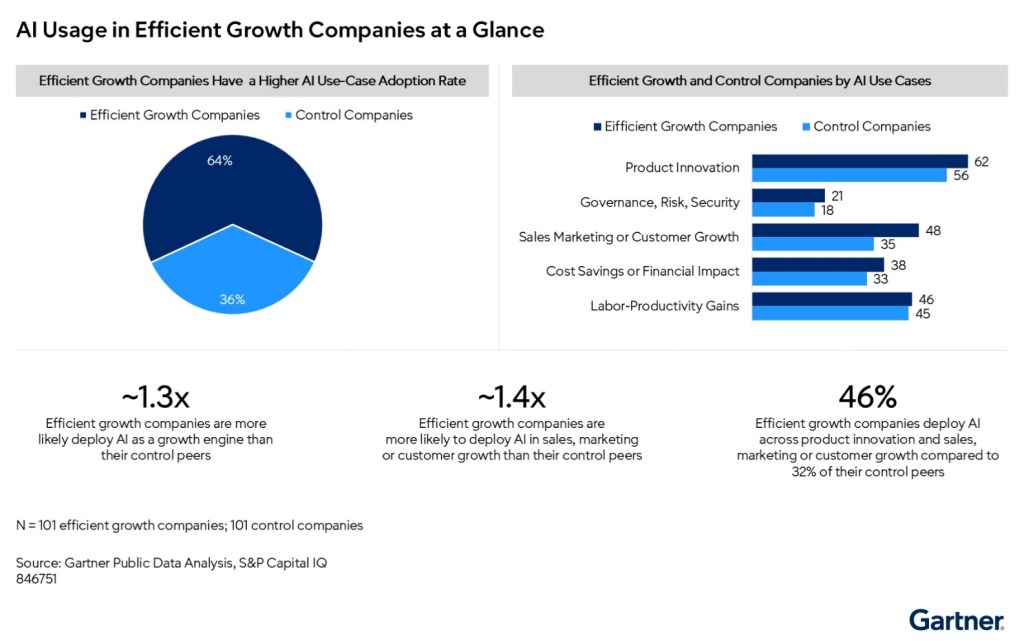
Source: Gartner (May 2026)
“The most important question for CFOs is not how much can the organization spend on AI, but whether those investments are being deployed in ways that reinforce the business’s core growth and value drivers,” said Carlsen. “Moreover, the near-identical amount of use cases for efficiency and productivity use cases between efficient growth firms and control peers suggests that productivity-focused AI investments alone do not explain performance differences, and that automation by itself is increasingly becoming table stakes rather than a durable source of advantage.”
AI Advantage Varies by Company Scale and Industry Structure
The research also found that the AI advantage is most visible among smaller and midsize organizations. Efficient growth companies with less than $3 billion in revenue deployed two times more AI use cases than comparable peers, highlighting AI’s potential as a scale multiplier when resources are constrained. Among companies below $10 billion in revenue, efficient growth companies were 2.6 times more likely to deploy AI across both product innovation and sales, marketing, and customer growth
Industry context also matters: AI differentiation was strongest in data-intensive technology and financial services, where AI can be embedded more directly into products, customer interactions and decision workflows. In asset-intensive industries, AI is currently delivering more efficiency than differentiation, making it a competitive necessity rather than an automatic source of advantage.
“For CFOs, the implication is to evaluate AI investments not only by the return of individual use cases, but also by how well those capabilities reinforce broader growth, product and decision processes across the enterprise,” said Carlsen.
Sign in to get access to this free resource, and all of our whitepapers and reports.

Download this content today!
Register Now Already registered? Click here to Log In