




Finance organizations are often investing in artificial intelligence (AI) in ways that do not align with board expectations, creating a gap between AI activity and perceived business value, according to Gartner, Inc., a business and technology insights company.
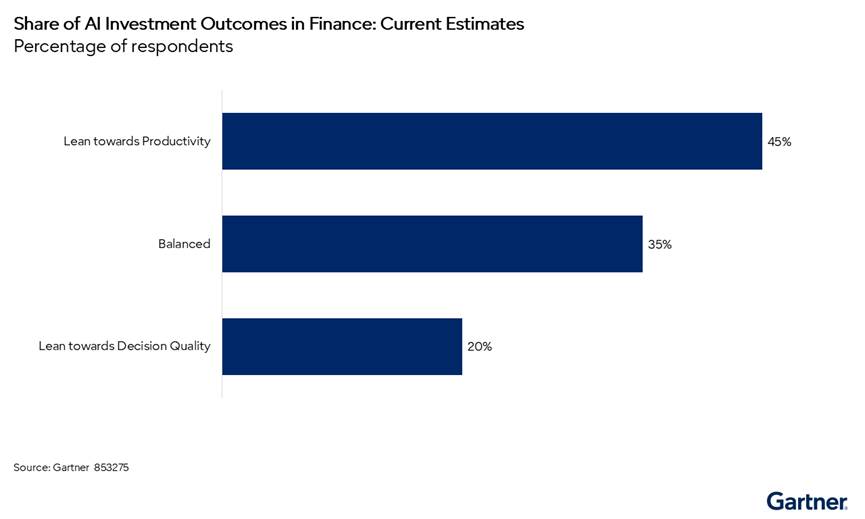
A Gartner survey of 204 finance leaders in March 2026 revealed that just 20% of finance AI projects lean towards decision quality, while 45% of AI investments in finance lean towards productivity (see Figure 1).
“Many CFOs are prioritizing AI use cases focused on productivity and efficiency,” said Shankar Keshav, Principal Analyst in the Gartner Finance practice, “However, boards place greater emphasis on investments that drive growth, improve decision-making and deliver competitive advantage.”
Figure 1. Share of AI Investment Outcomes in Finance
Finance AI portfolios are frequently concentrated on use cases that enhance individual productivity or streamline transactional processes. While these investments can deliver measurable efficiencies in the finance function, there is a ceiling to the benefits they return for most organizations. Once a task becomes faster or lighter touch, the benefit often plateaus unless that efficiency changes a broader business decision or allows finance to operate in a meaningfully different way.
“This imbalance can lead to a perception gap, where finance leaders report progress on AI adoption, but boards see limited strategic impact,” said Keshav. “As a result, even well-executed AI initiatives may fall short of expectations when they fail to address the outcomes most valued at the enterprise level.”
Notably, the survey found that those functions that invested in “Upend” AI initiatives – those which create new value propositions, products or markets – were more than twice as likely to report high realized value from AI.
CFOs Must Rebalance Finance AI Investments Toward Enterprise Outcomes
To better align with board expectations, CFOs should take a portfolio approach to AI investments, ensuring a good mix of initiatives that contributes to enterprise outcomes rather than just internal efficiency.
“CFOs need to shift more investment toward AI use cases that improve decision-making, enable scenario analysis, identify growth opportunities and build reusable assets such as data, models and knowledge,” said Keshav.
This will require a shift in how AI initiatives are measured, focusing more on enterprise impact rather than just the number of pilots or hours saved.
“CFOs must spell out and communicate what finance AI success looks like with clear metrics that are tied to enterprise objectives, including both near-term benefits and long-term strategic value,” said Keshav. “And this will be a moving target, requiring reassessment and rebalancing as business needs and expectations evolve.”
Sign in to get access to this free resource, and all of our whitepapers and reports.

Download this content today!
Register Now Already registered? Click here to Log In