

Artificial intelligence is now the defining ethical issue for the accounting profession, the Association of Chartered Certified Accountants points out in a new report.
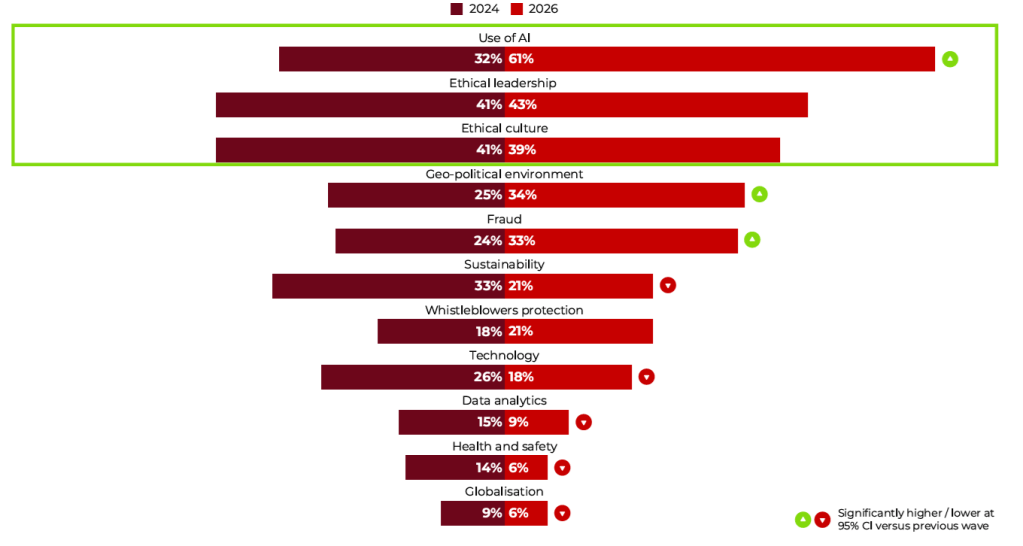
The London-based group says there’s been a dramatic increase in the number of accounting and finance professionals who rank AI use as the leading ethical challenge—61% of respondents, up from 32% in ACCA’s 2024 survey.
According to the report, Navigating Ethics for Trust, both ethical leadership (43%) and ethical culture (39%) remain in respondents’ top three ethical challenges.
The 2026 survey draws on 1,178 responses from finance and accounting professionals across 135 countries, with roundtable discussions adding qualitative depth.
Taken together, the evidence presents a profession that remains strongly grounded in ethics, trusted for its core qualities, and well-placed to lead through change, the report says.

“The overall picture is one of a profession that remains ethically grounded, self-aware, and willing to adapt,” Sarah Lane, head of ethics and assurance at the ACCA, said in a statement. “Finance professionals are not asking for more rules, the fundamental principles remain the ethical anchor. They are asking for the tools, support, and guidance needed to apply the fundamental principles in an increasingly complex world.”
But accountants are feeling more pressure as the profession becomes more complex and difficult to navigate in practice. Half of respondents agreed that ethical challenges have become more difficult to resolve in the last three years, and 53% report witnessing unethical behavior in that period.
When it comes to AI specifically, the top ethical challenges cited by survey respondents include:
- Overreliance;
- Verification;
- Reduced human judgment;
- Confidentiality;
- Inadequate human oversight on AI outputs;
- Transparency;
- Unclear accountability;
- Lack of appropriate governance; and
- Weak organizational guardrails.
But despite all that, 72% of respondents say AI tools enhance the quality and efficiency of their work, while 89% say they apply professional skepticism and ethical judgement when using it. Seventy-two percent also agree that strong AI literacy helps them use the technology responsibly.
“The evidence supports a balanced reading. Respondents recognise the value in AI use, but the roundtables and open-ended responses are clear that responsibility remains human,” the report says. “AI-assisted outputs still
require review, challenge, documentation, and the ability to explain how conclusions were reached. In that sense, AI increases the need for professional judgement—rather than reducing it.”
The report includes a toolkit that provides a practical 10-step process for applying the International Code of Ethics for Professional Accountants in real situations.
Other key findings from the survey data include:
- 89% agree ethical capability in the profession remains strong—but it depends on continuous professional development.
- Trust in the profession is grounded in strong ethical standards (46%), transparency (38%), and independence (36%).
- Enabling ethical behavior in practice is a shared responsibility—with ethical culture and leadership acting as core conditions for ethical action. In the survey, ethical leadership and ethical culture remained among the top ethical challenges in both 2024 and 2026.
“Professional accountants are operating in a changed world. Technology, geoeconomic pressure, geopolitical uncertainty, and rising expectations of transparency are reshaping the conditions in which ethical decisions are made,” ACCA Chief Executive Helen Brand said in the report. “In this environment, the profession’s strength lies in ethics: applying our Ethical Code’s fundamental principles with consistency, judgement, and courage—this is what drives trust.”
Photo credit: Association of Chartered Certified Accountants
Sign in to get access to this free resource, and all of our whitepapers and reports.

Download this content today!
Register Now Already registered? Click here to Log In