




Imagine a business owner asking ChatGPT, “What should I look for in a CPA firm that specializes in construction companies?”
Instead of receiving ten website links, the owner gets a detailed answer explaining what matters, which services to consider, and potentially which accounting firms specialize in construction. Now comes the important question: Is your firm part of that answer?
For years, accounting firms have invested in search engine optimization (SEO) to appear in Google results. Today, generative AI platforms are introducing another way prospective clients discover, evaluate, and select professional advisors. Welcome to Generative Engine Optimization (GEO).
What Is GEO? How Is It Different From SEO?
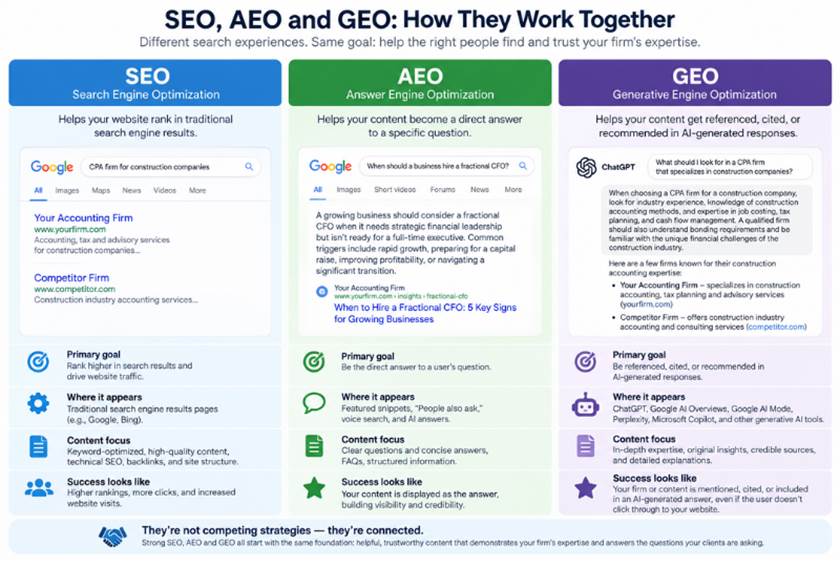
According to Semrush, “Instead of focusing solely on search engine rankings (i.e., SEO), GEO is about becoming part of the output that AI systems deliver, known as agentic search.” SEO focuses on improving website visibility in traditional search engine results. GEO focuses on making content more likely to be discovered, referenced, and cited by AI-powered search experiences.
For example, traditional search might return a list of accounting firms for “estate planning CPA near me.” An AI-powered search might explain estate planning considerations, identify relevant professional qualifications, and reference accounting firms or educational resources.
With SEO, success often means earning a high search ranking and attracting website visitors. With GEO, visibility may also mean having your firm’s expertise included in an AI-generated answer, even when someone never visits your website. Google confirms that traditional SEO fundamentals remain important for its generative AI search features. Therefore, firms still need accessible websites, helpful content, and reliable information.
The good news? GEO doesn’t replace SEO. It builds on it.
[Click to enlarge]
Five GEO Actions Accounting Firms Can Take Today
The transition to AI search doesn’t require a complete website redesign or expensive new technology. Start with these five actions.
1. Test Your Firm’s AI Visibility
Open an AI tool and enter questions your ideal clients might ask, e.g., “What should a manufacturing company look for when hiring a CPA firm in Chicago?” Review the response.
- Is your firm mentioned?
- Are competitors referenced?
- Which websites or articles appear as sources?
Repeat the exercise using several questions related to your firm’s services, industries, and geographic markets. Document the results to establish a starting point.
2. Rewrite One Service Page Around Client Questions
Choose an important service page. Does it explain what the service includes, who benefits, when someone might need it, and how the process works? Also, include clear headings and direct answers to common questions. For example, replace a generic heading like “Our Advisory Solutions” with “When Should a Growing Business Consider Outsourced CFO Services?”
Keep the language natural and useful rather than repeating keywords. Consider using the AI Visibility Industry Page Framework as a starting point.
3. Demonstrate Expertise, Not Just Services
AI search creates another reason to publish original, experience-based content. Instead of writing another general article about tax planning, consider addressing a specific situation, such as “What Construction Company Owners Should Review Before Making Year-End Equipment Purchases.”
Include practical considerations, relevant examples, and links to authoritative sources. Also, identify qualified authors, explain their professional experience, and review technical information for accuracy. For accounting firms, credibility isn’t optional. It’s part of the value proposition.
4. Strengthen Your Digital Footprint
Your website isn’t the only place prospective clients encounter your firm. Your firm’s Google Business Profile, professional directories, association listings, and relevant third-party websites can support discoverability and credibility.
Confirm that your firm’s name, location, services, and areas of specialization are accurate and consistent. Look for opportunities to contribute expert commentary to reputable industry publications or professional associations.
5. Look Beyond Website Traffic
Website traffic and Google rankings still matter, but they don’t tell the whole story anymore.
Start asking a few new questions.
- Is your firm showing up in AI-generated answers?
- Is your content being cited?
- Are competitors getting mentioned while your firm is missing from the conversation?
Google Search Console now offers reporting on visibility in AI Overviews and AI Mode, while Google Analytics 4 can help you see whether AI platforms are sending visitors to your website.
You don’t need a complicated dashboard. Start tracking a few meaningful indicators alongside website traffic and new business inquiries. Over time, you’ll get a better picture of how your firm is performing in AI search.
Your 30-Minute GEO Starting Plan
Not sure where to begin? Set aside 30 minutes this week.
- 10 minutes: Test five client-focused questions across AI search platforms.
- 10 minutes: Review your most important service page for clear answers and evidence of expertise.
- 10 minutes: Identify three improvements and assign responsibility for completing them.
Repeat the visibility assessment monthly using the same questions, while recognizing that AI results can change between tests.
The Future of Search Is About Being Useful
Accounting firms shouldn’t abandon their existing SEO investments or chase every new AI marketing tactic. Instead, focus on what makes a firm valuable to clients, like specialized knowledge, credible advice, and the ability to answer important financial questions.
Search technology will continue to evolve. Your opportunity is to make your firm’s expertise easier for both people and AI systems to find, understand, and reference.
Disclaimer: Becky Livingston is a Semrush Ambassador.
Sign in to get access to this free resource, and all of our whitepapers and reports.

Download this content today!
Register Now Already registered? Click here to Log In
Tags: chatgpt, Firm Management, generative ai, gpt, llm, search engine, seo, Technology