



By Luke Frye, CPA, Accountant in Residence at Canopy
The accounting profession is undergoing a structural transformation more consequential than any technology shift of the past two decades. Cloud software changed where work happened. Workflow tools changed how work moved. Artificial intelligence is changing who does the work, and that change has the potential to reshape the very architecture of your firm.
Executive Summary
- Structural Shift: AI is transforming the traditional accounting firm structure by automating repetitive base-level labor, displacing the traditional “pyramid” staffing model.
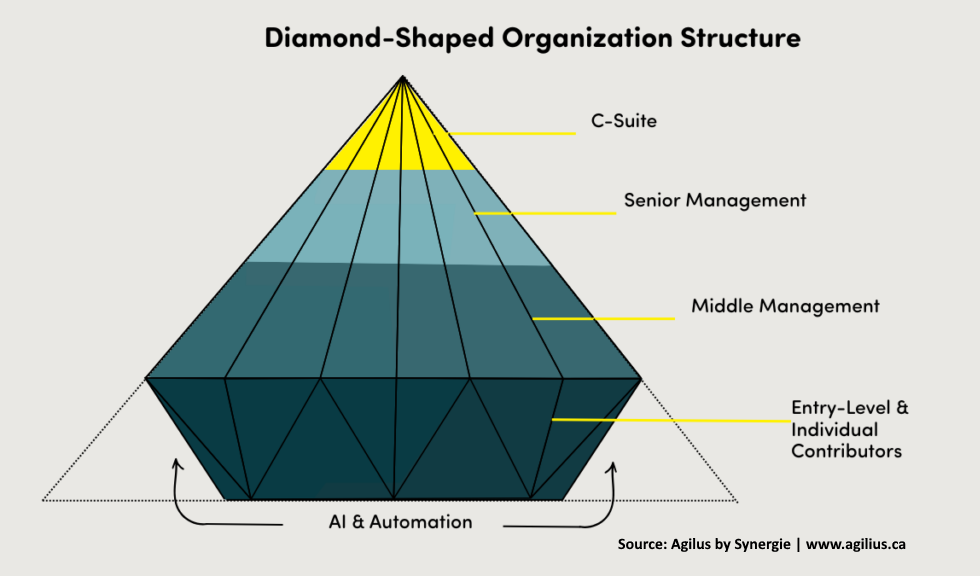
- The “Diamond” Model: Firms are shifting to a diamond shape: a smaller entry-level layer focused on judgment, a expanded middle layer driving core value, and a partner layer focused on strategic advisory.
- Elevated Middle Layer: Mid-level professionals shift from traditional reviewers to strategists, translating automated data into actionable, contextualized client insights.
- Evolved Talent & Training: Hiring will target mid-career experts, AI specialists, and data analysts, while training shifts from manual repetition to mentorship, scenario-based judgment, and technology fluency.
- Future Leadership: Success requires leaders to adapt workflows, standardize automation processes, and prioritize adaptability, continuous learning, and client trust.
For more than half a century, the pyramid has been the defining geometry of the profession. It was built on layers of manual labor, with a wide base of entry‑level staff performing repetitive tasks, a narrowing middle of reviewers and managers, and a small top layer of partners focused on relationships and strategy. AI is now dissolving the foundation of that model. As the work changes, the structure must change with it.
Why the pyramid no longer fits the work, and what to do about it.
The pyramid practice model may make sense when firms needed large numbers of junior staff to handle data entry, reconciliations, document collection, tie‑outs, and the administrative follow‑ups that kept engagements moving. These tasks were predictable, time‑consuming, and essential. They also served as training grounds for new accountants, who learned the profession by doing the work manually.
AI disrupts this logic. When automation handles the unseen work including intake, preparation, routing, and first‑pass analysis, the need for a wide base of junior labor diminishes. Firms no longer scale by adding more people at the bottom. They scale by increasing the leverage of professionals who can interpret AI outputs, manage exceptions and guide clients through increasingly complex decisions.
Consider thinking about a new proposed firm structure that looks less like a pyramid and more like a diamond. The entry‑level layer becomes smaller, focused on developing judgment rather than performing repetitive tasks. The middle expands, becoming the core of the firm’s value creation. These mid‑level professionals are the ones who validate anomalies, contextualize results, and lead client conversations. At the top, partners concentrate on advisory work, long‑term planning, and relationship leadership.
This type of diamond shape approach better reflects a profession shifting from production to interpretation, from compliance to counsel, from task execution to strategic partnership. It is a structure built for a world where technology handles the background work and humans handle the meaningful work.
Value creation is mobilized in the middle of your firm
In an AI‑enabled practice, the middle layer becomes the engine of the firm. These professionals are no longer simply reviewers. They are strategists who ensure that automated workflows produce accurate, contextualized outcomes. They translate complexity into clarity. They manage risk and judgment. They coordinate cross‑functional collaboration. Their work is not defined by checking boxes but by guiding clients through uncertainty.
This shift elevates the importance of human skills. Communication, empathy, curiosity, and the ability to build trust become central to the firm’s competitive advantage. Technology is not making accountants less human. It is making the human elements of the profession more valuable.
Strategic staffing in needed to leverage the diamond practice model
A diamond‑shaped firm will also require a different approach to talent. Firms will hire fewer entry‑level staff because the traditional apprenticeship model of learning through manual repetition, no longer aligns with the work. Instead, firms will seek mid‑career professionals who can manage exceptions, oversee quality, and lead client relationships. They will also bring in non‑traditional roles such as data analysts, technologists, and AI specialists who support the firm’s new operating model.
Firms that continue hiring for the pyramid will find themselves overstaffed at the bottom and underdeveloped in the middle. Firms that hire for the diamond will be positioned to grow without expanding payroll at the same rate.
By the same token, training must evolve alongside hiring. New accountants will not learn the profession by performing repetitive work. They will learn by interpreting, validating, and communicating. This requires a shift in how firms design onboarding and professional development. Critical thinking, scenario‑based judgment, advisory frameworks, and technology fluency become the new foundation of growth. Mentorship replaces manual labor as the primary learning mechanism.
New leadership skills are needed in the diamond‑shaped firm
Leaders must rethink how they measure performance, allocate resources, and design workflows. The autonomous firm requires standardized processes that support automation, clear quality‑control frameworks, and client experiences built around transparency and ease. Technology investments must reduce friction rather than add complexity. Above all, leaders must cultivate a culture that values adaptability, continuous learning, and human connection.
The firms that succeed will be those that intentionally redesign their structure, not those that wait for the structure to change around them.
The next decade belongs to firms that reshape themselves
Diamonds may be a firm’s best strategy. The structure of the profession is changing. The opportunity is to change with it. AI is not replacing accountants. It is replacing the pyramid. The firms that embrace the diamond‑shaped model will operate with greater capacity, stronger relationships and a more resilient talent strategy. They will be built for advisory, built for autonomy, and built for the human‑centered future of the profession.
==
Luke Frye, CPA, is the Accountant in Residence at Canopy, where he uses his background in accounting tech startups and private practice to help firms build smarter, more scalable businesses.
Sign in to get access to this free resource, and all of our whitepapers and reports.

Download this content today!
Register Now Already registered? Click here to Log In





Chris Denver August 7 2026 at 2:40 pm
Luke, It would have been great if you credited me and others for the development of the Diamond model. This has been in the market for several years. Best, Chris