A Top Technology Initiative Article – July 2026
My, what a spring and unusual start to summer! While our family, and hopefully yours, just celebrated the 250th anniversary of the signing of the Declaration of Independence, events leading up to that day were generating just as many fireworks. The spring speaking season included invitations to the AICPA G400 event, AGN, AICPA Engage, Scaling New Heights, and the CPAmerica conference, as well as many technology strategy consulting engagements in CPA firms and industry businesses.
Other notable events included the PrimeGlobal Tax & Assurance Summit, BDO Conference, and RightNOW. Around 200 vendors at AICPA Engage and 130+ at Scaling New Heights brought out the big guns and new messages.
We like to review leading products and have discussions with thought leaders on the Accounting Technology Lab podcast. My co-host, Brian Tankersley, and I recorded a session covering AICPA Engage and Scaling New Heights as part of our weekly program cadence. When I consider how lucky I am to prepare and present on Artificial Intelligence (AI) for so many events, I would like to summarize some of my new learning and guidance on AI and how to implement AI in your practice.
I have presented on AI 20+ times in the last 90 days, live in Nashville, Salt Lake City, Las Vegas, Orlando, and Indianapolis. My virtual reach has been all over the US, Canada, and Ireland.
So, What Has Changed with Products and AI?
Publishers are desperate to get their AI-enabled products to market. Some AI is real and useful, some is fake. The pace of some is turtle, and of others, hare. I have had the good fortune to review every AI-powered General Ledger on the market, and the future looks bright.
I do not believe I have seen a single new product brought to market without AI this year. Many of the platforms were Vibe-coded. I recently reviewed Clean Books from Seth David. He had created a small accounting system, starting in January 2026 and releasing the product in June 2026. The features and capabilities exceed many legacy GL products. Jeff Siebert at Digits claimed that in December 2025, the entire five-year effort of building Digits was rewritten, optimized, and bug-checked in 72 hours. Likewise, Andrew Argue and his team at Instead have developed and released a new tax system. Because of AI’s increased capabilities, programmers are experiencing a 25-50-fold improvement in productivity. Silicon Valley managers suggest that AI Token budgets should be 1.5-3 times the programmers’ salaries.
Legacy products are struggling to add AI features, but at least most have added MCP (Model Context Protocol) interfaces, augmenting their APIs (Application Programming Interface). Consider this three-layer view of strategically implementing AI, building on Large Language Model (LLM) providers, such as Microsoft Copilot 365 (particularly considering the May 1 release of Microsoft Agent 365 and E7 licenses), Claude Anthropic, OpenAI ChatGPT, Google Gemini, and Perplexity:
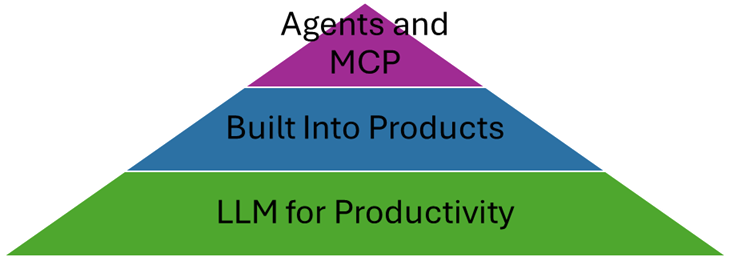
To start with the LLM layer for productivity, choose a small team (3-5, or just yourself), and license paid versions of at least 3 of the 5 platforms listed above. If I were making the decision, I would license them in the order listed. Most of these subscriptions will cost between $20 and $30 per month. Later, you should license the advanced models ($200/month) to get access to those platforms’ tokens. Wait a minute, AI has way too much new terminology. There may be more terms than the computer world’s TLAs (three-letter acronyms). A few terms that you will need:
- Prompt is how you ask a question of an AI platform or issue a command for the platform to perform a specific action on your behalf. Well-structured prompts ensure accurate, relevant work that aligns with professional standards while avoiding waste. While we have reviewed 10+ prompting approaches, these three are common.
- RACE – Role, Action, Context, Execute
- GRICO
- Goal: Start by being clear about what needs to be done
- Role: Give the AI a specific job title or perspective to take
- Instructions: Walk through the steps to keep things on the right track
- Context: Share the background info so they do not have to guess
- Output: Say exactly how you want the final version to look
- TCEO – Task, Context, Expectation, Output
- Generative AI – Uses Large Language Models (LLM) to respond to a chat or prompt.
- Tokens – Units of resource for AI to work. A rough measure of a unit is a word or syllable of a word.
- Context Window – The number of Tokens an AI can have in memory at a time. The context window includes all background processing. The context window in the current models is 1 million, but it is changing to more.
- MCP (Model Context Protocol) Server – Tools for AI to connect to external applications, replacing Application Programming Interface. Established by Anthropic.
- Agents – AI that can take actions or build tools
- Why “steps” matter. Earlier AI use was often a one-shot interaction: ask a question, get an answer. AI 3.0 matters because many real-world business tasks are not one-shot. They require several linked activities such as gathering information, applying rules, using software tools, checking for exceptions, and deciding what to do next. A step-based design lets AI move through that work in a more structured way.
- Why “loops” matter. The “loop” is what makes the system adaptive. The AI does not merely mechanically complete Steps 1, 2, and 3. It can review what happened, detect problems, revise the plan, call another tool, and continue until it reaches an acceptable result or needs human review. That iterative pattern is a core distinction between simple AI assistance and more agentic AI behavior.
- Retrieval Augment Generation – Known as RAG. Method of giving a dataset for the AI to work with
- Markdown – a structure for representing formatting (bold, italics, headings, etc.) in plain text.
- Vibe Coding – tools that let non-programmers develop systems with AI prompts. Vibe coding matters because it turns software creation into a faster, more accessible business capability—while also increasing the need for review and governance.
- Lower barrier. More professionals can help build useful software with natural language.
- Faster innovation. Ideas can move from concept to prototype much more quickly.
- Broader participation. Domain experts can shape tools directly rather than wait for developers.
During the last few months, new generation releases of all the LLM platforms have
- Increased desktop interaction (Copilot Work, Claude Work, ChatGPT Work, Gemini Computer)
- Increased the context window
- Become more sophisticated while reducing hallucinations
- Been restricted by the US Government as a munition, and then later released. Security threats with the new platforms are real, and the vulnerability and security of client data are legitimate concerns
- Seen vendors change license agreements to accumulate more private data since the models have hoovered up most public data
- Been adopted by software publishers building their own agents and AI, while other publishers have established a form of private AI
While I still benefit from using many AI models, given the safety improvements and the availability of Microsoft Copilot 365, I have been using this platform more, particularly with the new Microsoft AI models, Claude and ChatGPT. We have recommended Microsoft 365 Business Premium to most small firms at $22 per month, and now suggest Microsoft Defender and Purview Suites for Microsoft 365 Business Premium, which is $15/user/month, paid yearly, as the best SMB bundle for those who want both advanced security and advanced compliance.
Why We Shouldn’t Assign Copilot Licenses Before the Environment Is Ready?
Microsoft Copilot is not just a software license—it is an AI service that has access to the same files, emails, chats, meetings, and SharePoint content that users can access. Microsoft recommends assessing readiness, security, permissions, governance, and user adoption before broad deployment.
If you assign licenses before preparing the environment, you risk:
- Oversharing sensitive information because Copilot can surface content that users already have permission to access, even if those permissions were granted unintentionally.
- Poor user experience and adoption if users are not properly trained or selected for an initial pilot group.
- Wasted licensing costs on users who may not be technically ready or who will not receive immediate value from the service.
- Governance and compliance issues may arise if SharePoint permissions, data classification, retention, and security controls have not been reviewed.
Our recommended approach is:
- Assess tenant readiness.
- Review security, permissions, and data governance.
- Select and train a pilot group.
- Validate results and address issues.
- Expand licensing in phases.
Bottom line: A successful Copilot rollout is a readiness-and-governance project first and a licensing project second. Simply assigning licenses without preparation can create security risks, increase costs, and reduce user adoption. Competitive AI platforms don’t have the governance to protect your data, and there are indications that the privacy settings in the platforms are ignored.
So, What Should You Do Now?
My understanding and clarity in making recommendations is far more precise now. Most presentations I have seen take client data too much for granted, a clear compromise on CPA licensing and protection of client data. Various vendors are not protecting data at an acceptable level, but some are, most notably the larger players like Microsoft, CCH/Wolters Kluwer, and Thomson Reuters. Others are taking liberties with both your firm’s data and the client’s.
The top takeaways of the last 90 days include:
- Start with an AI policy that has security and governance – This is obviously so much more critical that I completely rewrote my recommendations, incorporating 20+ AI governance considerations for common practice products. AI policies written last year are obsolete.
- Set AI strategy and tactics that align with your firm’s strategy and tactics – Per our past guidance for technology, AI alignment is critical.
- Start small, and start now – If you wait, you will get further behind. Competitors are not that far ahead of you. Pick 3-5 people and ask them to use structured prompting to enable others in your firm. Have them build a standard prompt list as a starting point. I have been providing a structured prompting spreadsheet and 100 Client Accounting Services prompts in my courses.
- Then, expand the team – Once you are convinced that the small team is getting good results, decide how you will expand this knowledge across the firm, and then have them teach others. Firms that deployed “AI for all” have seen some productivity gains but are not seeing genuine improvement.
- Add off-the-shelf AI built into products – You have real needs for client work that require accurate results. Tax research is a great example of an area where many firms have enhanced tools with AI. A common strategy is to license Thomson Reuters CoCounsel Tax, CCH Answer Connect for Tax Research, or Bloomberg Tax Research for work where you have to be right, and BlueJ, TaxGPT, Marble, Accordance, CPA Pilot, or other platforms for ease of use and reduced costs. The same could be said for tax preparation, audit, and Client Accounting Services tools.
- Write a few agents for repetitive tasks – Consider what tasks are repetitive in your firm. Create a few agents to do those jobs. While in prior years, I had recommended n8n as the repository for those agents, Microsoft Agent 365 is quickly becoming a favorite.
- Prepare for the token economy – Agents will consume tokens. Rather than licensing LLM models for everyone, expect to spend on tokens for the firm. At this stage, consider paying $200 for Claude Anthropic, OpenAI ChatGPT, Google Gemini Ultra, and possibly Perplexity. You will have access to more sophisticated models for chat, cowork, and agent development, and be able to produce work. For an estimate of token consumption, consider the following.
- Put on your listening ears and professional skepticism – Publishers need sales and are struggling to position their products. There is much overlap in what is being sold. Exaggeration is common. Since you mapped your needs in step #2 above, match them to the products. However, be in listening mode for new possibilities.
- Sales pressures are mounting – Many teams are not meeting goals. We expect company failures this year and beyond, as there are too many suppliers and too many products without enough market demand to consume them. Expect deals to be offered, but keep your firm in a position to switch as needed.
- Watch for Shadow AI – If you do not control AI, team members will use it to make their work easier. Unfortunately, they will frequently use free tools that do not provide sufficient client data protection. Remember that LLM vendors are desperate for more data, and they want your firm’s and your clients’ data.
- Expect to talk to AI – While there have been utilities in the past that made talking to AI useful, expect all AI platforms to support voice interaction as the year progresses. Consider how you structure your offices and hardware to make talking to the computer practical.
As noted in my last column, AI is rapidly commoditizing compliance, as underscored by the IRS in the Introductory Guidelines for Responsible AI Use in Federal Tax Practice, which suggests that if AI is used, the tax professional should reduce client billing time by the amount of time AI saves. Without compromising quality, “good enough” products and services have changed my attitude about AI and firm practice technology stacks. Many professionals are vibe coding all the software they need and have a goal of minimizing licensing paid to publishers.
Real value has shifted from deliverables to outcomes. There are flat-rate engagement pressures to bill for outcomes, which can be beneficial for both the firm and the client. Understanding what the client wants is the beginning of advisory. Advisory is quite different from what the client would expect from compliance services. Your best blend of services today should be what the client must have, needs, and wants. Can you use an AI stack to provide services that were uneconomic or unattainable just a few years ago? That is where the magic of AI will become real.
Sign in to get access to this free resource, and all of our whitepapers and reports.

Download this content today!
Register Now Already registered? Click here to Log In