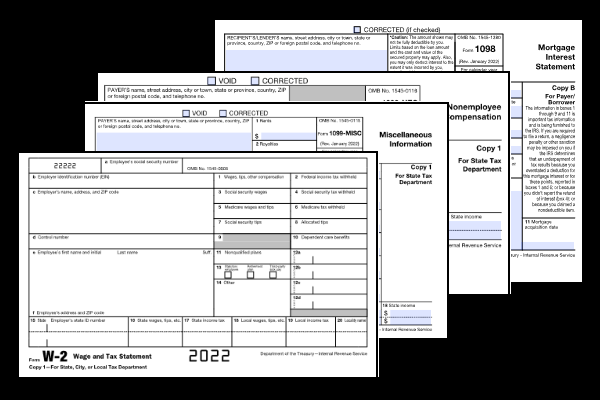




The IRS does not have to guess when a taxpayer leaves income off a return. In many cases, it already has the other side of the story.
That is the power of information reporting.
The numbers are staggering. According to the IRS’s 2025 update to Publication 6961, the agency projects roughly 4.8 billion information and withholding documents for calendar year 2025 and more than 5.2 billion for calendar year 2026. That is the information-reporting engine behind modern IRS enforcement.
The IRS information reporting system is not just a filing system. It is a tracking system. Every Form W-2, 1099, 1098, 5498, K-1, and payment platform report gives the government another data point to compare against the taxpayer’s return. Clients can fight back by keeping records that are just as complete, just as organized, and just as ready for review.
This is not the old paper-driven IRS many clients still imagine. The IRS is modernizing its intake systems, pushing electronic filing, scanning paper submissions through IRIS, and using data analytics, artificial intelligence, and machine learning to identify mismatches faster. Notices that once took years to generate may now arrive within months.
Recommended Articles


A tax return tells the IRS what the taxpayer says happened. A Form 1099 tells the IRS what someone else says happened. When those two stories do not match, the IRS does not need to begin with a traditional audit. It can begin with computer matching, a CP2000 notice, proposed tax, interest, penalties, and a taxpayer who is suddenly playing defense.
For decades, many clients treated Forms 1099 as January paperwork. They gathered a few names, chased down a few W-9s, filed a few forms, and moved on. That approach is becoming harder to defend.
In addition to compliance, Form 1099 is now a key part of the IRS enforcement system. They reveal whether a client has good records, proper vendor onboarding, reliable bookkeeping, and a process for identifying reportable payments before year-end.
The One Big Beautiful Bill Act now adds another layer to the conversation. Beginning with payments made after December 31, 2025, the long-standing $600 reporting threshold for many Forms 1099-MISC and 1099-NEC payments increases to $2,000. Beginning after 2026, that threshold is indexed for inflation. The old $600 threshold had been in place since 1954. For many payors, this is a significant change.
On the surface, the higher threshold appears to reduce paperwork. In many cases, it will. Fewer low-dollar vendors will require Forms 1099-MISC or 1099-NEC. Clients who make occasional smaller payments to service providers may have fewer forms to prepare. Firms may see some reduction in the volume of year-end information returns.
But tax professionals should be careful not to let clients draw the wrong conclusion. Changing the reporting thresholds does not change taxability. A vendor who receives $1,500 of taxable income from a client may not receive a Form 1099-NEC under the new threshold, but the income is still taxable.
The Sixteenth Amendment gives Congress the power to tax income “from whatever source derived.” That phrase is worth remembering. The tax law does not say income is taxable only if a Form 1099 arrives in the mail. IRS form 1099 is only a reporting requirement, the taxable income was already triggered.
Clients often confuse the two, they often ask, “Do I have to report it if I did not receive a 1099?” Or they say, “I thought it was not taxable because it was under the threshold.” Those assumptions are wrong, and the higher threshold may make that misunderstanding more common.
For CPAs, accountants, and tax professionals, this is an opportunity to educate clients before the first filing season under the new law. The message should be simple: the threshold for filing certain 1099 forms may be higher, but the need for accurate records is just as important.
The 1099 problem has never really been the form. The problem is the system behind the form.
Most 1099 failures begin when a client pays a vendor before collecting a completed Form W-9. Once the vendor has been paid, the client has lost leverage. The vendor may ignore requests, provide incomplete information, or disappear entirely. The client is then left deciding whether to file late, file incomplete information, issue a correction, or do nothing and hope the issue never surfaces.
While the issue surfaces in January, it begins during the initial onboarding process.
A better practice is to help clients implement a “no W-9, no payment” policy for vendors who may require information reporting. Before a vendor is added to the accounting system, the client should collect a completed W-9, verify the legal name and taxpayer identification number, identify the vendor type, and determine how payments will be made.
The accounting system should then track whether the vendor may require a 1099, what type of payment is being made, and whether the payment method affects reporting. Payments made by credit card or third-party payment networks may be reported on Form 1099-K by the settlement organization rather than Form 1099-NEC by the business payor. If the client does not understand that distinction, duplicate reporting, missed reporting, and reconciliation problems can follow.
The Form 1099-K rules add further complexity. The One Big Beautiful Bill Act restored the Form 1099-K threshold to more than $20,000 and more than 200 transactions for third-party settlement organizations. That change reduced the risk that millions of small or casual transactions would generate forms. But again, the reporting threshold is not the tax rule. A taxpayer may have taxable income even if no Form 1099-K is issued.
That is where CP2000 notices enter the discussion.
A CP2000 notice is not a formal audit, and it is not a final bill. It is a proposed adjustment generated when the IRS identifies a possible mismatch between information reported to the IRS and information reported on the taxpayer’s return. Forms W-2, 1098, 1099, and other information returns are central to that matching process.
But clients should not be comforted by the word “proposed.” A CP2000 notice requires an answer. The taxpayer must agree, disagree, explain the mismatch, provide documentation, or otherwise resolve the issue. If the taxpayer does not respond, the IRS can move forward and assess the proposed increase in tax.
At that point, the client is dealing with an assessed balance, interest, penalties, collection notices, and a much more expensive problem—not merely a proposed adjustment.
For clients, the CP2000 notice often arrives long after the transaction occurred. By then, memories have faded, records are harder to locate, vendors may be gone, and the client may not understand the difference between gross receipts, net income, reimbursements, refunds, duplicate platform reporting, or amounts already reported elsewhere on the return.
For the tax professional, the CP2000 response often becomes a reconstruction project. Was the income already reported on Schedule C? Was the 1099 issued under the taxpayer’s Social Security number even though the income was reported through an entity? Was the amount gross of fees? Was a corrected 1099 issued? Was the income reported in a different year? Was the form simply wrong?
These questions are better prevented through clean records than answered under deadline pressure.
The new $2,000 threshold may reduce some 1099 filings, but it will not eliminate CP2000 risk. In some cases, it may make recordkeeping even more important because clients may receive fewer forms and assume fewer items require attention. Tax professionals should remind clients that the absence of a form is not proof that income does not exist.
The penalty environment also remains important. The IRS can assess penalties for failure to file correct information returns, failure to furnish correct payee statements, late filing, and intentional disregard. The amounts vary based on how late the correction is made and whether the failure was intentional. For high-volume clients, even modest per-form penalties can become material.
Backup withholding is another underappreciated issue. If a client fails to obtain a valid taxpayer identification number or receives notice that the name and TIN do not match IRS records, the client may have backup withholding obligations. The Big Beautiful Bill Act also made conforming changes to backup withholding rules tied to the new reporting threshold, but the practical lesson remains the same: clients need valid W-9s before they pay.
For firms, the advisory recommendation is straightforward. Effective 1099 compliance begins with client controls, vendor onboarding, and recordkeeping—not with January filing deadlines.
That control system should include a written vendor onboarding policy, W-9 collection before payment, TIN matching where appropriate, accounting system fields for 1099 status, payment method tracking, quarterly vendor reviews, documentation of exceptions, and a January filing calendar. Clients should know who inside the business collects W-9s, who approves vendor setup, who reviews payment totals, and who communicates with the tax professional before filing deadlines arrive.
Firms should also use the 1099 process to identify related advisory issues. A client with many independent contractors may need worker classification review. A client paying attorneys may need guidance on the special attorney reporting rules. A client receiving Forms 1099-K may need help reconciling platform deposits, refunds, merchant fees, chargebacks, and gross receipts. A client receiving CP2000 notices may need better bookkeeping, entity reporting, or income reconciliation procedures.
Technology can help, but only if the underlying process is sound. The IRS is using better technology on its side of the equation. Clients need better technology and better records on their side. Accounting platforms, accounts payable tools, payroll systems, TIN matching tools, and 1099 filing solutions can reduce manual work and improve consistency. But technology cannot fix bad intake. If the wrong legal name, taxpayer identification number, entity type, or payment classification is entered at the beginning, automation simply moves bad data faster.
The coming threshold increase should not lessen the focus on 1099 compliance. It presents an opportunity for firms to elevate the conversation. Rather than focusing solely on filing requirements, firms should evaluate whether clients have reliable processes for identifying payees, documenting payments, tracking payment methods, and meeting applicable reporting obligations. Those controls ultimately determine whether January filing season is routine or problematic.
More importantly, those controls extend well beyond Forms 1099. They reflect the overall quality of a client’s financial records and compliance processes. The 1099 form may be filed once a year, but the system supporting that filing operates throughout the year. Firms that help clients strengthen those systems can reduce filing-season chaos, avoid preventable penalties, respond more effectively to CP2000 notices, and reinforce their role as trusted advisors throughout the year.
====
Steven A. Leahy is a tax attorney, author of Fight Back Now: Freedom Through Preparation and 1099 Reporting: A Professional Guide, and the principal of Opem Tax Advocates, Inc. He helps business owners and taxpayers resolve IRS problems, improve tax compliance, and build systems to avoid future tax trouble. He also teaches tax professionals and business owners on IRS enforcement, information reporting, tax resolution, and practical compliance strategies.
Sign in to get access to this free resource, and all of our whitepapers and reports.

Download this content today!
Register Now Already registered? Click here to Log In
Tags: audits, cp2000, Income Taxes, IRS, IRS notices, Small Business, tax audits