



From fiscal year 2020 to fiscal year 2024, only 8% (5,673) of the 70,879 people hired by the IRS were veterans, falling way short of the 14% veteran hiring goal established by the Treasury Department, according to a new report from the Treasury Inspector General for Tax Administration.
Veteran new hires ranged from 7% to 11% of total new hires each year during that time period.
The IRS’s 14% veteran hiring goal was set by the Treasury Department in fiscal year 2013, but Treasury hasn’t reassessed this goal to meet current hiring trends, TIGTA noted.
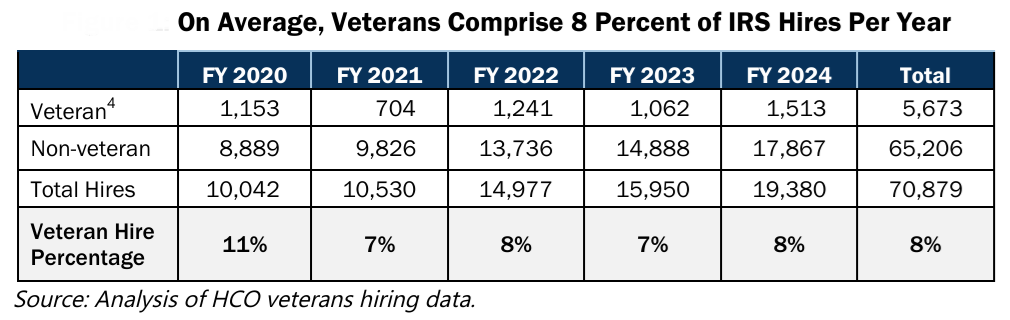
In its report, TIGTA said 74% of IRS functions met or exceeded the 14% veteran hiring goal. However, other functions—primarily entry-level and lower-paying positions, including seasonal positions—reported substantially lower veteran hiring rates. Because these functions represent a large portion of the IRS’s hiring, they reduce the overall IRS veteran new hire percentage, TIGTA said.
IRS Human Capital Office officials said there could be several reasons why the veteran hiring goal wasn’t hit, including whether the candidate met and demonstrated basic knowledge, skills, and abilities for open positions; the hiring authority used; and whether all veteran hires self-identified as a veteran if not specifically hired under a veteran authority.
“For example, when someone applies for a federal job, veteran status is not automatically shared with thehiring agency,” the report says. “Applicants can self-identify as veterans or use a veterans hiring pathway. However, for veterans who do neither, their veteran status is effectively invisible in the hiring data, which results in undercounting. HCO management also stated that outreach to veterans could teach them how to translate their military experience into a civilian position and build a resume that fits the position(s) for which they are applying.”
According to HCO management, many veteran applicants aren’t interested in seasonal positions, which comprise a large portion of the IRS’s hiring.
“For example, FY 2025 hiring data showed that only 5 percent (585 of 10,702) of applicants for the recent seasonal Contact Representative job announcements self-identified as veterans,” the report says. “In contrast, 26 percent (928 of 3,507) of applicants for the latest Criminal Investigation job announcements self identified as veterans. Many veterans acquire significant experience and job skills during their military service, which can qualify them for higher-graded, full-time positions. This may contribute to the lower veteran hiring rates in seasonal positions.”
Veteran hiring percentages for seasonal positions remained consistently low, ranging from 2% to 3% from FY 2020 through FY 2025, the report shows.
In its FY 2024 Strategic Recruitment Plan, IRS management recognized that the agency hasn’t met the Treasury Department’s veteran hiring goal. IRS officials said there’s an ongoing effort to develop strategies to meet that goal in the future, including tracking and analyzing IRS veteran hiring and workforce data to produce an annual hiring summary and trend analyses (by IRS function) that shows progress made toward achieving the goal.
During TIGTA’s review in May 2025, the Office of Personnel Management issued a memorandum outlining a Merit Hiring Plan to simplify federal hiring and refocus recruitment to technical skills-based criteria. This plan highlighted three areas for the recruitment strategy: veterans; early career; and science, technology, engineering, and math.
The OPM will lead a government-wide veteran recruiting road map that defines target occupations with agency leadership and partner with agency veterans’ program leaders to find opportunities to match the talents of veterans with in-demand skills at agencies, the report says, adding that the impact of this effort is currently not known.
TIGTA recommended that the IRS human capital officer should coordinate with the Treasury Department’s chief human capital officer to reassess the IRS’s veteran hiring goal. However, the IRS disagreed with the recommendation, saying the 14% goal was “aspirational” and “not a mandated target.”
“The referenced 14 percent goal originated from the Council on Veterans Employment’s Hiring Percentage Model established in 2013 and was an aspirational goal not a mandated target,” Alex Kweskin, IRS chief human capital officer, wrote in response to the report. “This aspirational goal was intended to encourage agencies to boost their hiring and engagement, and it was not a binding or mandated target by the Department of the Treasury.
“At the IRS, we proudly reaffirm our unwavering commitment to veterans,” he added. “We deeply value the extraordinary skill, leadership, discipline, and service that veterans bring to our workforce. Their dedication to our nation strengthens both our organization and our mission to serve the American people.”
Photo credit: Sean Lee/Unsplash
Sign in to get access to this free resource, and all of our whitepapers and reports.

Download this content today!
Register Now Already registered? Click here to Log In