



For many CPA firms, the lack of marketing is not due to a lack of effort. It is a lack of consistency.
At the beginning of the year, there is often a push to improve visibility. LinkedIn posts are published, a blog is drafted, or the website is updated. Then client demands increase, deadlines take priority, and marketing activity slows.
Over time, this pattern leads to a familiar outcome:
- an inconsistent pipeline,
- increased reliance on referrals, and
- limited control over growth.
A structured 90-day marketing plan offers a practical solution. It provides a focused, manageable approach that aligns with how accounting firms operate, while also addressing how prospective clients now search for and evaluate professional services.
Why a Structured Approach Matters
The client journey has changed significantly.
Referrals still play an important role, but they are no longer the only driver of new business. Prospective clients are conducting their own research before making contact. They are:
- Searching online for answers to specific financial questions.
- Reviewing firm websites and service offerings.
- Engaging with educational content.
- Increasingly using AI-driven tools to explore options.
By the time a prospect reaches out, they are often already informed and comparing providers.
Firms that are not visible during this early research phase are less likely to be considered. A structured 90-day plan helps ensure consistent visibility during these critical moments.
A Practical Framework for 90-Day Marketing
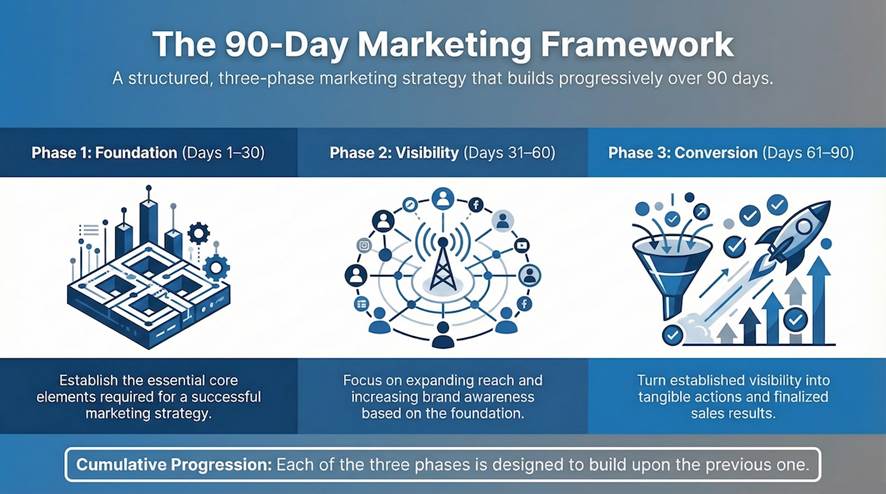
Rather than approaching marketing as a series of disconnected activities, firms benefit from thinking in phases. Each phase builds on the previous one, creating a more effective and sustainable approach.
This progression ensures that firms do not move into content creation or advertising before establishing clear messaging and positioning.
Phase 1: Establishing a Clear Foundation
The first 30 days should focus on clarity, not volume.
Many firms attempt to increase marketing output without first defining who they are targeting and how they differentiate themselves. As a result, their messaging becomes too broad and fails to resonate.
Key areas of focus include:
- Identifying ideal client profiles by industry, size, and common challenges.
- Understanding the most frequent questions that those clients ask.
- Clarifying core services in terms of outcomes, not just tasks.
- Evaluating website messaging for clarity and relevance.
In practice, even modest adjustments at this stage can have a meaningful impact.
For example, a mid-sized firm that primarily served construction clients found its website messaging overly generic. By refining its positioning, updating service descriptions in plain language, and introducing a targeted resource addressing common cash flow concerns, the firm significantly improved engagement without increasing marketing spend.
To support this process, structured tools can be particularly effective. A prompt-based framework guides firms in defining their ideal client, identifying key questions, refining messaging, and evaluating website performance. Download the “CPA Marketing Foundation Cheat Sheet” with AI prompts to help you get started with this phase.
Phase 2: Building Consistent Visibility
With a clear foundation in place, firms can shift their focus to visibility.
At this stage, the objective is not volume for its own sake, but relevance and consistency. Content should be aligned with the questions and concerns identified in Phase 1.
Effective activities during this phase include:
- Publishing educational content that addresses specific client questions.
- Sharing insights through professional platforms such as LinkedIn.
- Developing a focused resource, such as a checklist or guide, aligned with client needs.
- Structuring content in a way that supports both traditional search and AI-driven discovery.
Search engines and AI tools prioritize clear, useful, and well-structured content. Firms that consistently produce content addressing real client concerns are more likely to be surfaced during the research process.
A practical example is a solo practitioner specializing in dental practices who was committed to publishing one article per week based on common client inquiries. Within two months, the firm experienced increased website engagement and began receiving inquiries from prospects referencing specific content topics.
Phase 3: Converting Visibility into Action
Visibility alone does not generate growth. It must be paired with clear pathways for engagement.
Many firms invest in content and a digital presence but do not provide a clear next step for prospective clients. As a result, opportunities are lost.
This phase focuses on:
- Incorporating clear and consistent calls-to-action across digital assets.
- Offering practical resources in exchange for contact information.
- Establishing a simple follow-up process.
- Monitoring engagement and refining the approach based on results.
In one example, a firm with steady website traffic but limited inquiries introduced a targeted downloadable resource and streamlined its contact process. This relatively small adjustment led to a measurable increase in qualified inquiries within a short period.
The Role of AI in Execution
AI tools are increasingly being integrated into marketing workflows, offering efficiencies in content creation, idea generation, and analysis.
However, their effectiveness depends on the quality of the underlying strategy.
Firms with clearly defined audiences, messaging, and objectives can use AI to accelerate execution and maintain consistency. Without that clarity, AI may simply produce a higher volume of unfocused content.
In this context, AI is best viewed as a tool that supports a well-structured plan, rather than a substitute for one.
Structure, Focus, and Consistency
A 90-day marketing plan does not require significant resources or a large internal team. It requires structure, focus, and consistency.
Firms that approach marketing in phases—establishing a clear foundation, building visibility, and enabling conversion—are better positioned to adapt to changing client behaviors and maintain a steady pipeline of opportunities.
For firms seeking a practical starting point, focusing on the first 30 days of clarity and alignment often delivers the greatest immediate impact.
What’s your biggest marketing challenge?

Thanks for reading CPA Practice Advisor!
Subscribe Already registered? Log In
Need more information? Read the FAQs