

Every year, thousands of foreign-owned U.S. limited liability companies face IRS penalties that should never have happened. The filings were late. The forms were incomplete. Or the owners simply did not know the obligation existed.
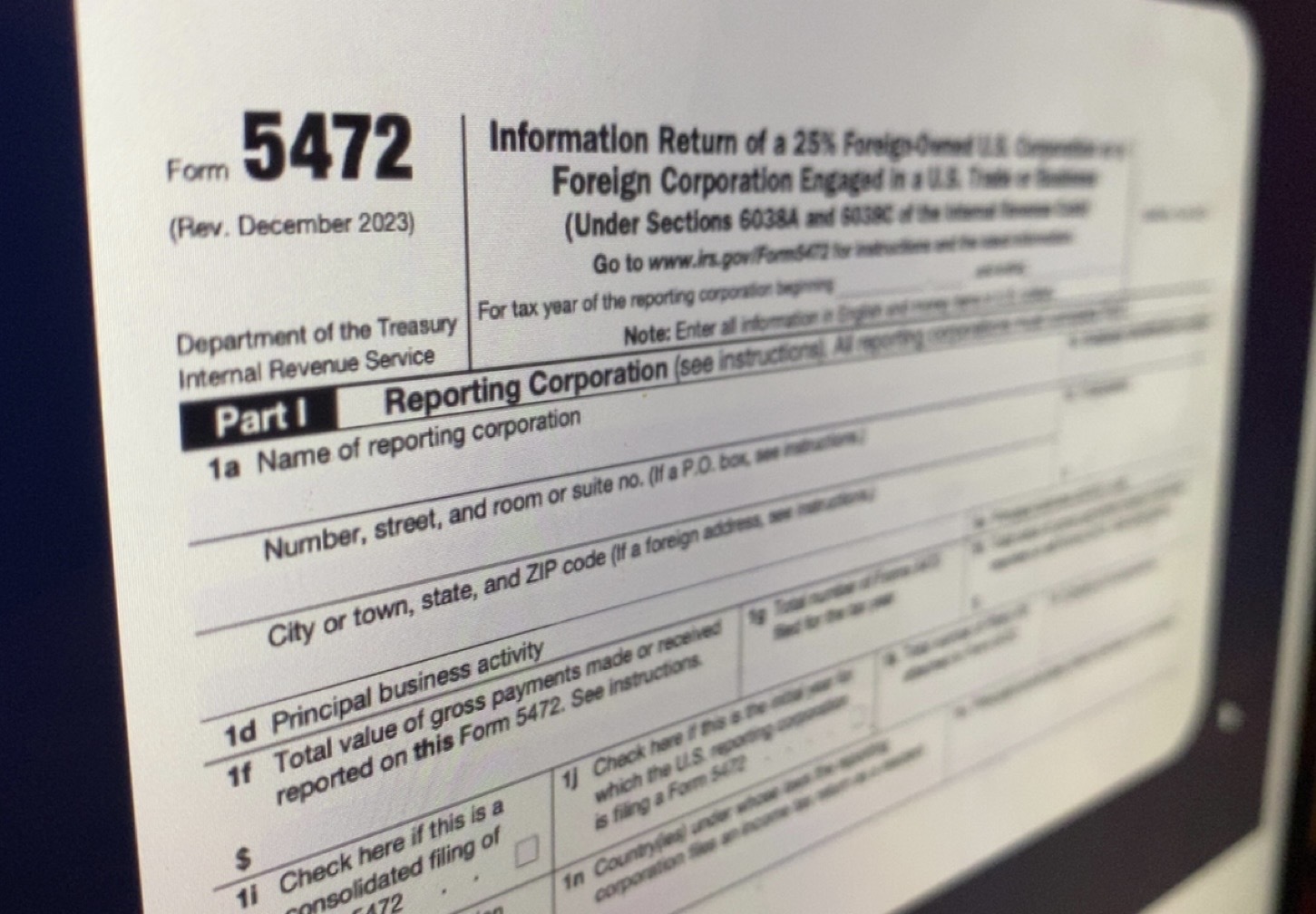
Form 5472, Information Return of a 25% Foreign-Owned U.S. Corporation or a Foreign Corporation Engaged in a U.S. Trade or Business, is one of the most technically demanding international information returns in the IRS toolkit. The official instructions run several pages. But the gap between what those instructions say and what actually trips up real filers is wide enough to drive a $25,000 penalty through.
Here is what CPAs advising foreign-owned entities need to understand about that gap.
What the IRS instructions say
The IRS instructions for Form 5472 describe the form as an information return filed by a “reporting corporation” to disclose related-party transactions. The instructions specify:
- A reporting corporation is any U.S. corporation at least 25% owned by a foreign person, or a foreign corporation engaged in U.S. business.
- Since 2017, a U.S. single-member LLC wholly owned by a foreign person is treated as a domestic corporation for Section 6038A purposes, even though it remains a disregarded entity for income tax.
- The form must be filed with a pro forma Form 1120 as a cover sheet.
- The deadline follows the corporate return deadline: April 15 for calendar-year filers, with a six-month extension available
The instructions define reportable transactions broadly: any exchange of money, property, services, or rights between the LLC and its foreign owner. That includes capital contributions, owner-paid expenses on behalf of the entity, loans, and distributions.
What actually happens in practice
The instructions are technically accurate. They are also optimized for corporate tax attorneys at large firms, not for foreign entrepreneurs or their first CPA.
- The “dormant LLC” assumption: The most common real-world error is the belief that a non-operating entity has no filing obligation. An LLC with no revenue, no employees, and no U.S. bank activity still almost certainly had a reportable transaction in its first year: the owner paid the state filing fee, the registered agent fee, or both. Those payments are reportable. The IRS does not care that the LLC was idle.
- The pro forma 1120 is not optional: Form 5472 cannot be filed alone. It must be attached to a pro forma Form 1120 with “Foreign Owned U.S. DE” written across the top of the return. This combined package is mailed or faxed to the IRS’s international processing unit in Ogden, Utah. Many online filing platforms do not support this workflow, leaving foreign owners with incomplete submissions.
- The extension does not protect against the penalty: A common misconception: that filing for a six-month extension covers Form 5472. It does not. The extension applies to the underlying income return. Form 5472 is an information return, and the $25,000 automatic penalty for a late or substantially incomplete filing is assessed regardless of whether an extension was timely filed.
- Penalty stacking is real and fast: Under IRC Section 6038A(d), the initial penalty is $25,000 per tax year per form. If the IRS issues a notice and the filing remains outstanding after 90 days, an additional $25,000 applies. After that, the penalty increases by $25,000 for each additional 30-day period of non-compliance. A single unfiled year can reach $100,000 in assessed penalties before most clients are even aware there is a problem.
Recommended Articles

The multi-year late filer problem
Foreign clients who discover a missed Form 5472 filing often have not one but three or four unfiled years. The IRS process for these situations, the Delinquent International Information Returns Submission Procedures (DIIRSP), requires all delinquent years to be submitted together in a single package with a reasonable cause statement.
The key word is reasonable cause. The IRS does not automatically waive penalties. A credible, documented explanation grounded in the specific facts of the client’s situation is required. Boilerplate letters fare poorly. A well-constructed reasonable cause statement referencing the client’s lack of prior U.S. tax presence, reliance on incorrect advice, or first-time filing status gives the best outcome.
Four things to check at client intake
For any foreign-owned U.S. entity entering your practice:
1. Determine the ownership structure on day one: Is the LLC single-member? Is the owner a non-U.S. person? If yes, Form 5472 is in scope from year one, regardless of activity level.
2. Ask about the formation year: The filing obligation begins the year the LLC is formed or acquires its first foreign owner. Many clients assume it starts when revenue begins. It does not.
3. Confirm whether prior years were filed: A client who says “my previous accountant handled it” deserves a follow-up question. Ask to see the filed returns. The absence of a pro forma 1120 in the prior year package is a red flag.
4. Scope the engagement letter explicitly: Form 5472 and the pro forma 1120 are distinct deliverables from the income return. List them separately. Ambiguity in the engagement scope is how these filings fall through.
The Full IRS requirement vs. practice breakdown
For a detailed section-by-section comparison of the IRS instructions against real-world practice, including the exact mailing address, the DIIRSP submission process, and penalty abatement mechanics, the full guide is at form5472.online/form-5472-instructions.
Conclusion
Form 5472 looks like a disclosure form. It behaves like a penalty trap. The clients most at risk are not the ones with complex international structures. They are the ones with simple, single-member LLCs who assumed that no revenue meant no filing. By the time a $25,000 notice arrives, the window for easy remediation has closed.
CPAs who understand these mechanics protect clients from an entirely avoidable outcome, and position their practice as the authority on cross-border compliance.

ABOUT THE AUTHOR:
Arik Rozen, CPA, MBA, is an international tax practitioner specializing in U.S. compliance and cross-border advisory for foreign-owned businesses. As head of the tax team at form5472.online and TAX USA GROUP, Arik helps accountants and non-resident entrepreneurs navigate Form 5472 reporting, penalty relief, and international tax planning. Virginia CPA license No. 025991.
Sign in to get access to this free resource, and all of our whitepapers and reports.

Download this content today!
Register Now Already registered? Click here to Log In