

The Securities and Exchange Commission gave the final go-ahead Monday to the Public Company Accounting Oversight Board’s quality control standard before it finally goes into effect on Dec. 15.
The SEC approved several amendments to QC 1000, A Firm’s System of Quality Control, that the PCAOB adopted in September.
According to the PCAOB, the amendments “improve alignment, where appropriate, with other quality management standards and seek to reduce compliance costs without compromising the PCAOB’s statutory mission to protect investors and further the public interest in the preparation of informative, accurate, and independent audit reports.”
Recommended Articles

In a statement on Nov. 2, PCAOB Chairman Demetrios Logothetis called the SEC’s approval of the QC 1000 amendments “a significant milestone for the PCAOB.”

He continued: “It continues our efforts to refocus on our core mission by strengthening the effectiveness of our standards while also preserving the rigor our U.S. capital markets deserve. This is a win for auditors and investors alike. These amendments also reflect a thoughtful, robust stakeholder-informed effort.
“By enhancing alignment with international quality management frameworks, where appropriate, refining requirements that imposed unnecessary burdens, and facilitating a modern, quality control-focused inspection program, the amendments advance the PCAOB’s broader modernization agenda.
“Most importantly, these amendments position QC 1000 to fulfill its intended purpose: helping firms build effective systems of quality control. This will enable the PCAOB to take a more proactive, risk-informed approach to oversight that promotes accountability, strengthens audit quality, and better serves investors and stakeholders throughout the audit and financial reporting ecosystem.”
Initially approved by the PCAOB in May 2024 under the leadership of then-chair Erica Williams, the audit regulator decided in August 2025 to postpone the standard’s effective date by one year—from Dec. 15, 2025, to Dec. 15, 2026.
The board said at the time postponing the effective date “struck an appropriate balance between the benefits to investors of having QC 1000 take effect as soon as practicable and the need to allow sufficient time for registered public accounting firms to design and implement robust QC 1000-compliant quality control systems.”
Recommended Articles

The PCAOB had heard concerns from audit firms and others in the auditing community that certain provisions of QC 1000 were unclear in their application, might impose higher costs than initially anticipated in relation to the potential benefits, or might be unnecessarily prescriptive.
One such provision was a requirement for accounting firms that issue audit reports for more than 100 issuers in the prior calendar year to adopt and implement an external quality control function. This external group, comprised of individuals who aren’t principals or employees of the firm, would be tasked with evaluating the significant judgments and conclusions reached by the firm when assessing and reporting on the effectiveness of its overall quality control system.
The PCAOB said it found that the EQCF requirement had proved to be more difficult and more costly than originally expected. The board also acknowledged the concerns raised about the costs, operability, and potentially limited benefits of the EQCF requirement, including the availability of qualified individuals to serve in an EQCF role, for firms of any size.
Among the amendments to QC 1000 approved by the SEC on Monday was rescinding the EQCF requirement.
Although the SEC says the EQCF requirement could lead to some improvements in audit quality, it agreed with the PCAOB’s assessment that the ability of the EQCF to provide an independent evaluation is limited due to the structural features of the role.
“Specifically, QC 1000 only specifies the minimum responsibility for the EQCF role—evaluating the significant judgments made and related conclusions reached by the firm when evaluating and reporting on the effectiveness of its QC system—and otherwise mostly leaves the assignment of additional responsibilities as well as the design and operation of the role up to the firm,” the SEC said. “Notably, QC 1000 does not provide the EQCF with decision-making authority and does not specify procedures to be performed by the EQCF, including the nature, timing, and extent of the EQCF’s review and how any disagreements between the EQCF and firm leadership should be addressed. Although this flexibility allows firms to structure the role to suit their circumstances, it also means that there is a lack of clarity around the role, which could limit the potential effectiveness and independent oversight benefits the role was originally expected to provide.”
The other amendments approved by the SEC include:
- Rescind the “design-only” requirement so that QC 1000 imposes requirements only on accounting firms that are required to comply with applicable professional and legal requirements with respect to any “engagement”;
- Provide increased flexibility in filling certain specified roles in the quality control system by permitting roles to be assigned to non-firm personnel and divided among multiple individuals;
- Narrow and simplify communication requirements relating to metrics that the firm communicates to external parties about its audit practice, firm personnel, or engagements;
- With respect to identified engagement deficiencies, require evaluation of whether similar engagement deficiencies exist on other engagements only if the identified deficiency resulted or could result in a failure to obtain sufficient appropriate evidence to support the conclusion reached on an engagement or an inappropriate overall conclusion on the subject matter of an engagement;
- Revise the definition of quality control deficiency to make clear that, when firms have implemented more than one quality response to address the same quality risk, they can take those other quality responses, such as compensating responses, into account when determining whether a deficiency exists;
- Allow firms to select the date in which they annually evaluate the effectiveness of their quality control system, rather than requiring firms to evaluate as of Sept. 30;
- Revise the quality control system evaluation conclusions to align more closely with the conclusions in other quality management standards while retaining a structured process, including specified factors for consideration, to guide the evaluation; and
- Simplify the requirements for retention of quality control system documentation and abbreviate the retention period from seven to five years.
“We continue to believe that QC 1000 will lead firms to significantly improve their QC systems,” the SEC said. “As such, we believe it was reasonable for the Board to reconsider whether the new standard imposes costs that may not be necessary to achieve the Board’s regulatory goals and, relatedly, whether there were certain aspects of QC 1000 that could be brought into closer alignment with other quality management standards with which most firms are complying.”
The amendments approved by the SEC don’t change QC 1000’s Dec. 15 effective date, the PCAOB says.
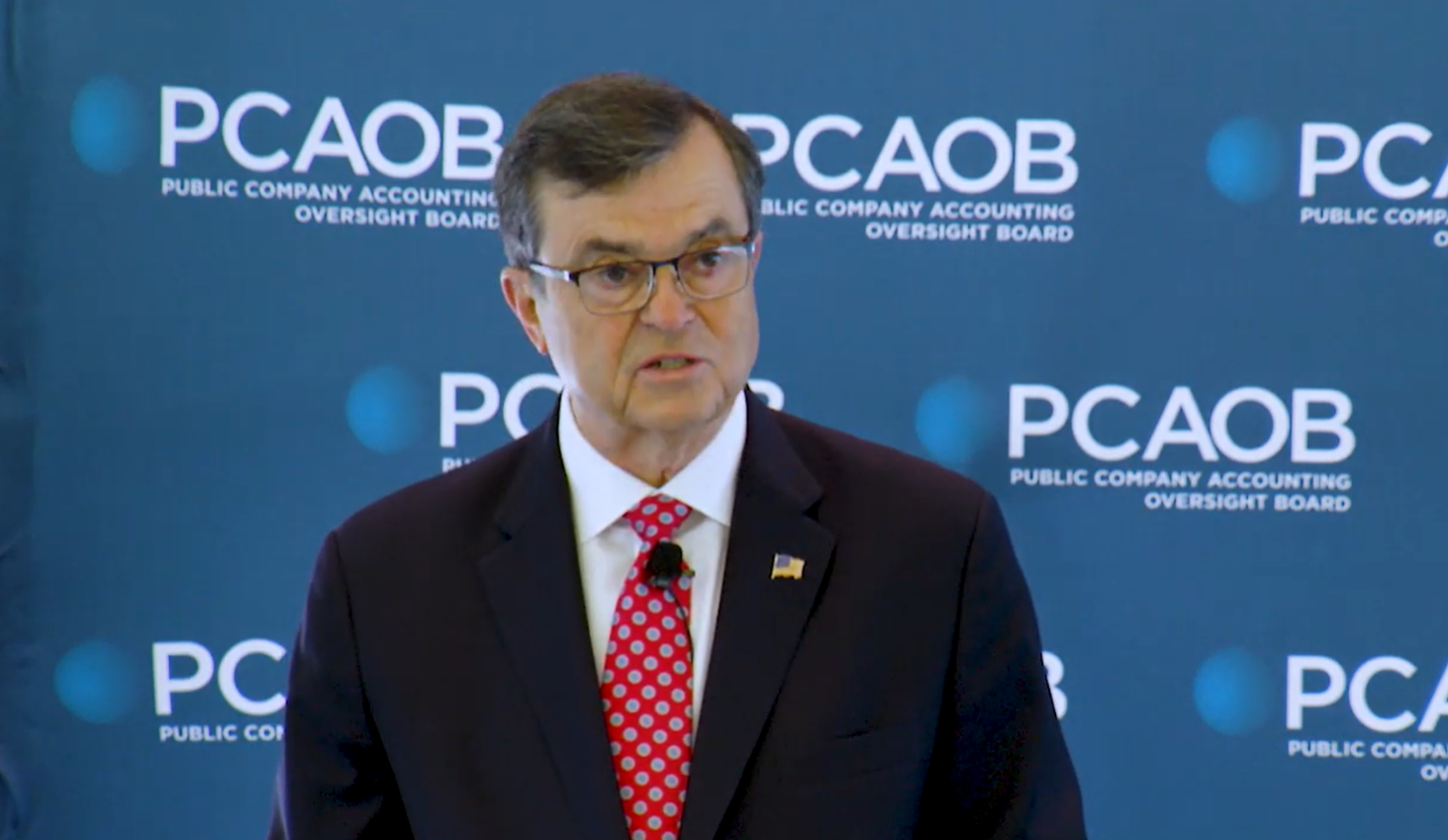
Photo caption: PCAOB Chair Demetrios Logothetis participated in a Small Business and Broker-Dealer Forum on May 13, 2026. (PCAOB/YouTube)
Sign in to get access to this free resource, and all of our whitepapers and reports.

Download this content today!
Register Now Already registered? Click here to Log In