

A profitable month can end with an awkward question from a client: How are we going to cover payroll?
Before looking at financing, work through the numbers with the owner. The business may be waiting on customers, carrying more inventory or paying for equipment. A cash shortage can have several causes, and the right response depends on which ones are at work. Start by explaining the bank balance, then look at the next payment the business has to make.
Start with the balance the owner is reading
Ask the client to point to the number they had in mind. This month’s net income? Retained earnings? Total equity? An owner who sees a large retained earnings balance may reasonably wonder why that money isn’t available.
Use the client’s own balance sheet to explain assets, liabilities and equity. Point out the cash first, then the invoices still awaiting payment, inventory on the shelves and equipment in use. Equity is the residual interest after liabilities. It isn’t another bank account.
Retained earnings generally form part of equity. Earlier profits may have helped pay for the assets the owner has just identified. Showing where those amounts appear gives the client something specific to follow.
The SEC’s guide to financial statements is a useful reference for clients who want to revisit how the statements fit together after the meeting.
Reconcile one profitable month
For example, consider a distributor using accrual accounting. It starts the month with $40,000 in cash, earns $60,000 in net income and finishes with just $15,000 in cash. Here’s what happened.
| Item | Effect on cash |
| Opening cash balance | $40,000 |
| Net income | +$60,000 |
| Add back depreciation included in net income | +$5,000 |
| Increase in accounts receivable | −$45,000 |
| Increase in inventory | −$15,000 |
| Increase in accounts payable | +$10,000 |
| Cash purchase of equipment | −$20,000 |
| Loan principal paid | −$10,000 |
| Distributions paid to owners | −$10,000 |
| Closing cash balance | $15,000 |
Source: Author’s example. These are the only cash-related movements assumed. Receivables and inventory changes arise from ordinary operations, with no write-offs, acquisitions or other noncash changes. This is a simplified reconciliation, not a complete financial statement.
After the operating adjustments, the business generated $15,000 in cash. Equipment, loan principal and distributions used $40,000. Cash therefore fell by $25,000.
The owner may need more explanation of one line than another. The receivables increase shows that more money remained with customers. Buying equipment used cash to acquire an asset. Paying loan principal reduced a liability; it wasn’t another expense deducted in arriving at net income. Be careful with interest, too. Where interest expense is already included in net income, don’t deduct it a second time.
The SEC’s cash flow statement overview shows how operating, investing and financing activities are reported separately. That structure helps the client see why a profitable month can still leave less money in the bank.
Put collection dates beside payment dates
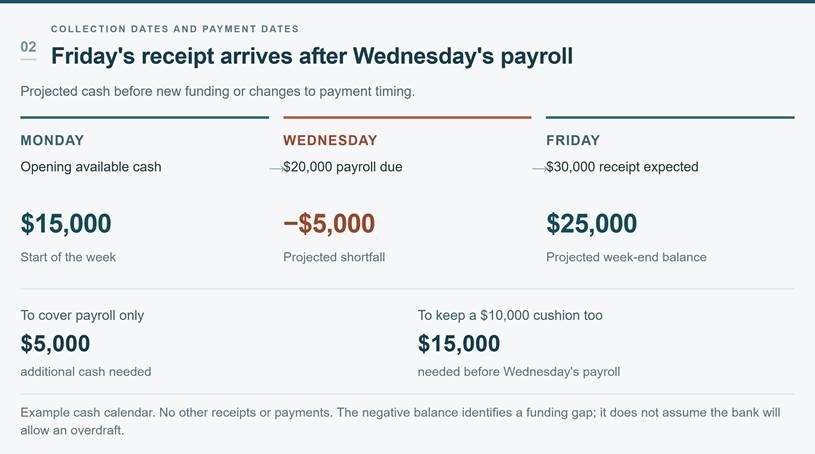
Now turn to the coming week. The distributor has $15,000 left. It owes $20,000 for payroll on Wednesday and expects a $30,000 customer payment Friday.
That would leave $25,000 at week’s end, assuming no other activity. But the company is $5,000 short on Wednesday. To pay payroll and keep a $10,000 cushion, it needs another $15,000 before the payment goes out.
Check the Friday assumption with whoever handles collections. Has the customer released the payment? Is an approval still outstanding? Is there a dispute? Write down the date being used and what supports it.
Build the forecast around the operating cycle, using daily dates when cash is tight. Include existing debt payments, taxes, purchases and owner withdrawals. Start with cash the business can actually use. Keep restricted funds separate, and don’t treat an unused credit limit as money already received.
Find out whether the shortage repeats
Next, push that Friday receipt back a week. Add a second $20,000 payroll on the following Wednesday. With no other changes, the deepest shortfall becomes $25,000. Preserving the same $10,000 cushion would now require $35,000. Both scenarios finish with $5,000 before any additional financing; the difference is what happens before the customer pays.
Then ask why collections or inventory are growing. More sales can mean more cash is needed while customers take their agreed time to pay. Older, disputed invoices raise a different concern. Stock bought for confirmed orders also deserves a different discussion from goods that have stopped selling.
Work through changes the client can make. Could someone resolve the invoice dispute? Can a planned distribution wait? Would a supplier agree to different purchasing terms? Put a change into the committed forecast when its amount and timing are supported. Keep proposals separate until then.
Bring proposed repayments into the conversation
If the client still needs financing, add the proposed fees, interest and principal to the forecast on their payment dates. Extend it through the repayment period. Check those payments alongside the obligations already on the calendar.
For a facility tied to receivables, confirm which invoices qualify and how much can be advanced. The invoice total alone won’t tell the client how much funding is available.
Before ending the meeting, agree who will check the customer payment and when you’ll review the forecast again. Identify any purchase or withdrawal that depends on that receipt. If the collection date changes, the owner needs to know before committing the cash.
ABOUT THE AUTHOR:
Nathan Abadi is the founder and CEO of Excel Capital Management. He combines experience in capital markets, underwriting, and business funding with practical financial education, helping entrepreneurs understand financing options, make informed decisions, and access capital. He writes and reviews educational content grounded in firsthand funding experience.
Sign in to get access to this free resource, and all of our whitepapers and reports.

Download this content today!
Register Now Already registered? Click here to Log In