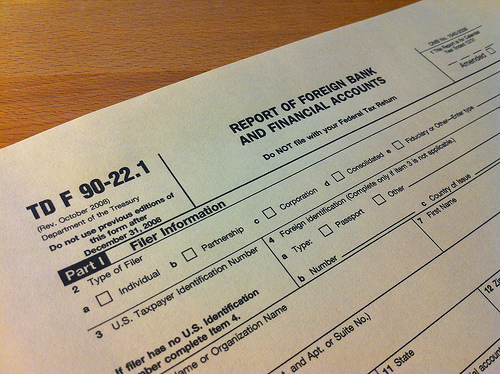


Taxpayers with foreign bank accounts, and the advisors who serve them, have a new court decision to study with major financial implications.
In United States v. Rund, a U.S. citizen and businessman who failed to report more than a dozen foreign accounts over eight nonconsecutive years wound up with a $2,915,663 civil penalty judgment.
The U.S. Court of Appeals for the Fourth Circuit affirmed the judgment against the taxpayer, Richard M. Rund. The court held that his violations were willful as a matter of law and that the penalty did not violate the Excessive Fines Clause of the Eighth Amendment.
The decision – which builds on earlier cases — matters for taxpayers and their advisers, especially in the Fourth Circuit, which covers Maryland, Virginia, West Virginia, North Carolina, and South Carolina. And for taxpayers and their advisers elsewhere, this case provides a cautionary tale for anyone with foreign bank accounts.
For taxpayers within those five states, the government does not need to prove that they intended to conceal assets from the IRS. Under the standard the court applied, the IRS merely needs to show that a taxpayer clearly should have known there was a grave risk that the Report of Foreign Bank and Financial Accounts (FBAR) was not filed accurately, and the error could have been discovered very easily.
For taxpayers who work with return preparers and fail to mention any foreign bank accounts, this standard is a low bar for the government to clear.
The stakes are substantial. Currently, a non-willful FBAR violation carries a maximum civil penalty of $16,536. But a willful violation carries a maximum penalty of the greater of $165,353 or 50% of the account balance at the time of the violation, for each account and each year.
In Rund, the government calculated that the statutory maximum was $9,842,840. The IRS chose to impose roughly 30% of that figure, and the Fourth Circuit treated that restraint as a reason to uphold the penalty, rather than to question it.
This is a technical area where the Bank Secrecy Act, the Internal Revenue Code, and constitutional law intersect. But the stakes for taxpayers with foreign interests are high, with the potential penalty running into thousands or even millions of dollars.
A Closer Look at FBAR Reporting
The Bank Secrecy Act of 1970 and its regulations require annual FBAR reporting for U.S. persons with a financial interest in, or signature or other authority over foreign financial accounts exceeding $10,000 in aggregate value. As the Supreme Court explained in Bittner v. United States, the reports are designed to help the government trace funds that may be used for illicit purposes and identify unreported income that may be subject to tax.
The penalty structure hinges on the taxpayer. The $16,536 ceiling for inadvertent or non-willful violations can be waived where the failure was due to reasonable cause. The IRS can authorize the far larger penalty – the larger of $165,353 or 50% of the account balance — where non-disclosure is found to be willful.
Because the word “willful” separates a manageable penalty from a potentially ruinous one, the meaning of that term is the basis for most FBAR litigation.
What Rund Means for Taxpayers with Foreign Accounts
The common thread throughout the Rund case involves documentation: The government prevailed on willfulness not because it proved Rund intended to deceive, but because he failed to produce evidence that he ever asked a professional the right question and received an answer he relied upon. But taxpayers who do ask their tax adviser, and who keep a record of the inquiry and the advice, are in a fundamentally different position.
There are some practical lessons from this decision tax professionals should keep in mind when advising taxpayers with foreign accounts:
- Recklessness is willfulness. Within the Fourth Circuit, and in the circuits that have followed Bedrosian, the government does not need to prove intent to conceal. If a taxpayer knew about the FBAR requirement, had foreign accounts, had access to a professional, and did not ask about it, they are exposed to the 50 percent penalty.
- Schedule B answers are evidence. Every Form 1040 asks whether the taxpayer had an interest in or authority over a foreign financial account. A “no” answer signed under penalty of perjury, when the answer was “yes,” is a fact the government will use, and courts have repeatedly treated it as strong evidence of recklessness.
- Tax-motivated structures increase the duty to inquire. If a taxpayer holds accounts through a nominee, a foreign corporation, or an entity created for tax planning purposes, the court in Rund treated that structure as a reason people should have been more careful about reporting, not less. The court treated beneficial ownership and control over funds as enough to create a reportable financial interest regardless of whose name is on the account.
- IRS voluntary disclosure programs demand complete candor. Opening new accounts and omitting them from tax filings while participating in a disclosure program was one of the strongest facts against Rund. If a taxpayer enters a program, every account must be disclosed in a truthful, timely, and complete manner.
- Document professional advice. The single most important difference between Rund and a taxpayer who prevails on willfulness is evidence that the taxpayer disclosed the accounts to a professional, asked whether reporting was required, and received advice. If that conversation happened, it needs to be in writing. If it has not happened, it should happen now.
- Late filings do not cure the problem. Rund filed belated FBARs in 2016 and 2019, and even those were incomplete. The court gave him no credit for the late filings, beyond noting that the IRS had already assessed these well below the maximum amount. Before simply making a late filing, taxpayers with unreported accounts should evaluate their options, including the IRS Streamlined Filing Compliance Procedures, the delinquent FBAR submission procedures, or a voluntary disclosure, each of which has different eligibility requirements and different consequences.
- The constitutional defense remains uncertain. The Fourth Circuit has not held that the Excessive Fines Clause applies to civil FBAR penalties, and it has not ruled out an account-by-account analysis. So taxpayers should not count on help on the Eighth Amendment’s provisions for excessive fines. Where the IRS has assessed a penalty below the statutory maximum against a repeat violator, courts have been unwilling to find it grossly disproportional.
The Rund decision confirms that in Maryland, Virginia, West Virginia, North Carolina, and South Carolina, willful FBAR liability can be established based on what a taxpayer should have known and could have easily ascertained. But there are important insights for tax pros and taxpayers beyond those areas.
The bottom line: Taxpayers with foreign accounts, foreign entities, or signature authority over accounts abroad should not wait for an IRS examination to find out where they stand.
===
Heather Posey is an Attorney in the Tax Controversy and Tax Advisory practice groups at Frost Law, where she co-chairs the firm’s Pro Bono Committee. She is also an Enrolled Agent and a fellow of the National Tax Practice Institute
Darius Liely is an Attorney at Frost Law, a firm in metropolitan Washington, D.C. He provides services across multiple practice groups including Tax Law and International Tax Compliance.
Sign in to get access to this free resource, and all of our whitepapers and reports.

Download this content today!
Register Now Already registered? Click here to Log In
Tags: bank reporting, fbar, foreign accounts, Income Taxes, reporting