

“Only 5 to 10 percent of the value of today’s AI is actually being used.” That was Dario Amodei, the CEO of Anthropic, on stage with Marc Benioff at Dreamforce this month. Living in Silicon Valley, I hear some version of that number in almost every conversation with founders and finance leaders. The models are ready. The finance team is still exporting CSVs late at night on day four of close.
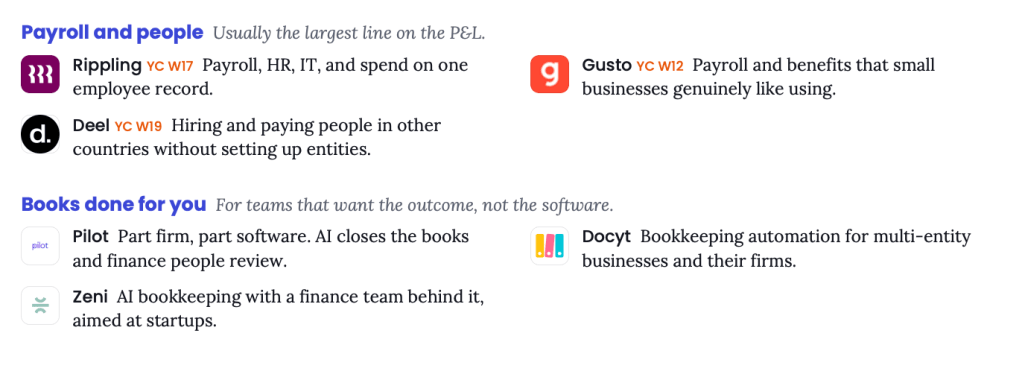
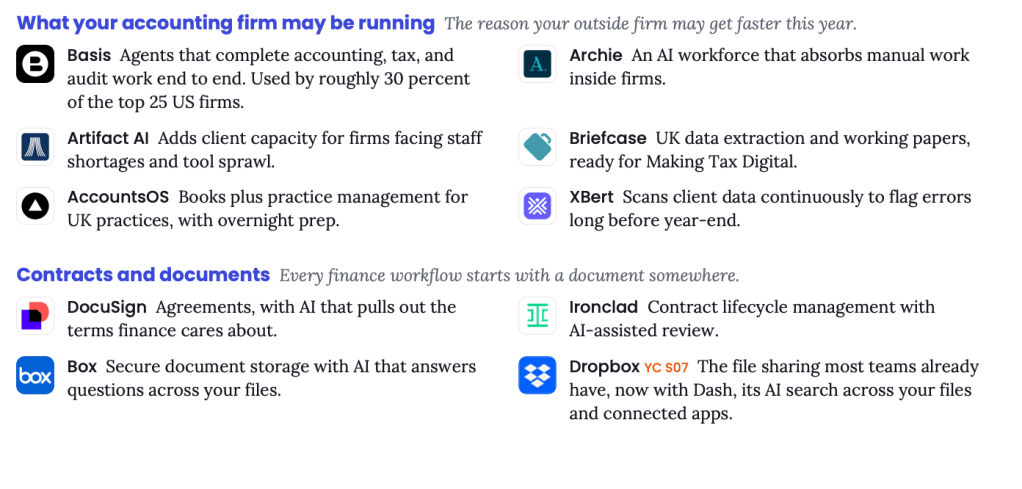
This is my attempt to narrow that gap: the tools worth knowing in 2026, grouped by the job they do, and the trends behind why teams are choosing them. It is written for anyone who buys software for a finance function, whether you run a venture-backed startup, a 40-person agency, or a family business on QuickBooks.
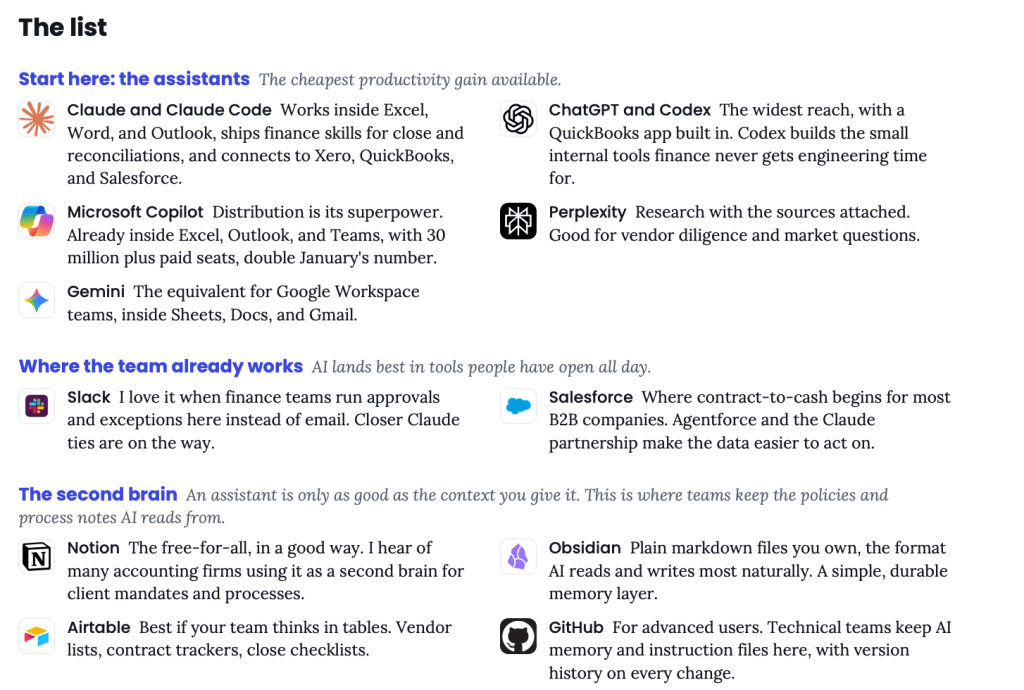
The assistant is becoming the front door. The biggest shift this year is where the work starts. In August, Salesforce and Anthropic announced Claudeforce, which puts Salesforce data and actions inside Claude. Xero signed a multi-year deal that brings its financial data into Claude and Claude into Xero. Intuit played both sides: an agreement with OpenAI worth more than $100 million that put a QuickBooks app inside ChatGPT, and an integration with Anthropic a few months later. OpenAI says its own finance team used Codex to process five times more contracts with the same size team, and it is now working with PwC to bring that playbook to other CFOs. Systems of record are no longer trying to keep you inside their interface. They are opening up so the assistant you already use can read from them and, increasingly, act in them.
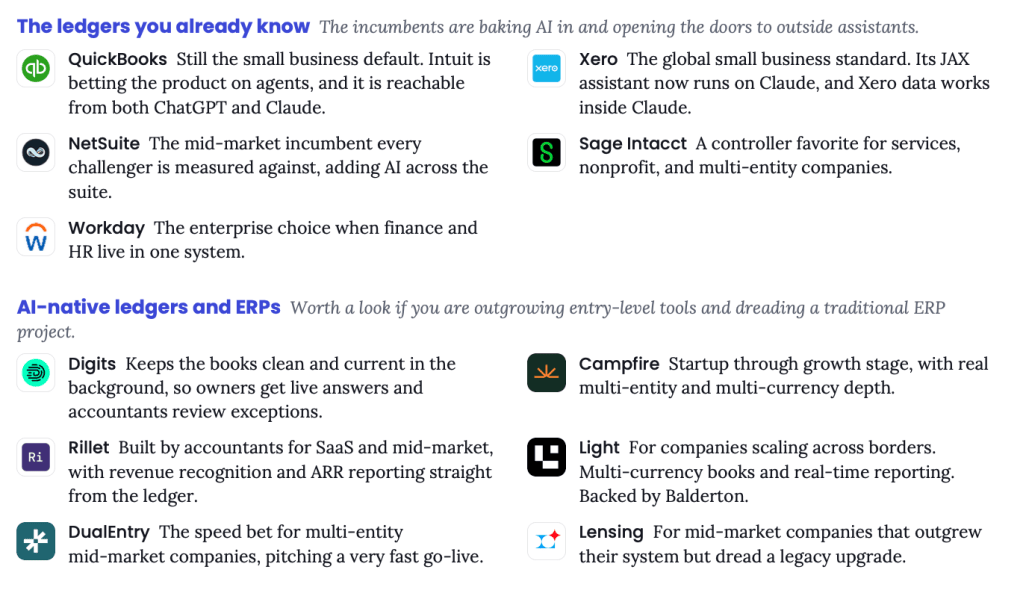
The ledger is being rebuilt, and the money is real. By one independent count, investors have put close to half a billion dollars into AI-native ERPs in just over a year. Campfire raised a $65 million Series B led by Accel and Ribbit. Rillet raised more than $100 million in under a year from Sequoia, Andreessen Horowitz, and ICONIQ. Basis reached a $1.15 billion valuation building agents for accounting firms, and Ramp hit $44 billion while calling AI tokens the third pillar of business spend after people and vendors. All of them sell the same idea: your team should review exceptions, not process every line.
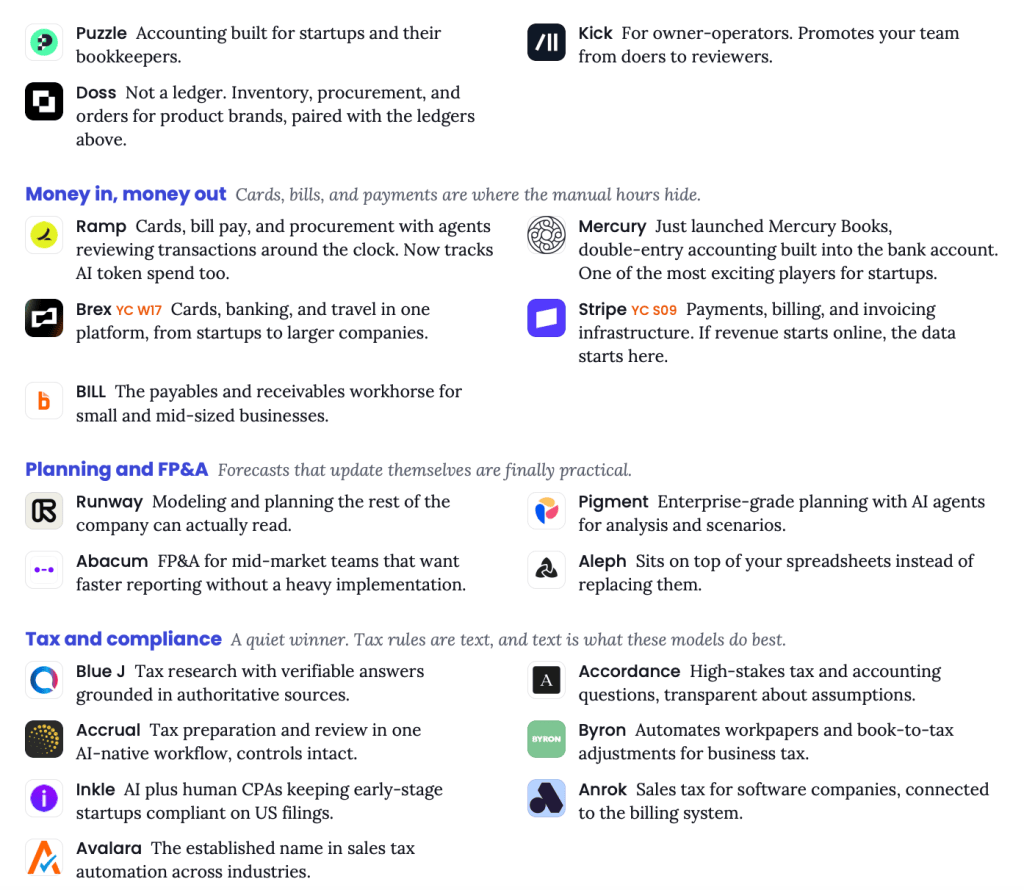
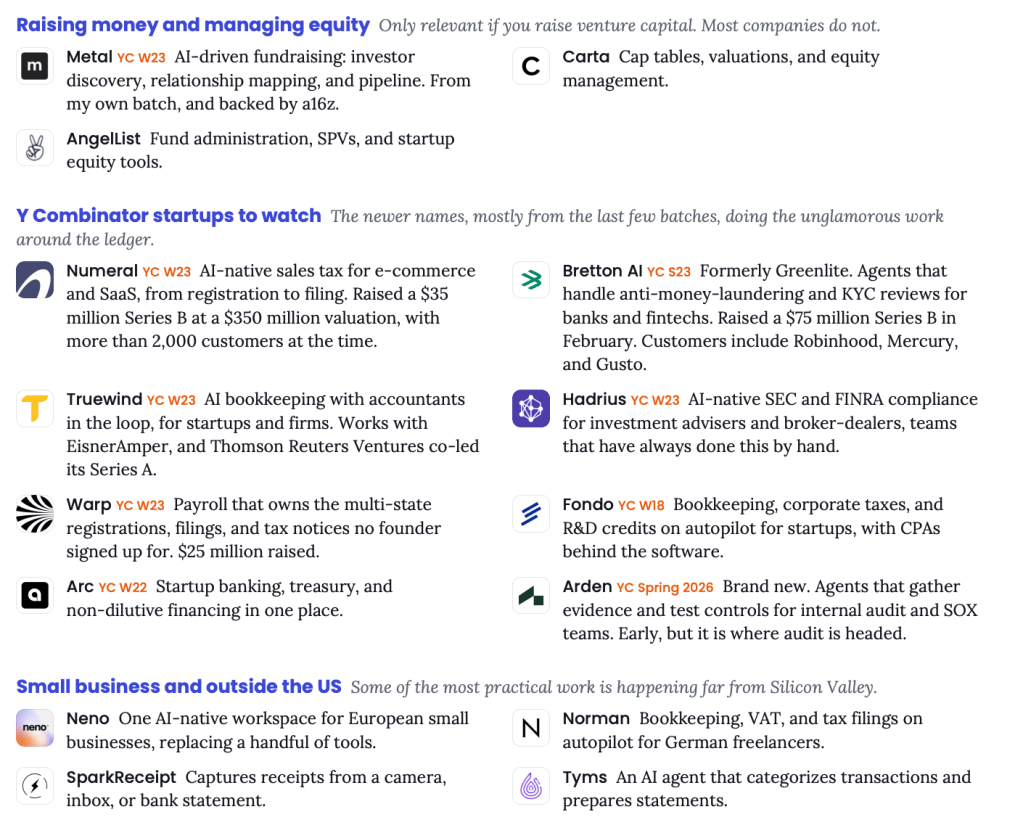
The next wave is already here. As a two-time Y Combinator founder, I watch the batches closely, and the newest finance startups are not building ledgers at all. They are going after the unglamorous work around the ledger: sales tax, payroll filings, anti-money-laundering reviews, SOX evidence. Numeral, from my own
Winter 2023 batch, reached a $350 million valuation automating sales tax. Bretton AI raised $75 million to put compliance agents inside regulated banks. I gave these companies their own section below. One caution before the list. Finance does not run on “probably.” Whatever you buy, ask whether it can show its work, whether the same input gives the same output every time, and whether your auditor can follow the trail.
.
.
How I would build the stack
Build in layers and buy in this order. First, an assistant for everyone on the team. Second, a ledger that fits your stage: QuickBooks or Xero for most small businesses. If you are outgrowing those, look at the modern AI-native ERPs like Rillet, and the others listed above, before defaulting to NetSuite, Sage Intacct, or Workday, which still make sense when your complexity demands it. Third, a spend platform, because cards and bills eat the most manual hours. Then add tax, payroll, and planning tools as the pain shows up, not before. Not every company is venture-backed, and not every company needs twelve tools. A landscaping business running QuickBooks, Gusto, a good assistant, and Slack has a modern finance stack.
Questions to ask any vendor
1. Can Claude or ChatGPT read from it and act inside it?
2. Is every action the AI takes logged?
3. Can it show how it got to a number?
4. Does the same input always give the same output?
5. Does it sit on top of my systems, or replace them?
6. Do you have a SOC report my auditor can review?
7. When it is wrong, who reviews the exceptions?
8. Can I get all of my data out if I leave?
Where this goes
The assistant becomes the interface, the system of record stays the source of truth, and the valuable work moves to the layer in between: the workflows that carry data from one system to the next, reliably, with a record of everything that happened. That layer is what my team and I build at loopfour.
A note on how to read this
I have used several of these tools, but not all of them. Treat this as a map of the trends and of the companies taking us forward in AI for finance, not a set of personal endorsements. Run your own demos and pick what fits the way your team works.
==
Daniel Kivatinos is the cofounder and CEO of loopfour, which builds deterministic, auditable workflow automation for finance teams. He previously cofounded DrChrono, a medical platform that processed billions in medical billing annually and was acquired in 2021. He lives in Silicon Valley. More at loopfour.com and kivatinos.substack.com.
Sources and notes. Amodei at Dreamforce: Bloomberg, Sept 15, 2026. Claudeforce: Salesforce and CNBC, Aug 26, 2026. Xero and Anthropic: Xero, Mar 27, 2026. Intuit and OpenAI: OpenAI and Intuit, Nov 18, 2025; QuickBooks app in ChatGPT live Mar 5, 2026. Intuit and Anthropic: PYMNTS, Feb 24, 2026. OpenAI finance team and PwC: OpenAI and PwC, May 5, 2026. AI-native ERP funding: ERP Research (July 2026), TechCrunch. Basis: SiliconANGLE, Feb 24, 2026. Ramp: company announcement, June 4, 2026. Microsoft 365 Copilot seats: Microsoft FY26 Q4 earnings, July 29, 2026. Mercury Books: Mercury, Sept 16, 2026. Numeral: TechCrunch, Sept 18, 2025. Bretton AI: Business Wire, Feb 10, 2026. Truewind: Business Wire, Dec 18, 2024. Other YC companies: company sites and the Y Combinator directory. Funding and customer figures are company-reported. Logos belong to their respective owners and are used for identification only.
Sign in to get access to this free resource, and all of our whitepapers and reports.

Download this content today!
Register Now Already registered? Click here to Log In