The role of the CFO has moved beyond digital transformation readiness. CFOs are now emerging as cross‑functional orchestrators, coordinating strategy, risk, and technology across the C‑suite to deliver measurable business results, a new report from Wolters Kluwer Corporate Performance and ESG finds.
In addition to traditional accounting and finance leadership tasks, the following data points to a fundamental expansion of the CFO role:
- 53% of respondents say CFOs own digital transformation;
- 42% are responsible for capital allocation; and
- 40% oversee risk management.

“CFOs are signaling a decisive shift in how they lead, orchestrating a digital future, bringing together data, technology, risk, and strategy across the enterprise,” Maria Montenegro, CEO of Wolters Kluwer CP & ESG, said in a statement. “As they operate in an environment shaped by AI‑powered decision making, CFOs are taking on a central role in how their businesses plan, predict, and act with greater precision.”
The findings are presented in the 2026 Wolters Kluwer “Future Ready CFO Report, Performance Orchestrator in the Age of Transformation.” According to the global survey of 1,672 senior finance leaders across more than 20 markets, accounting and finance teams now operate in an environment defined by relentless volatility, compounding disruption, and rapidly breaking assumptions, where agility is no longer an advantage but a requirement for performance.
AI accelerates the shift from financial oversight to orchestration
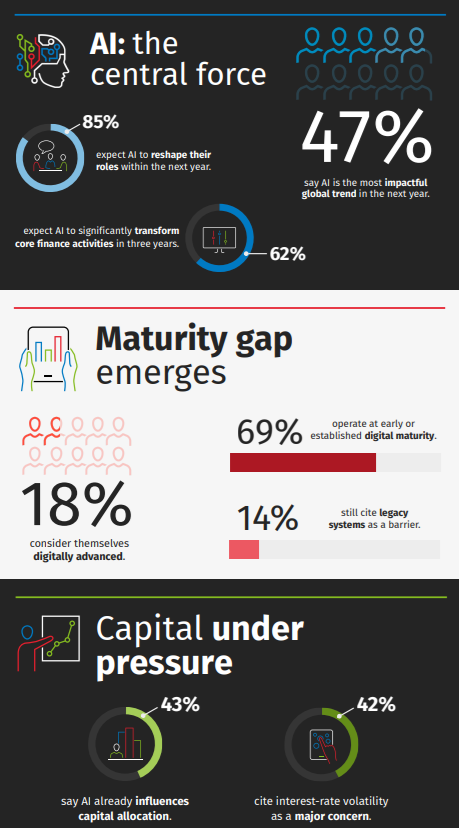
Artificial intelligence is emerging as the primary catalyst behind this shift. Nearly half (47%) of the financial executives polled identify AI adoption and implementation as the most impactful global trend today, outranking interest rate volatility and regulatory complexity. The findings show AI moving beyond automation and efficiency into the core of strategic decision making.
This shift is reshaping leadership expectations: 87% of finance leaders say expectations of the CFO are expanding as AI becomes embedded in enterprise decision making, reinforcing the CFO’s role as a central orchestrator of performance across planning, forecasting, and execution.
Leaders have shifted their expectations with 85% believing AI will reshape their role within the next year, signaling a rapid expansion of CFO accountability for how technology informs planning, forecasting, and performance outcomes.
Looking ahead, 62% expect AI and advanced analytics to drive transformational change in capital allocation within the next three years, further strengthening the CFO’s role as the conductor of enterprise performance across functions and timelines, Wolters Kluwer says.
Capital allocation becomes a performance and risk discipline
The report highlights capital allocation as one of the most pressured responsibilities facing CFOs. Investment decisions are increasingly shaped by external forces, leaving little margin for error:
- 43% of respondents said AI investment is directly influencing capital allocation decisions;
- 42% point to interest rate volatility; and,
- 37% cite regulatory complexity as primary drivers of investment decisions.
“These pressures are transforming capital allocation from a discretionary optimization exercise into a disciplined performance and risk management function,” Wolters Kluwer says. “CFOs are expected to balance growth, compliance, and resilience simultaneously, using scenario planning, advanced analytics, and real-time insight to guide decisions.”
Performance orchestration depends on digital maturity
While most accounting and finance teams have established digital foundations, the research exposes a critical maturity gap. Sixty-nine percent of accounting and finance teams describe themselves as in early or established stages of digital maturity, while only 18% consider themselves digitally advanced, defined by real-time capabilities, automation at scale, and continuous optimization.
“As market volatility becomes structural and regulatory complexity intensifies, accountability increasingly defines the modern finance mandate,” Wolters Kluwer says. “CFOs are being evaluated by their ability to drive measurable transformation outcomes, embed AI into decision making, and reallocate capital in a climate of persistent uncertainty.”
The report also highlights the widening divide between leaders and laggards, shaped by digital fluency, AI literacy, and the cultural capacity to adapt quickly.
“The organizations best positioned to succeed are those whose CFOs can combine strategic foresight with strong technology execution, bringing together data, risk, and enterprise strategy to deliver long-term value,” Wolters Kluwer says.
Photo credit: JTKPHOTOz/iStock
Sign in to get access to this free resource, and all of our whitepapers and reports.

Download this content today!
Register Now Already registered? Click here to Log In
Tags: Accounting, Artificial Intelligence, CFOs, finance, finance teams, risk, strategy, Technology