




Fifty-eight percent of companies plan to lay off employees in 2026, with 39% having already conducted layoffs this year and another 35% saying additional job cuts will happen before the year ends, according to a new survey from resume building platform Resume.org.
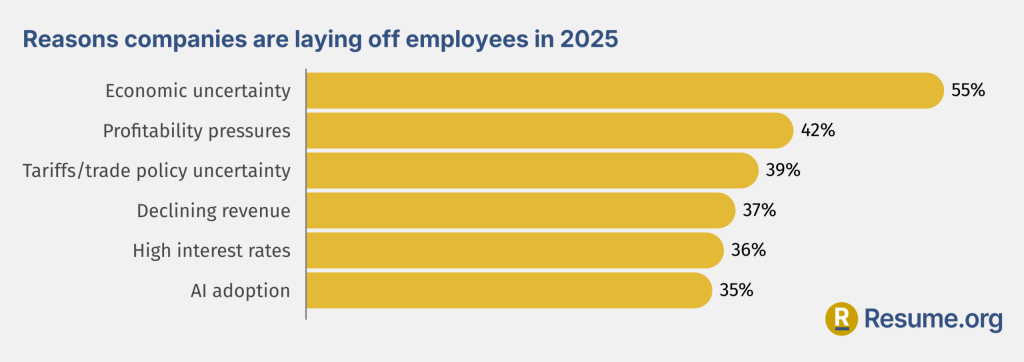
Among companies that have conducted or plan to conduct layoffs this year, economic uncertainty is the primary driver, cited by 55% of the 1,000 U.S. business leaders who were polled, followed by tariff and trade policy concerns (39%) and artificial intelligence adoption (35%).
Next year, 58% of companies say layoffs are very (26%) or somewhat (32%) likely. Key drivers include tariff or trade policy concerns (48%) and the overall economy (47%).
Other key findings of the survey include:
Hiring has also slowed: A total of 9% of companies have implemented hiring freezes, and 41% say they’ve cut back on hiring. Only 9% have increased hiring this year. Among companies scaling back, 63% blame economic conditions, 38% cite concerns over tariffs or trade policy, 35% point to declining revenue, and 22% say AI is reducing their staffing needs.
Not all employees face equal risk: Nearly half of business leaders (48%) say high-salary workers are most likely to be laid off, followed by those lacking AI-related skills (46%). Recent hires (42%) and entry-level employees (41%) are also at risk. Demographics matter too: 30% say younger employees are more vulnerable, 29% cite older workers, and 19% say H1B visa holders face increased risk.

“High-salary roles are often targeted first because companies see immediate savings in payroll, and employees lacking AI-related skills are vulnerable because organizations are accelerating automation,” said Kara Dennison, head of career advising at Resume.org. “Recent hires and entry-level employees are also at risk because they haven’t built deep institutional knowledge or proven long-term value. Demographic factors also play a role: younger employees may be seen as replaceable, older employees may be viewed as less adaptable, and visa holders bring added administrative costs.
“There is a push toward leaner, more tech-ready workforces where cost efficiency and agility outweigh tenure or traditional career pathways. For professionals, this is a call to start reskilling, especially in AI and emerging technologies,” Dennison added.
The role of AI continues to grow: In 2025, 27% of companies significantly increased their investment in AI, and 41% reported a moderate increase. So far, 28% of companies say they have already replaced jobs with AI. By the end of 2026, 37% expect to replace roles with AI, and many are actively restructuring teams to prioritize automation.
“AI adoption is going to reshape the job market more dramatically over the next 18 to 24 months than we’ve seen in decades. We’ll see continued displacement of routine and process-driven roles as well as entirely new categories of work centered on AI oversight, data ethics, prompt engineering, and human-AI collaboration,” Dennison said.
“Technical skills alone won’t be enough; adaptability, critical thinking, and emotional intelligence will become the defining differentiators for talent,” she continued. “To future-proof their careers, professionals should be building both digital fluency and human skills that AI can’t replicate. For organizations to maintain engagement and retention, they must upskill their workforce and prepare employees to work alongside AI. Those that treat AI as a cost-cutting tool without reinvesting in their people risk eroding culture, trust, and long-term competitiveness.”
Photo credit: sanfel/iStock
Sign in to get access to this free resource, and all of our whitepapers and reports.

Download this content today!
Register Now Already registered? Click here to Log In