

A toddler could file an R&D tax credit claim. Fill in the numbers, attach Form 6765, wait for the refund. Filing was never the hard part. Keeping the credit is.
Starting with 2026 returns, keeping it got a lot harder.
The form the IRS had to delay
The IRS first said Section G of Form 6765 would be required for 2025 returns. Taxpayers and practitioners pushed back hard, and in October 2025 the IRS gave everyone another year. Final instructions landed in February 2026. Section G is now required for tax years beginning after Dec. 31, 2025.
A few clients are exempt: qualified small businesses taking the payroll tax election, and filers with $1.5 million or less in qualified research expenses and $50 million or less in gross receipts on an original return. Everyone else lists business components, largest first, until they cover 80% of QREs or hit 50 components. For each one, wages are split three ways: direct research, direct supervision, and direct support.
The IRS doesn’t give the whole country an extra year because a form is easy.
Why “by project” really means “by person”
On paper, Section G asks for one thing: break the credit out by project. In practice, you can’t split a project’s wages into research, supervision, and support without knowing what each person actually did. The math now runs bottom up.
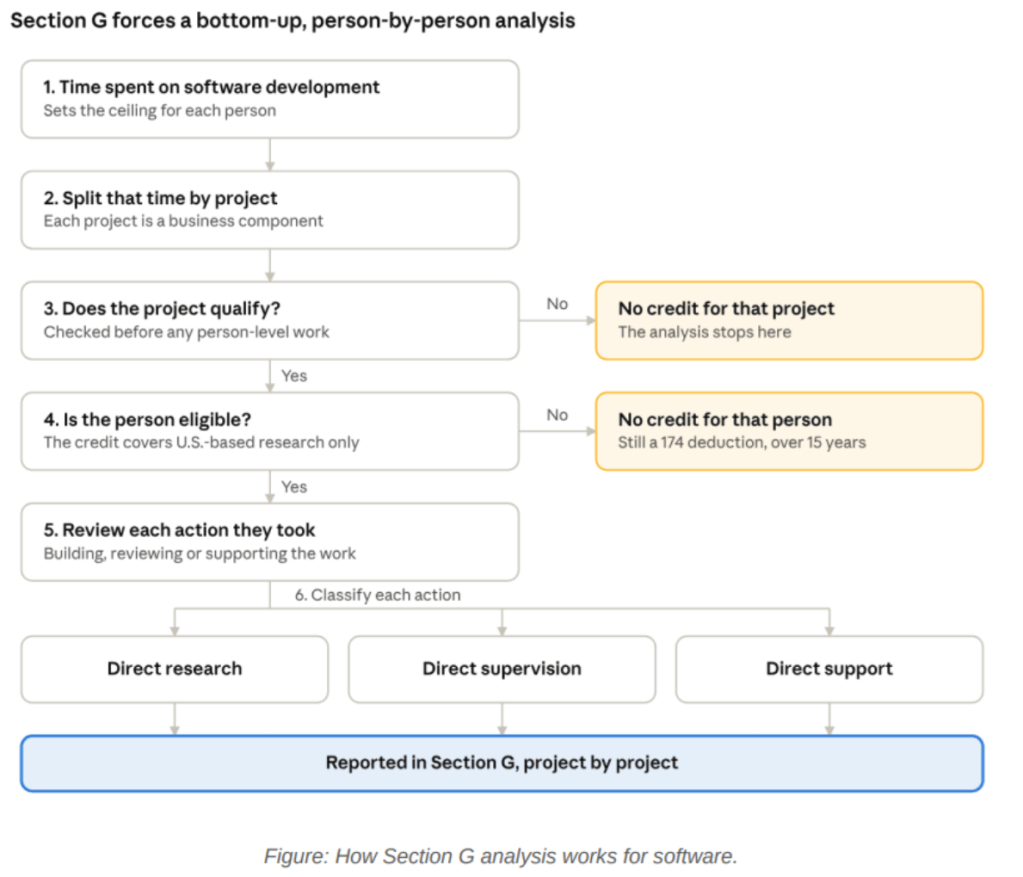
For software clients, the funnel looks like this. Start with how much of each person’s year went to software development. That’s the ceiling. Split that time across projects. Drop any project that doesn’t qualify. Confirm the person qualifies, because the credit only covers research performed in the U.S. (Offshore engineers still count toward the Section 174 deduction, just spread over 15 years.) Then classify the work itself.
For decades, most claims ran top down: total payroll, a few interviews, a percentage that felt right. Section G leaves no room for gut feel.
Getting the credit isn’t the same as being right
Software may be the most traceable work a company does. Every change leaves a trail, and the IRS knows it. At an IRS conference I attended in Orlando last month, software R&D claims came up as one of the areas where they see the most abuse.
Section G wasn’t written as a fraud tool, but it works like one. It hands examiners a project-by-project map of the claim. If a client can’t back that map up, the exam is short.
That’s why I wince when a client says, “We’ve claimed it for seven years and never had a problem.” That doesn’t prove the method is right. It may only prove nobody has looked. The IRS generally has three years to assess, six with a substantial omission, and no limit for fraud. A carried-forward credit can also be adjusted in the year it’s used, even if the year it came from is closed. Repayment comes with interest and penalties.
Evidence, not stories
Examiners don’t want a story about what the team believes it worked on. They want facts.
Tickets in tools like Jira are the most common evidence in software claims, and the weakest. A ticket is a glorified notepad: anyone can type anything into it. It shows what someone intended, not what got built. Strong evidence ties to actual code changes: the commits and pull requests in source control systems such as GitHub, GitLab, Bitbucket, and Azure DevOps.
Here’s the catch. The code stays in source control. The context around it doesn’t: how long the work took, which project it served, whether the person was building, reviewing, or supporting. Unless something captures that as it happens, it’s gone.
So clients reconstruct. Engineers go on screenshot safaris, rebuilding last year from memory and documenting their documentation. That’s expensive talent, and increasingly expensive AI tokens, spent on admin work nobody hired them to do. And reconstruction is exactly what examiners pick apart.
AI spend runs through the same funnel
Here’s what most firms are missing. A laptop bought for an engineer never qualifies; it’s depreciable property that keeps its value after the project ends. AI tokens are different. They’re consumed in the work, and the statute already covers amounts paid for the right to use computers in qualified research. The IRS hasn’t issued AI-specific guidance, so this is still a gray area, but the IRS agents I’ve discussed it with agree: AI spend on qualified software development can count toward both the credit and Section 174A.
The catch is substantiation, and it should look familiar. AI lives in the cloud and has no location, so tie each use to the person who prompted it. Then run it through the same funnel as a human engineer: development share, project, eligibility, location, action. Treat the AI like a member of the team, and keep the same records.
Still worth every bit of the effort
The credit has been around since 1981 and became permanent in 2015. Other countries followed: 34 of the 38 OECD countries now offer R&D tax relief. With that much competition for talent, it isn’t going anywhere.
It also stacks. Under the new Section 174A, domestic research costs are deductible immediately again, while foreign research is still spread over 15 years. Unused credits carry forward 20 years. Startups with under $5 million in gross receipts, and no receipts more than five years back, can apply up to $500,000 a year against payroll taxes for up to five years. Many states offer credits of their own.
What this means for your firm
Your job is to run the calculation and file. Your client’s job is to hand you data you can defend. When they can’t, nobody wins. I’ve had those calls, and my hands were tied.
For 2026, many of your software clients will be reconstructing. For 2027, they don’t have to. Before Jan. 1:
- Sort your software clients by whether Section G applies to them.
- Have them name their 2027 projects up front, so work is tied to a project as it happens.
- Move their evidence from tickets and year-end surveys to source control activity captured in the moment, without turning engineers into clerks.
Filing was never the hard part. Section G just made sure everyone knows it.

ABOUT THE AUTHOR:
Taylor Meadows, CPA, CISA, PMP, is the founder and CEO of CodeROI. A former Big Four auditor, he has spent his career helping companies build software in a compliant way and claim the incentives tied to that spend, including R&D tax credits, Section 174A deductions and software capitalization. Learn more at coderoi.com.
Disclosure: This article is for informational purposes only and is not tax or legal advice. Readers should consult their own CPA or attorney before making any decisions based on the information contained herein.
Photo credit: Freepik
Sign in to get access to this free resource, and all of our whitepapers and reports.

Download this content today!
Register Now Already registered? Click here to Log In