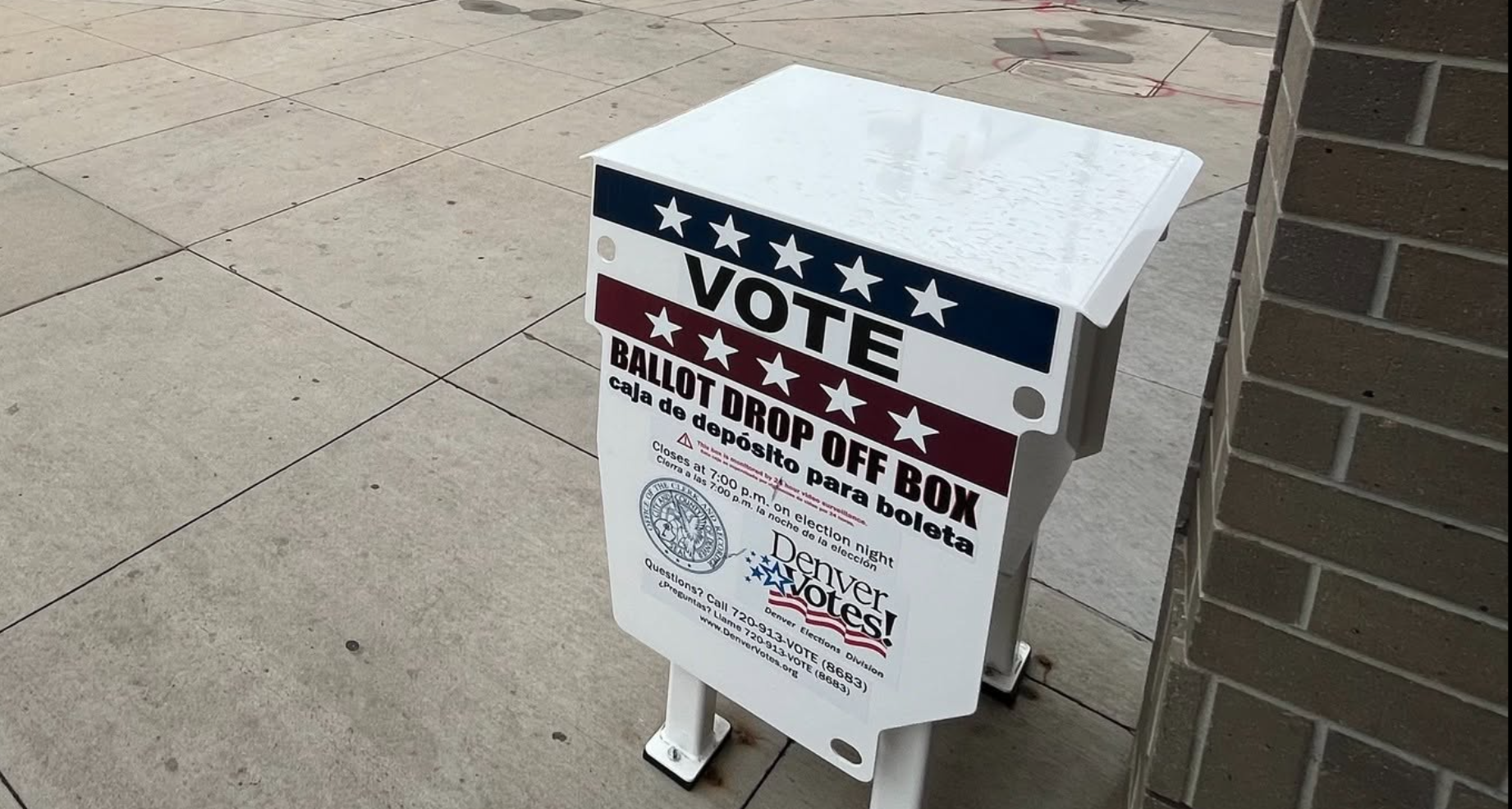


DENVER — Courtroom fights, false claims and mountains of spending have dominated the high-stakes battle over the ballot measure that would increase income taxes on higher-earning Coloradans while cutting them for everyone else.
Opponents of Amendment 87—mostly made up of conservative advocacy groups—have outraised the liberal groups that put forward the proposal and have poured millions of dollars into attack ads. A conservative activist last month filed a lawsuit seeking to strike the measure from the ballot, a challenge rejected by a Denver judge last week.
The opposition has also found unlikely allies in prominent Colorado Democrats, including outgoing Gov. Jared Polis.
Amendment 87 would abolish the Colorado Constitution’s requirement of a flat income tax, under which all taxpayers, regardless of income, pay the same rate—currently 4.4%. If passed, the amendment would also add, in state law, a graduated income tax rate structure that would ratchet up the rate paid by people and businesses making over $500,000, while cutting taxes for those making less.
The amendment is projected to generate about $2 billion annually that the state would earmark for healthcare, education and childcare.
It’s the most ambitious of four tax-related state measures on the Nov. 3 ballot. Conservative groups are pushing a competing measure, Proposition 136, which would cap the income tax rate at 4.4%. That measure was placed by Advance Colorado, a conservative nonprofit that is considered a dark-money group because it does not disclose its donors.
Also in the mix are propositions NN and 137, which would raise the state’s spending cap under the Taxpayer’s Bill of Rights to fund education and conservation, respectively—while eliminating or reducing taxpayer refunds otherwise required by TABOR.
But 87 has attracted the fiercest pushback, with some opponents resorting to false claims in a bid to dissuade voters from approving what would be the biggest change to state income taxes in over a generation. Proponents say it shows that working-class Coloradans are on the brink of an economic revolution.
“Voters passing 87 is an acknowledgment that working people and small businesses are really what drives our economy forward,” said Chris deGruy Kennedy, the president and CEO of the liberal nonprofit Bell Policy Center, which placed Amendment 87 on the ballot. “We are not dependent on big businesses and the wealthy for our success.”
For his part, a leading opponent said it was important to fight Amendment 87, which he believes will have devastating effects on the state’s economy. He’s also focused on defeating other tax measures that would chip away at TABOR, which conservatives have long defended as a protection for taxpayers and a check on government spending.
“I don’t think the tax debates in Colorado are ever over,” said Michael Fields, Advance Colorado’s president. “I can’t remember an election cycle where liberal groups or politicians didn’t bring a tax hike or a measure to go after TABOR refunds.”
Opponents circulate false claims
To accomplish its backers’ aims, Amendment 87 proposes deletions from the Colorado Constitution as well as changes to state law. Proponents opted to remove language from the constitution, rather than adding words to it, to avoid needing to win 55% support from voters. As a result, Amendment 87 needs only a simple majority to pass.
But parts of those constitutional changes are the basis used by opponents to say—often incorrectly—that the measure would raise taxes on recipients of Social Security and veterans’ pensions.
Recommended Articles

Taxes October 23, 2026
Denver Judge Rules Graduated Income Tax Can Stay on Colorado Ballot
Amendment 87, if approved, would institute a six-tier marginal tax rate schedule in state law, with rates set at:
- 3.7% for a person’s first $25,000 in income
- 4.2% for the portion of income that’s above $25,000 and up to $100,000
- 4.4% for income between $100,001 and $500,000
- 7.4% for income between $500,001 and $750,000
- 7.9% for income between $750,001 and $1 million
- 8.4% for income above $1 million
To put those tiered tax rates in place, Amendment 87 needs to strike language in the state constitution that requires “all taxable net income to be taxed at one rate.” The measure would remove that language, along with wording that prohibits the state from taxing “refund tax credits or voter approved tax credits.”
What it would leave is a sentence requiring “all taxable net income to be taxed with no added surcharge.”
Opponents say the reworked sentence could eliminate deductions on Social Security benefits and veterans’ pensions.
Earlier this month, text messages that said they were paid for by Colorado Dawn, a conservative dark money nonprofit that doesn’t disclose its donors, were sent to voters. The texts claimed that “all seniors and veterans will see their taxes increased because the measure will eliminate tax deductions for Social Security and military pensions.”
Experts say the claim isn’t true.
The state’s nonpartisan Legislative Council Staff, which is tasked with explaining ballot measures in the Blue Book voter guide, says there’s nothing in the ballot question’s language that would remove deductions for Social Security and pensions. And Colorado law already excludes those deductions from taxable income.
Paul Harrison, a finance professor at the University of Denver who studies tax law, said if older taxpayers and veterans were to see their taxes go up under Amendment 87, it would be because their income fell within a high-enough bracket under the measure’s new graduated rates.
But it wouldn’t be because of an automatic elimination of deductions.
“I disagree with the claims that Amendment 87 specifically raises taxes on those two groups,” he said.
“But,” he added, “if I were writing for the opposition and that’s what I was trying to say, I would target larger groups—and the larger groups that I would target would be people who have time and people who vote,” he said. “Veterans and Social Security recipients really fit that bill.”
Daniel Cole, a consultant for Colorado Dawn, declined a phone interview to discuss the claim. He said in a text message statement that there were differing opinions about how the measure would be interpreted, should it be challenged in the courts.
For that to happen, a lawsuit would need to be filed claiming that the measure should eliminate such deductions.
“People who say, ‘Oh, there’s no way a judge would interpret Amendment 87 that way’ are naive,” Cole said.
Colorado Dawn has given over $160,000 to conservative groups formed to defeat the ballot measure, according to the most recent campaign finance reports. But The Denver Post could not find records of payment for the sending of text messages opposing Amendment 87, despite the messages saying they were paid for by the group.
Governor echoes claim
Polis, who has long opposed income taxes generally, has amplified the claim that Amendment 87 would raise taxes on older people and veterans by eliminating deductions.
A tech entrepreneur whose net worth is estimated in the hundreds of millions of dollars, Polis declined to say when asked by The Post last week how much money he would avoid in higher taxes, should Amendment 87 pass. An analysis of Polis’ personal financial disclosure for income he made last year shows the governor could owe between about $155,000 and $330,000 under the new tax system, though a spokesperson said not all of his income on that disclosure was necessarily taxable.
In a statement sent through a spokesperson Monday, Polis said the measure’s removal of language in the state constitution, including the striking of “at one rate” and of the protection of certain tax credits from taxable income, could be interpreted by the courts to mean that all income should be taxed without exception, including Social Security and veterans’ pensions.
But he walked back past claims he’s made in which he indicated the removal of tax deductions was a certainty.
“On a few occasions I said that Amendment 87 would increase taxes on low income seniors and veterans and what I should have said is that it could, depending on a court’s interpretation,” Polis said in his statement. “I will be more careful in the future about identifying this as a risk, not a certainty.”
The measure’s supporters have lambasted the claim.
“I just couldn’t be more disappointed that the governor isn’t sticking to reality,” said deGruy Kennedy, the Bell Policy Center’s leader, who called the statement a “blatant lie.”
He said the legislature would have to choose to include deductions in the definition of taxable income for that to come to pass.
“In what world is that a policy choice that they’re going to make?” he said. “No Democrat, no Republican is looking to get rid of Social Security deductions in the tax code.”
Facing attacks from both sides of the aisle
The war of words over Amendment 87 is just one facet of an increasingly politically charged—and volatile—fight.
Supporters defended the measure against a lawsuit filed in September by Michael A. Hancock, a Republican (not to be confused with Denver’s former mayor) who was represented by the prominent public policy and lobbying firm Brownstein Hyatt Farber Schreck.
The lawsuit resulted in an 11th-hour court hearing to determine whether the measure could stay on the ballot, even as early voting in Colorado was underway. Hancock claimed the measure should not have been placed on the ballot because some of its signatures came from petition gatherers who were not in alignment with the state’s registration rules.
Denver District Court Judge Heidi Kutcher ruled that the state couldn’t remove a ballot question because of registration issues with signature gatherers. Opponents have appealed the ruling to the Colorado Supreme Court, which hasn’t yet weighed in.
Amendment 87’s proponents also face a major cash disadvantage.
The four issue committees formed to oppose the measure have raised some $6.2 million combined. Not all of that is going to attack Amendment 87—some groups are also opposing Proposition NN, which was referred to the ballot by lawmakers, and supporting conservative-backed measures.
Much of their money comes from conservative advocacy and political groups, including the American Prosperity Coalition, the campaign arm for the Colorado Chamber of Commerce, which has given about $1.7 million; and GOPAC, a Washington-based federal super PAC that supports conservative candidates and issues, which has given over $1.8 million.
By comparison, Protect Colorado’s Future Coalition, the issue committee formed to support Amendment 87, has raised just over $2 million. About a quarter of that—$500,000—comes from former oil and gas executive Merle Chambers, a prominent supporter of liberal causes in Colorado. Other funding comes from an assortment of progressive groups like the Colorado Fiscal Institute and New Era Colorado.
While progressives have powered the campaign, conservatives and business groups have been quick to highlight discontent over Amendment 87 even among Democrats. Amid Polis’ outspokenness against the measure, many Democratic state lawmakers have been mum about their feelings toward it.
Last week, Keep Colorado Affordable, one of the conservative issue committees formed in opposition to Amendment 87, sent a video to voters via text message that featured longtime Colorado Democrat Ken Salazar speaking against the measure.
“It will hurt our workers,” said Salazar, a former U.S. senator, Interior secretary under President Barack Obama and ambassador to Mexico under President Joe Biden.
The ad prompted ridicule from progressive state lawmakers.
In a video posted on her Instagram, Sen. Julie Gonzales, a Denver Democrat, urged voters to “tax the rich their fair share to fund healthcare, childcare and schools, while providing a tax break to 97% of Coloradans.”
“I know where I stand. Do you?” she said.
Polis and business leaders have warned the higher tax rates will make the state less attractive to businesses.
In his statement, Polis said economic impacts are his broader concern with Amendment 87, which he said would hit Colorado with a $2 billion tax increase and serve as a “huge blank check to politicians and the government.”
“All without any guarantee that any money from this huge tax hike would go to education as it’s only one of the allowable uses,” he said.
DeGruy Kennedy countered that that argument failed to consider the economic benefit that Amendment 87—through its funding of social programs—could provide.
He said more public support for healthcare and childcare costs were needs commonly raised by the business community.
“I just wish that the conversation we were having looked at the big picture,” he said. “We’ve got tax rates over here, but we’ve got healthcare and child care costs over here.”
Photo credit: Luis Olmos/Unsplash
_______
©2026 MediaNews Group, Inc. Visit at denverpost.com. Distributed by Tribune Content Agency LLC.
Sign in to get access to this free resource, and all of our whitepapers and reports.

Download this content today!
Register Now Already registered? Click here to Log In