


Confidence among accountants globally fell slightly in the third quarter, but despite the negative impacts from the conflict in the Middle East, data points to a resilient global economy, according to a new report from the Association of Chartered Certified Accountants and the Institute of Management Accountants.
The ACCA and the IMA say its Global Economic Conditions Survey is the largest regular economic survey of accountants around the world, in both the number of respondents and the range of economic variables it monitors.
Fieldwork for the Q3 2026 survey took place between Sept. 1 and Sept. 17, gathering 699 responses: 478 ACCA members and 221 IMA members.
While accountant confidence is higher than the near-record low in Q1 amid the outbreak of the Middle East conflict, it remains in the low range—a place where it has been since late 2024. This is likely in part due to the uncertain and unpredictable global economic backdrop, which has increasingly become the “new normal” operating environment for firms, according to the report.
“This continued caution among accountants likely reflects the impacts from geopolitical risks and tensions, major changes in trade policy, country-specific challenges, and rising political polarization, which have created a highly uncertain and unpredictable operating environment for firms,” the report says. “Unsurprisingly, economic pressures and geopolitics remained the top risk priorities for accountants globally in Q3.”
Confidence did improve among CFOs but remains quite low by historical standards. Twenty-eight percent of CFOs ranked economic pressures as their top risk priority, followed by 25% who chose geopolitics.
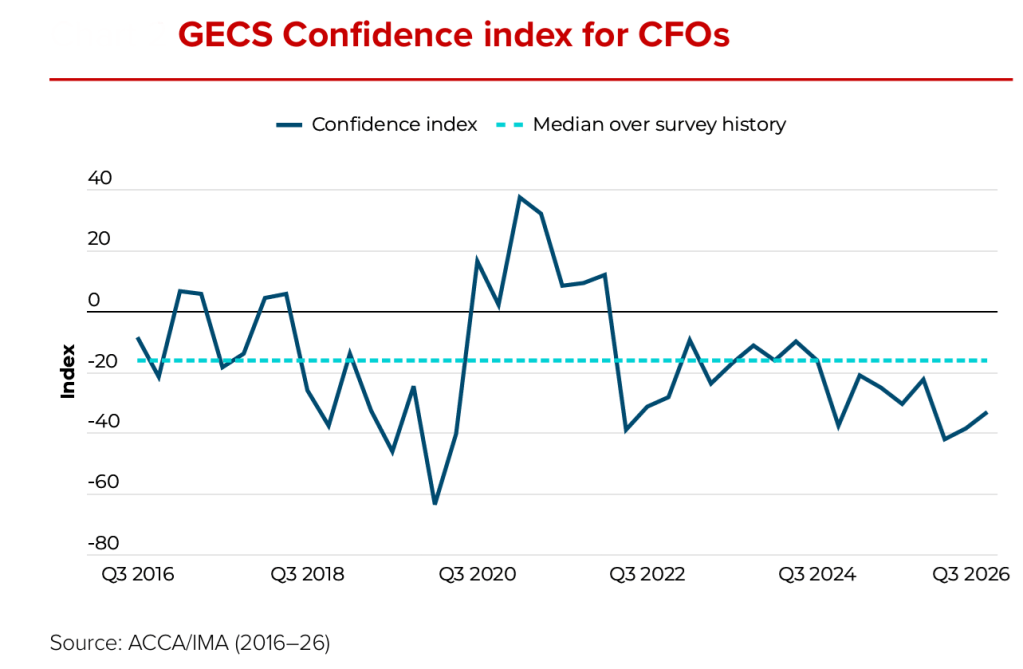
The other key indicators, however, remain consistent with a resilient global economy, the ACCA and the IMA say. The Global New Orders Index improved and is just above its historical average and broadly similar to other readings in the aftermath of Russia’s invasion of Ukraine. There were also small gains in the Global Capital Expenditure and Employment indices, although both remain below series averages. The artificial intelligence boom continues to provide major support to global growth and stock markets.
Downside risks are growing though, amid the renewed rise in energy prices and inflation in recent months, large increases in government bond yields, and tighter monetary policy. Cost pressures remain a major challenge for firms—almost 70% of surveyed accountants globally reported increased operating costs in Q3—down from Q2, but significantly above the series average. Eighty-two percent of CFOs experienced higher costs, barely lower than in Q2. Meanwhile, almost 50% of respondents expect interest rates to rise in their country over the next three months, up from 42% in Q2.
Recommended Articles


Economic pressures remain accountants’ top risk priority globally in Q3 (24%), followed by geopolitical instability (18%), and then regulatory/compliance risks and cybersecurity (13%).
Confidence rose in North America in Q3, driven by a marked rise among U.S.-based accountants. There was also a sharp rise in the U.S. Capital Expenditure Index and a decent increase in the Employment Index, although there was a very small fall in the New Orders Index. Overall, the indices point to some strengthening in the U.S. economy in Q3, although the key indicators remain below their historical averages by varying degrees, particularly the Employment Index, likely reflecting the sluggish jobs market.
Commentary from survey participants highlights the various headwinds still facing U.S. firms, including import tariffs, high energy prices and inflation, geopolitical and policy uncertainty, and elevated interest rates. Among U.S.-based respondents, 77% reported increased operating costs in Q3, down slightly from Q2, but very high by historical standards. Moreover, likely reflecting the headwinds and elevated uncertainty, 45% of U.S. survey respondents ranked economic pressures as their top risk priority, way ahead of the other risks.
“There is something of a tug of war going on in the global economy at the present time, with the AI boom a major driver of growth and equity markets, while higher energy prices, inflation, and government bond yields are pulling in the other direction,” Alain Mulder, region head of Europe and Central Asia and senior director of global B2B at the IMA, said in a statement on Oct. 21. “Further significant gains in energy prices and government borrowing costs would be increasingly challenging for global growth.”

“While the global economy has shown remarkable resilience this year, downside risks remain prevalent,” Jonathan Ashworth, chief economist at the ACCA, said in a statement. “The longer energy and other prices remain elevated, the greater the pressure on firms to pass on their cost increases, which would weigh on consumers and increase the likelihood of further monetary tightening by the Fed and other central banks.”
Ashworth concluded, “Despite various headwinds, U.S. economic growth is benefitting significantly from the AI boom. Anything that fueled a meaningful slowing in that over coming quarters would clearly be problematic.”
Photo credit: pratamayunus465/Freepik
Sign in to get access to this free resource, and all of our whitepapers and reports.

Download this content today!
Register Now Already registered? Click here to Log In