




Every tax professional knows the January ritual: a client drops a year of neglected books on your desk, and before you can do the work you were actually hired for, you spend billable weeks reconstructing what happened in March.
The cleanup problem isn’t a client-discipline problem. It’s a calendar problem. Most engagements treat the year as one long runway that ends at the filing deadline, with a single frantic handoff at the end. The fix is structural: split the year into defined segments, each with a specific deliverable from the bookkeeper to the tax preparer, so that by the time January arrives there is nothing left to clean up.
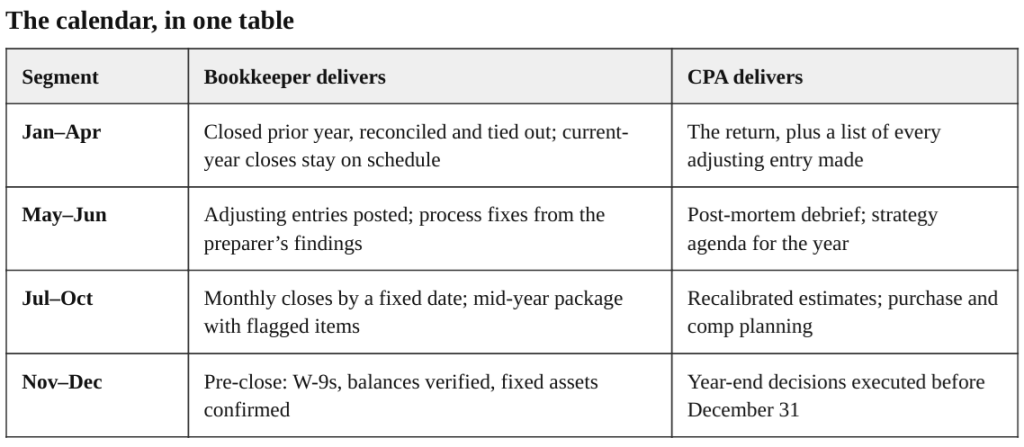
Here is the four-part calendar we run with our clients’ CPAs, and why each handoff exists.
Why the single-handoff model fails
When the only deadline that matters is the filing deadline, every bookkeeping error gets ten months to compound. A miscategorized owner draw in February becomes a distorted P&L by summer, a wrong estimated payment in September, and a multi-hour reconstruction project in January—performed at the most expensive time of year, by the most expensive person in the workflow.
The math is ugly for everyone. The CPA burns capacity on remediation during their most constrained weeks. The client pays a premium—cleanup billed at tax-season rates routinely runs 30–50% above what the same corrections would have cost handled in-period. And the return itself is riskier, because decisions about elections, timing, and estimated payments were made all year on numbers nobody trusted.
The alternative isn’t “better clients.” It’s a shared calendar with four checkpoints, where the bookkeeper owns clean data and the CPA owns tax strategy, and the two actually talk before the year is over.
Segment 1 (January-April): The bookkeeper protects the preparer’s time
During filing season, the bookkeeper’s job is to make the preparer untouchable. Concretely, that means the prior year is fully closed before organizers go out: every bank and credit card account reconciled through December 31, loan balances tied to lender statements, payroll tied to the W-3, and 1099s already filed—not “in progress.”
It also means the current year doesn’t fall behind while everyone stares at the prior one. The most common source of next January’s cleanup is the January-April period of the current year, when the client assumes the bookkeeper is “busy with taxes” and stops sending anything. Monthly closes continue on schedule through filing season, full stop.
The handoff deliverable: a closed year-end file with a reconciliation report, delivered before the preparer asks for it.
Segment 2 (May-June): The post-mortem nobody schedules
May is the highest-leverage meeting of the year, and almost nobody holds it. Within 30 days of filing, the bookkeeper and CPA should walk through one question: what did we find during preparation that the books should have caught
Every adjusting journal entry the preparer made is a process defect. If the CPA reclassified $18,000 of “miscellaneous expense,” the chart of accounts needs a fix, not just the entry. If distributions were tangled with payroll, the client needs a documented owner-compensation procedure. The bookkeeper posts the adjusting entries back into the file immediately—so the books match the return all year, not just at the next year-end—and converts the preparer’s findings into changed procedures.
This is also when the CPA sets the strategy agenda for the year: entity questions, accountable plans, retirement plan options, anything that requires months of clean data before a December decision.
The handoff deliverable: adjusting entries posted, a short list of process changes, and an agreed agenda for the fall planning meeting.
Segment 3 (July-October): Mid-year numbers that are actually load-bearing
By late summer, the books should be reliable enough to make decisions on—that’s the whole point of keeping them current. A mid-year review in July or August, run on six months of reconciled data, lets the CPA do the work that actually saves clients money: recalibrating estimated payments against real profit instead of last year’s safe harbor, evaluating equipment purchases and Section 179 timing while there’s still runway, and modeling S corp salary levels with actual distributions to date.
None of that analysis is possible on books that are four months behind. A projection built on unreconciled data isn’t planning; it’s guessing with a spreadsheet.
The bookkeeper’s job in this segment is cadence: every month closed by a fixed business day (we commit to the 10th), with a standing summary flagging anything anomalous—a margin swing, a new loan, a large asset purchase the CPA should know about before December.
The handoff deliverable: a six-month reconciled P&L and balance sheet, plus a flagged-items memo, in the CPA’s hands before the mid-year meeting.
Segment 4 (November-December): Decisions, not documents
The November planning meeting is where the year’s discipline pays off. With ten reconciled months on the table, the CPA can make real calls: accelerate or defer income, fund the retirement plan, true up the final estimated payment, execute any entity or election changes before the deadline that actually matters—December 31, not April 15.
December itself is pre-close month. The bookkeeper collects W-9s before issuing final vendor payments (chasing them in January is how 1099 season becomes a scramble), verifies loan and payroll balances, and confirms the fixed-asset list against what was actually purchased. By the last week of December, the only open items should be the handful of statements that can’t exist until January.
The handoff deliverable: a year-end that closes in the first two weeks of January as a formality, because every month behind it was already closed.
What this looks like from the CPA’s chair
Practitioners sometimes hear “year-round bookkeeper involvement” as more meetings and more coordination overhead. In practice it’s the opposite: three scheduled conversations a year—the May post-mortem, the mid-year review, and November planning—a monthly package that arrives without being requested, and a January in which the engagement starts at tax strategy instead of forensic accounting.
Clients feel the difference even more than the firm does. A tax bill discussed in November is planning; the same number revealed in April is a surprise—and surprises, not fees, are what erode a client’s trust in their accountant. When estimates are recalibrated mid-year and year-end decisions are made on reconciled numbers, the client walks into filing season already knowing roughly what they owe and why. Fewer surprises make happier clients, and happier clients renew, refer, and say yes to advisory work.
It also changes the economics of the relationship. Cleanup work is low-margin, low-satisfaction, and unbillable at its true cost—clients resent paying tax-season rates for data entry, and firms resent doing it. When the bookkeeper owns data integrity on a fixed calendar, the CPA’s hours shift toward advisory work that clients value and firms can price properly.
For clients who don’t have a bookkeeper capable of holding this cadence, that conversation is worth having in May, not January. The clients who most resist year-round bookkeeping are, reliably, the ones whose January files cost the most to fix.
Tax season will always be intense. But intensity and cleanup are different problems. The first is seasonal and unavoidable; the second is a scheduling failure that compounds for ten months and lands on the profession’s desk at the worst possible moment. Split the year, define the handoffs, and January becomes what it should have been all along: the start of tax season, not the end of last year’s bookkeeping—with fewer surprises for the client, and a happier client for the firm.

ABOUT THE AUTHOR:
Steph Conley is the founder of Steph’s Books, an outsourced bookkeeping firm serving professional services businesses with $1 million to $10 million in revenue. Her team partners with clients’ CPAs on a year-round close calendar so tax preparation starts from reconciled books.
Photo credit: rawpixel.com/Freepik
Sign in to get access to this free resource, and all of our whitepapers and reports.

Download this content today!
Register Now Already registered? Click here to Log In
Tags: Accounting, bookkeeping, clients, CPAs, tax professionals, tax season