The Treasury Department and the IRS have proposed regulations on eligible investments for Trump Accounts, a new investment vehicle created by the One Big Beautiful Bill Act to help children build wealth from an early age.
The tax-advantaged accounts are available to any child in the U.S. under the age of 18 with a Social Security number. Babies born between Jan. 1, 2025, and Dec. 31, 2028, are eligible for $1,000 in federal seed money, regardless of family income.
As of the end of July, 7 million Trump Accounts have been established, and 1 million people have claimed the federal money for their newborns.
The accounts officially launched on July 4.
Earlier this month, the Treasury Department and the IRS issued proposed rules providing guidance to employers that choose to make contributions to Trump Accounts for employees or their dependents. The proposed regulations also clarify nondiscrimination requirements for employers offering Trump Account contribution programs and dependent care assistance programs.
Recommended Articles

Payroll October 20, 2026
Musk Plans to Gift SpaceX Shares to Kids Through Trump Accounts

Payroll October 13, 2026
Dell $250 Donation May Be in Your Child’s New Trump Account
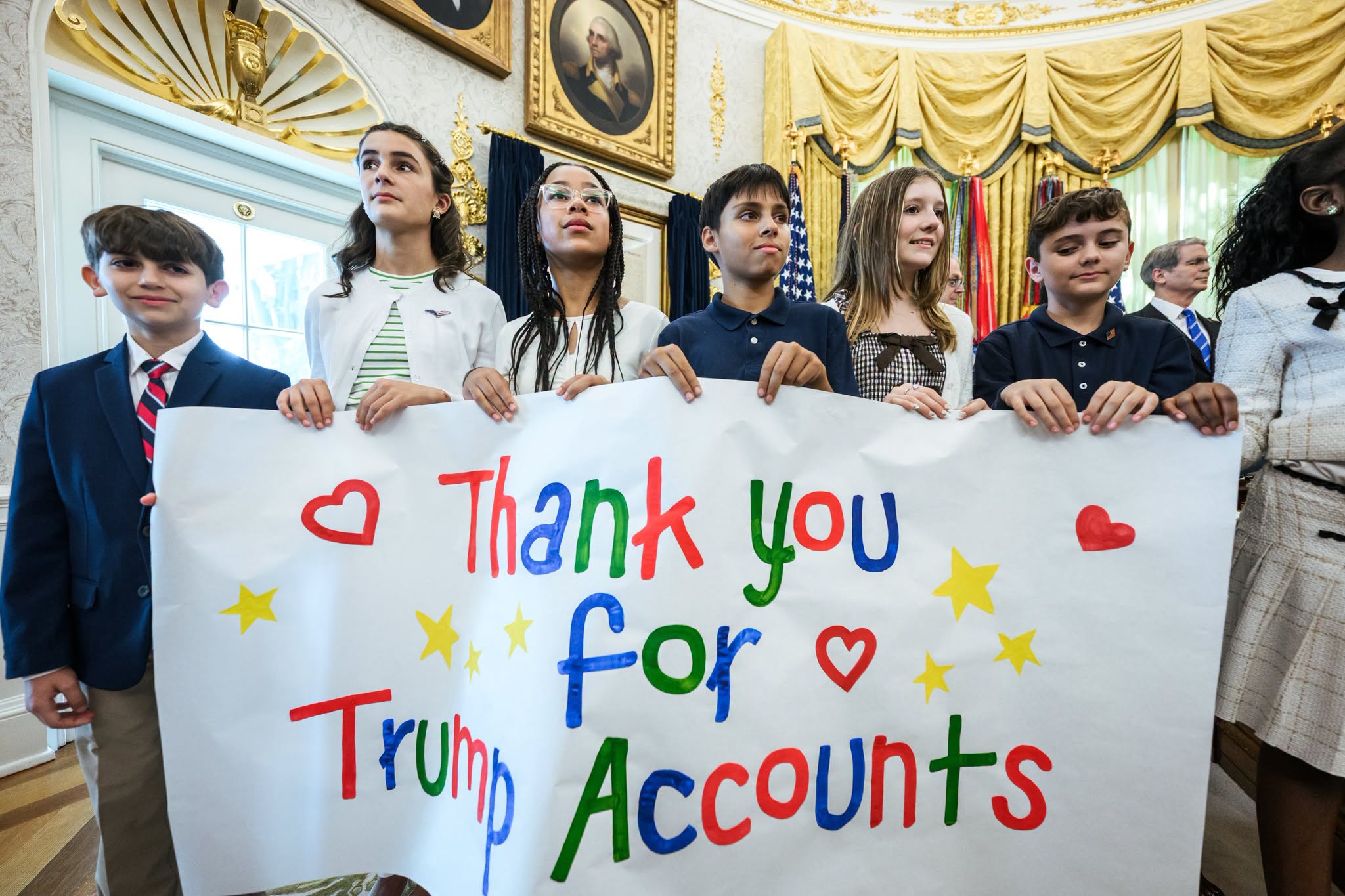


Under the proposed regulations issued Thursday, funds in a Trump Account can only be invested in eligible investments during the growth period, which begins when the account beneficiary’s initial Trump Account is established and ends on Dec. 31 of the calendar year in which the account beneficiary turns age 17. After the growth period, the eligible investment restrictions no longer apply.
For Trump Accounts, an eligible investment generally is a mutual fund or exchange-traded fund that tracks an equity index of primarily U.S. companies, such as the S&P 500 index, doesn’t use leverage, and has annual fees and expenses of no more than 0.1% of the balance of the investment in the fund, according to the IRS.
If an account beneficiary doesn’t select an eligible investment offered by the trustee, funds in a Trump Account automatically will be invested during the growth period in an eligible investment selected by the trustee.
The proposed regulations provide rules for determining whether an investment is an eligible investment and procedures for a trustee to ensure that funds are invested in an eligible investment. These regulations generally would apply to tax years beginning on or after Jan. 1, 2026.
“These proposed regulations will provide clarity for trustees and beneficiaries of Trump Accounts, thus encouraging eligible participants to invest in low-fee mutual funds and ETFs that will grow on a tax-deferred basis potentially over their entire lives,” IRS CEO Frank Bisignano said in a statement on Aug. 20. “Funds deposited in Trump Accounts enable American children to start investing now and enjoy years of compound earnings for their future college, retirement and other needs.”
These proposed regulations take into account stakeholder comments regarding eligible investments that were made in response to Notice 2025-68, issued in December 2025.
The Treasury Department and the IRS are now requesting additional comments from interested parties by Oct. 20, 2026. Complete instructions on submitting comments can be found in the proposed regulations.

“Every dollar in a child’s Trump Account should be working toward that child’s financial future, not diminished by unnecessary fees,” Treasury Secretary Scott Bessent said in a statement on Thursday. “Under President Trump’s leadership, Treasury is putting simple, commonsense protections in place to help families keep more of their investment returns.”
The Treasury Department previously announced that State Street SPDR Portfolio S&P 500 ETF (SPYM) would be the default investment for all Trump Accounts. Treasury also announced four additional low-cost index ETFs that can be chosen for investment by a parent or other responsible party.
The Treasury Department said Thursday that the proposed regulations would support the long-term growth of children’s Trump Accounts by limiting eligible investments to choices with low expense ratios and excluding products with excessive fees or unnecessarily complex strategies.
“By emphasizing straightforward, low-cost investment options, the proposed guidance would allow children to benefit more fully from decades of compound growth and ensure that a greater share of investment returns remain in their accounts,” the Treasury Department said in a media release. “The proposed guidance establishes a framework for the designation of eligible investments for future Trump Account trustees, including rollover trustees. Under the framework, an eligible index must be designed primarily to measure the performance of a broad segment of the U.S. or global equity market using objective financial criteria.
“This framework is intended to provide families with clear, transparent investment choices focused on cost, diversification, and long-term financial performance,” Treasury continued.
Bisignano added, “For a child investing over decades, even small differences in annual costs may have a meaningful effect on the amount available in adulthood. By emphasizing low-cost index investing, the proposed rules seek to maximize the share of investment returns that remains in each child’s account.”
Parents, guardians, and other authorized individuals can use IRS Individual Online Account to complete Form 4547, Trump Account Election(s), to open a Trump Account for a child with a Social Security number if the election is made before the calendar year in which the child turns age 18. If that child is a U.S. citizen born in 2025 through 2028, the parent or other individual who qualifies to make the election can check a box on Form 4547 to elect a $1,000 pilot program contribution for the child’s Trump Account.
Visit trumpaccounts.gov for more information.
Photo caption: President Donald Trump delivers remarks on Trump Accounts at the Andrew W. Mellon Auditorium in Washington, D.C., on Jan. 28, 2026. (Daniel Torok/The White House/Flickr)
Sign in to get access to this free resource, and all of our whitepapers and reports.

Download this content today!
Register Now Already registered? Click here to Log In