




The fear of AI replacing humans is becoming a thing of the past—in fact, the present paints a picture that is very different, as depicted in the 2026 Intuit QuickBooks Accountant Technology Survey.
The annual survey of 725 US accounting and bookkeeping professionals highlights a growing demand for accountant services, and how AI can transform a practice and its clients, when fully embraced and implemented strategically and decisively. And yet, according to survey results, a majority of firms are still using AI situationally, something that will hold them back and see their proactive competitors soar.
As many firms fall back into these old habits, practitioners revealed all-too-familiar disruptions that represent their day-to-day challenges: too many tools, too much cleanup, and a growing tension between the work firms want to do and the capacity they actually have to do it.
The data discovered reveals that there’s a clear path for those firms taking these challenges head-on and finding success, with AI at the forefront, working hand-in-hand with other key factors that make up the current industry landscape.
Here’s what the survey found on these areas and how you can apply it to your own practice.
Are You a Firm of the Future? Your AI Usage Depends on It
AI adoption remained about the same from 2025, with 88% of respondents using AI for at least one client service and 86% using it for at least one firm operation. The top client-service uses include data entry and processing (54%), financial forecasting (51%), and real-time insights (49%). On the operations side, invoicing and payments (53%), client communication (50%), and portfolio management (44%) top the list.
But here is where it gets interesting: Only 30% say AI is fully embedded as their default. The largest group, at 54%, uses AI situationally, reaching for it when it feels helpful rather than building it into repeatable workflows. More than three in four respondents (77%) agree the gap is widening between firms where AI is embedded and firms where it’s occasional.
The ROI is showing up for those who have committed. Among AI users, 75% say the tools delivered more value than expected. Looking ahead, the top expected benefits over the next 12 months are more sustainable workloads (56%), greater confidence in work delivered (56%), and more consistent output quality (54%).
What this means for your firm: Stop treating AI as a novelty and start treating it as a necessity, valuing it as infrastructure that offers the key to driving success.
The question is no longer whether to use AI; it’s whether you have designed your firm’s workflows around it. Pick two or three high-volume, repeatable tasks where AI can take the first pass, and build the review process around that. Situational use is better than nothing, but embedded use is the real game-changer to your capabilities. Firms that have standardized their AI use report that it’s changing what they can take on, not just how fast they finish existing work.
Your Tech Stack may be Hindering Your Capabilities—Probably Costing You Half a Day Every Week
AI isn’t the only area determining your capabilities and capacity to get work done how you see fit. Enter your tech stack.
There’s no doubt that technology is vital to all firms, but at what cost?
The data showed that the average accounting firm now runs on about 10 different apps and software programs, with one in three firms juggling 11 or more. Despite 92% of respondents investing in technology over the past 12 months and spending an average of $21,000 (up from $19,000 the year before), only 41% say their tools are fully integrated. Nearly half (48%) describe their setup as functional but fragmented.
The real cost? Accountants report losing an average of five hours per week moving, re-entering, or reconciling data across disconnected systems. That’s more than half a workday consumed before a single billable task begins!
“One thing this year’s data makes clear is that digital overwhelm is contributing to the AI depth gap,” said Jamerlyn Brown, principal communications manager, Intuit. “Firms are navigating dozens of tools and an expanding suite of AI capabilities, with no clear playbook for how it all fits together. The firms that will get the most from their technology will be the ones that are intentional about where AI belongs in their workflows and where it does not.”
Firms need to know their technology partners and providers are listening to their software/workflow needs and responding to meet those needs. Read more about how Intuit is making foundational improvements and adding new capabilities across its business platform based on accountant feedback to help them drive better outcomes for their firms and clients: Intuit Connect ON: What You Need to Know About the Latest Platform Innovations.
What this means for your firm: Before you spend another dollar on new software, audit what you already have. Are your tools actually integrated, or are you paying for systems that require manual bridges between them? Firms that consolidate their tech stack around a core platform, rather than layering on point solutions, are reclaiming hours every week and redirecting them to client work.
If you’re unable to decipher how data flows from one system to the next without human intervention, that gap is your first priority. The firms continuing to invest without addressing integration are not buying efficiency; they are buying more complexity.
Advisory Meets AI—Solutions to Overcome Bandwidth Concerns
By now, many accountants want to deliver more advisory services. After all, they offer opportunities to display value and grow their firm. Standing in the way is bandwidth.
For example, when asked what most prevents them from doing more proactive, higher-value advisory work, 30% of respondents named manual data cleanup as the top blocker, ahead of staffing shortages (24%) and app overload (16%).
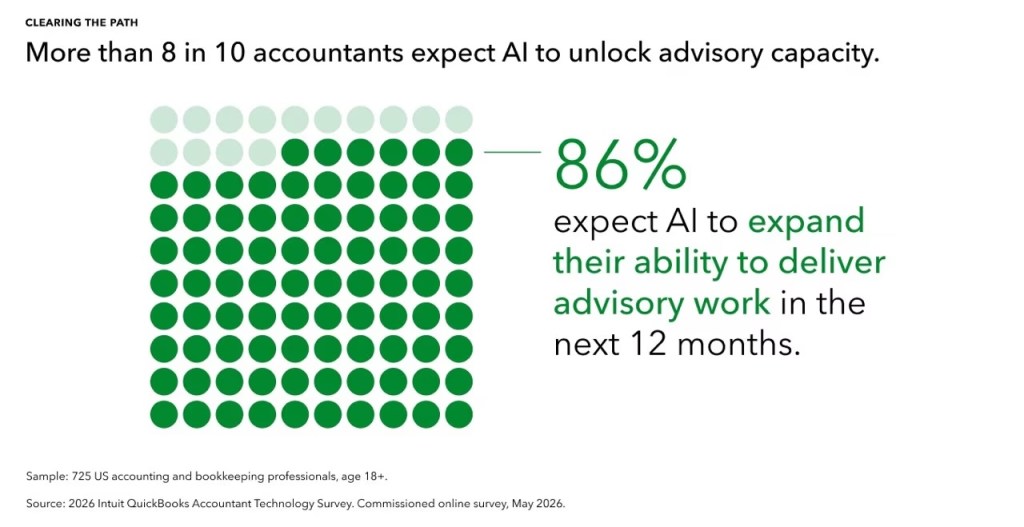
The encouraging signal: 86% expect AI to increase their advisory capacity over the next 12 months, including 38% who call it a genuine unlock—not just incremental help.
“For the firms looking to expand advisory, the challenge is often capacity,” said Brown. “Manual data cleanup is still slowing teams down, and AI can help move that work out of the way so accountants have more time for judgment, guidance, and client conversations.”
Outsourcing is emerging as a second engine alongside AI. For the second year in a row, 80% of respondents outsourced at least one service, most commonly AP and AR processing (43%), tax preparation (40%), and financial statement preparation (39%). And 65% plan to increase their outsourcing, up from 63% in 2025.
What this means for your firm: The path to advisory growth is an operational problem, and it has operational solutions. Identify the specific tasks consuming the most staff time that do not require human judgment, and then make a deliberate decision about whether AI and/or outsourcing can absorb them.
The firms making the most progress on advisory are not the ones with the most talented staff; they are the ones who have cleared the most friction from the path to higher-value work. If manual data cleanup is your biggest blocker, that is your roadmap: solve that first.
Trust and Transparency—What Clients Feel and Expect
You might think that AI is some secret sauce that, if revealed, would lessen your value or credibility in the eyes of your clients. However, it’s actually quite the opposite.
One of the most significant shifts in this year’s data involves how clients think about AI. Three in five respondents report that clients ask for proof of AI data protection always or frequently. And yet, only one in three accountants (33%) proactively explains how AI supports their work. Nearly half (49%) address it only when a client brings it up.
This reactive tendency is becoming a liability; 84% of respondents agree that strong AI data security practices are becoming a competitive advantage in keeping current clients and winning new ones. And 79% believe that used responsibly, AI actually increases client trust through consistency, earlier issue detection, and better documentation.
When asked why clients will continue to pay for human expertise as AI takes on more routine work, 41% cited trust and liability as the top reason, followed by complexity management (31%) and empathy (22%).
“Eighty-five percent of the accountants we surveyed agree that the firms that win the next decade will be the ones that combine AI efficiency with human expertise and trust,” said Brown. “That combination requires clarity, not just adoption.”
What this means for your firm: Ensure that your firm has a clear answer to the question, how do you use AI in your work? And provide it to clients before they ask it!
For full transparency and best practices, build a brief, easy-to-understand summary of your AI implementation: what tools you use, what they do, what humans review, and how client data is protected. Firms that can articulate this clearly are turning a potential concern into a differentiator. The ones staying quiet are offering an advantage to competitors who have already made this part of their engagement process.
Combating Hiring Pressure—The Definition of a Good Hire is Changing
Hiring improved modestly in 2026, with 77% of respondents reporting at least one hiring struggle over the past 12 months, down from 80% in 2025 and 94% in 2024. But the challenge remains significant across every experience level. The hardest tiers to fill are candidates with one or more years of experience (46%) and five or more years (42%). Even at entry level, one in three say finding quality candidates has been difficult.
And when firms do hire, they wait a long time before seeing the payoff: 56% say a new entry-level hire would take six months or more to reach full billable capacity.
The definition of an ideal hire is also shifting. When asked what expertise they are prioritizing most, 38% named strategic judgment—interpreting complex data, identifying risks, and making recommendations—with AI fluency second at 22%. And when it comes to entry-level signals, software and technology certifications (53%) and AI, automation, and data skills (53%) now rank dead even, and slightly ahead of CPA credential status (50%), as factors that improve a candidate’s hiring chances.
What this means for your firm: Rethink what you are looking for when it comes to hiring. A candidate who can navigate modern tools and work comfortably within AI-assisted workflows may generate billable value faster than a technically strong hire who needs to be retrained on everything digital.
Broaden your search to include candidates from adjacent fields, such as data analytics and business technology, because they can bring the fluency your team needs. At the same time, invest in reducing ramp time for new hires. Documented workflows, clear onboarding standards, and AI-assisted quality checks all shorten the time needed for a new hire to become an important contributor.
Your Role is Expanding—And So Are Client Expectations
When modern AI started to take force in the last five years or so, who would’ve thought that accountants would be needed today, now more than ever?
More than half of respondents report increased client demand across every financial category—financial management leads at 61%, followed by regulations and compliance (59%) and filing taxes (56%). Non-finance requests have become routine: 62% say clients need more guidance on technology management, and 59% say the same for business planning and strategy.
Also, more than three in four respondents (77%) now play a major or moderate role in supporting clients with HR and workforce management. And 70% say recent IRS staffing cuts have increased their administrative workload.
“The data is telling us that the traditional boundaries of the accountant’s role have effectively dissolved for many,” said Brown. “Clients are not distinguishing between financial advice and business advice anymore—they are bringing technology questions, workforce challenges, and strategic decisions to the same trusted person they call for taxes. That is a meaningful shift in how clients perceive the value of the relationship, and it’s a trend that shows up consistently in recent years.”
What this means for your firm: The expanding mandate is not going away, and it has real implications for pricing and positioning. If you are absorbing more scope without adjusting your fees or service structure, you’re missing out on growing your firm and simply wasting away your value.
Consider formalizing the advisory and consulting work you are already doing into defined service offerings, with pricing to match. The data suggests clients are leaning on their accountants more than ever. The question is whether you are capturing the value of that relationship or leaving it on the table.
Ready to be a Firm of the Future? Make the Right Decisions to Get There
The firms breaking away from the pack and reaching the most success have made a few clear choices.
The 2026 survey data is ultimately a picture of a profession sorting itself into two groups: firms that are fully embracing AI and embedding it into repeatable workflows, and firms that are still navigating the friction. The gap between them is widening every year.
The leading indicators are visible in the data: consolidated tech stacks, AI built into daily workflows rather than used occasionally, proactive AI transparency with clients, and hiring criteria aligned with where the profession is heading, rather than where it has been.
None of these are dramatic transformations. They are operational decisions that can quickly lead to meaningful, competitive advantages, as shown by the survey data.
So what will you and your firm do to set yourself apart and be a firm of the future? The answer and the roadmap is now clear.
The 2026 Intuit QuickBooks Accountant Technology Survey was conducted in May 2026 among 725 US accounting and bookkeeping professionals aged 18 and older.
Sign in to get access to this free resource, and all of our whitepapers and reports.

Download this content today!
Register Now Already registered? Click here to Log In





John Thomas October 4 2026 at 11:07 pm
The most instructive number in this survey isn't the AI adoption rate, it's the sequencing: 80% of firms outsourced at least one service while only 30% have AI fully embedded. Firms found it easier to hand a process to people than to embed a tool, and the reason is worth sitting with. Outsourcing forces process documentation. The five hours a week lost shuttling data between disconnected systems is exactly what an outside team maps on day one, because they cannot run on the partner's tacit knowledge. That documentation is also what AI needs. The firms I see failing at automation are the ones automating undocumented processes; the ones succeeding outsourced first and handed the bots clean, repeatable workflows. So the 'second engine' framing is right, but the order matters: process first, tool second. Manual data cleanup (the 30% blocker for advisory) is the exact work that shouldn't pass through expensive staff at all. Move it to a dedicated team with a named reviewer and documented turnaround SLAs, and you don't just buy back hours, you create the conditions for the AI investment to actually pay off. Advisory capacity is an operational problem with operational solutions, and the survey data keeps pointing at the same one.