



By Jim Brunner
The Seattle Times
(TNS)
Opponents of an initiative to repeal Washington’s new high-earners income tax are warning the proposal could also strike down other taxes, putting billions of dollars in state revenues that fund public services at risk.
Initiative 645, likely headed for a vote this fall, explicitly aims to repeal the so-called “millionaires tax” signed into law by Gov. Bob Ferguson this year.
But foes of the initiative are citing a new legal analysis that says the proposal’s broad wording—banning any taxes “measured by” income—may have far more sweeping and financially disastrous consequences for the state.
Backers of I-645 flatly deny those claims, calling them “scare tactics” aimed at confusing voters about the measure.
Recommended Articles

If approved by voters, I-645 would “likely repeal” Washington’s voter-approved capital gains tax, according to an eight-page memo written by attorneys with Pacifica Law Group for the initiative’s opponents.
Because the capital gains tax is calculated using profits reported on federal income-tax returns, it “likely falls within the Initiative’s prohibition on taxes ‘measured by’ income,” the legal analysis says, noting repeal of that tax would eliminate about $500 million per year dedicated mainly to K-12 education.
There is also a “substantial risk” the initiative would invalidate other programs, including the state’s unemployment insurance, paid family and medical leave and the state’s new long-term care program, the Pacifica memo states. Those programs are paid for by about $5.4 billion in annual payroll taxes that are calculated based on employee wages.
The initiative doesn’t actually say it would repeal those programs or even specifically mention them.
But because of the wording about prohibiting taxes “measured by” income, the full scope of its effects would likely be resolved only after “prolonged litigation,” causing “years of uncertainty regarding major state revenue sources and the programs they support,” the memo concludes.
Backers of I-645 rejected those claims as a false and desperate ploy by the Democratic establishment desperate to fend off an initiative that has garnered hundreds of thousands of signatures in mere weeks. They plan to submit signatures to the secretary of state’s office next week to qualify for the November ballot.
“The Repeal the Income Tax Initiative repeals only the unconstitutional income tax that the Washington Legislature adopted this past year and nothing else,” said Hallie Herzberg, a spokesperson for Let’s Go Washington, which is running the I-645 campaign, in a statement Friday.
Herzberg said the initiative was carefully worded to avoid sweeping in the capital gains tax or other state taxes, citing information from the campaign’s legal counsel.
Brian Heywood, the Redmond hedge fund manager who has bankrolled the anti-income-tax effort, said in a text message last month that I-645 does take aim at the capital gains tax.
Recommended Articles

Erik Houser, a spokesperson for the anti- I-645 campaign, Millionaires Tax for Washington, accused Heywood in a statement of “either not understanding” or being “deliberately deceptive” about “the potentially catastrophic impacts” of the measure.
Heywood tried to overturn the capital gains tax with an initiative in 2024, but the measure was overwhelmingly rejected, with more than 60% voting it down.
Hugh Spitzer, an emeritus law professor at the University of Washington and an expert on the state’s tax system, said in an interview there is a “legitimate concern” that a court could read I-645 as applying to the capital gains tax and payroll taxes.
However, Spitzer doesn’t fully buy into the theory, saying, “The odds are the courts would not use this language as a basis for blocking those other taxes” because the initiative doesn’t expressly repeal them.
Last month, the state attorney general’s office weighed in during a ballot title dispute over a similar anti-income tax initiative drafted by Heywood, acknowledging in a court filing the measure’s impact would be “uncertain” and that the initiative arguably could affect other taxes, potentially even Seattle’s JumpStart payroll tax.
But Deputy Solicitor General Peter Gonick also noted that since the initiative did not explicitly name the other taxes, a court would be required “to harmonize the measure with existing statutes” and “would not necessarily invalidate those taxes …”
What is certain is that I-645 would repeal the new high-earners income tax, which will put a 9.9% levy on household incomes of more than $1 million a year, with collections starting in 2029.
If it survives the vote and a legal challenge, the tax is projected to raise $3 billion to $4 billion a year, with most of the money devoted to shoring up the state operating budget, which pays for K-12 schools, universities, healthcare, the foster care system and other state services.
While I-645 would eliminate that tax, it would keep in place tax breaks for businesses and residents that were passed as part of the “millionaires tax legislation this year.
That combination would reduce state funding by more than $16 billion through 2032, according to the Pacifica memo.
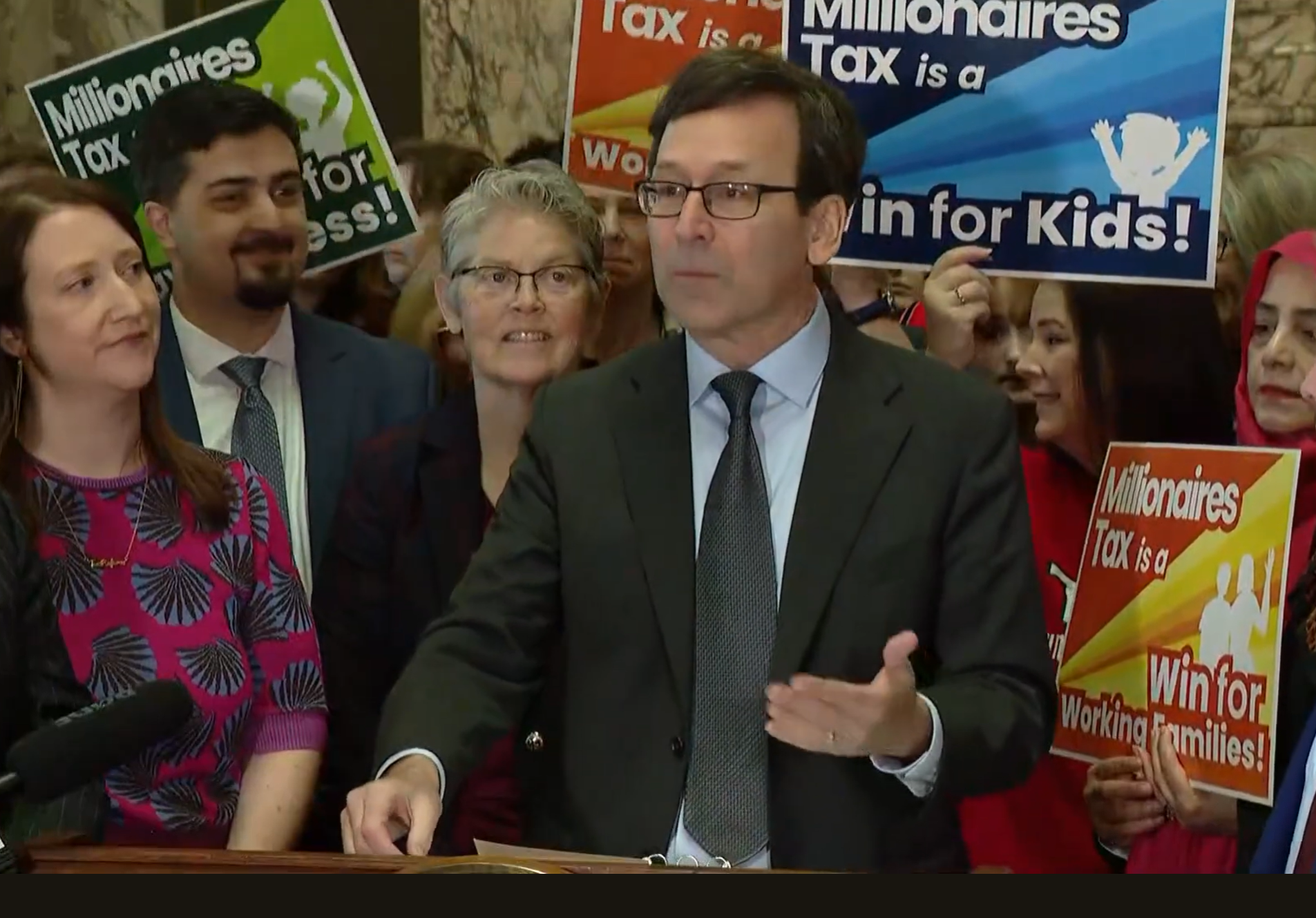
Photo caption: Washington Gov. Bob Ferguson speaks to supporters before signing the state’s new “millionaires tax” into law on March 30, 2026. (YouTube)
_______
© 2026 The Seattle Times. Visit www.seattletimes.com. Distributed by Tribune Content Agency LLC.
Sign in to get access to this free resource, and all of our whitepapers and reports.

Download this content today!
Register Now Already registered? Click here to Log In