



By Mary Beth Lougen, Chief Operating Officer, Expat Tax Tools
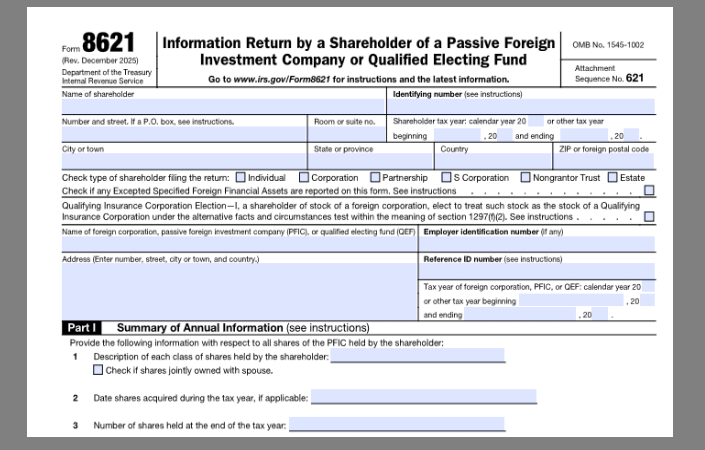
As international investing becomes more common among U.S. taxpayers, many tax professionals are encountering Passive Foreign Investment Company (PFIC) reporting issues more frequently than they did a few years ago. One area that still catches firms off guard is the potential statute of limitations exposure tied to missing Form 8621 filings.
Under the international information reporting rules, if a required Form 8621 is not filed, the IRS may be able to keep the statute of limitations open on the entire tax return indefinitely. Many practitioners assume the exposure is limited to the PFIC investment itself, but that is not necessarily the case.
“This is one of the areas practitioners often underestimate,” said Mary Beth Lougen. “A missed Form 8621 can potentially keep the entire return open, not just the investment reporting section.”
Recommended Articles

Taxes April 29, 2026
IRS Increases Foreign Earned Income Tax Breaks
PFIC Identification is Still a Major Problem
One of the biggest practical issues is simply identifying PFIC investments in the first place.
Common examples include:
- Non-U.S. mutual funds
- Foreign-domiciled ETFs
- Certain pooled investment and insurance-linked products
These investments are especially common in expatriate returns, dual-resident situations, and globally diversified portfolios. In many cases, clients do not realize the investments create separate U.S. reporting obligations, and the documentation they provide often does not clearly indicate PFIC status.
Another challenge is that Form 8621 filing requirements may apply even when there was no sale, distribution, or obvious taxable event during the year.
“We regularly see situations where taxpayers had no idea they owned a PFIC,” Lougen noted. “By the time the issue is discovered, multiple years may already be affected.”
The Compliance Burden is Significant
Once a PFIC is identified, practitioners must determine which reporting method applies:
- Section 1291 (excess distribution regime)
- Section 1293 (Qualified Electing Fund election)
- Section 1296 (mark-to-market election)
Each method creates its own computational and recordkeeping challenges. Depending on the election involved, firms may need to track historical income allocations, basis adjustments, deferred tax calculations, and interest charges over multiple years.
The work involved can become substantial very quickly, particularly when prior-year information is incomplete.
“The complexity is not just the form itself,” Lougen said. “The real challenge is gathering accurate historical data and determining whether prior elections were made correctly—or missed entirely.”
Practitioner Risk is Increasing
Many CPAs, Enrolled Agents, and generalist preparers do not routinely work with PFIC reporting and may not fully appreciate how technical the rules are.
At the same time, the IRS has greater visibility into foreign financial accounts and investment activity through FATCA reporting and international data-sharing agreements. As foreign account reporting continues to expand, practitioners should assume PFIC investments are becoming easier for the IRS to identify.
From a risk-management perspective, firms may want to review:
- PFIC identification procedures
- Foreign investment questionnaires
- Prior-year international filings
- Documentation standards for foreign assets
- Internal policies for handling specialized international tax matters
“This is a very specialized area of international tax,” Lougen said. “In some cases, firms are better served bringing in a specialist early rather than trying to correct years of PFIC issues later.”
The Role of Specialized Software
Because PFIC reporting can involve complicated multi-year calculations, many firms now rely on specialized software tools to improve consistency and reduce manual calculation errors.
However, practitioners should still understand the methodology behind any software they use and ensure the calculations are being reviewed appropriately.
“Software can help streamline the process,” Lougen said, “but firms still need to understand the underlying tax treatment and the assumptions being used.”
About Expat Tax Tools: Expat Tax Tools develops software solutions designed for complex international tax reporting, including PFIC compliance and Form 8621 preparation. Its tools are used by accounting firms and tax professionals working with U.S. taxpayers who hold foreign investments.
==
Mary Beth Lougen is Chief Operating Officer of Expat Tax Tools.
Sign in to get access to this free resource, and all of our whitepapers and reports.

Download this content today!
Register Now Already registered? Click here to Log In