



Costs to operate the now-defunct Direct File free tax preparation program last year were significantly less than the IRS estimated, according to a new report from the Treasury Inspector General for Tax Administration.
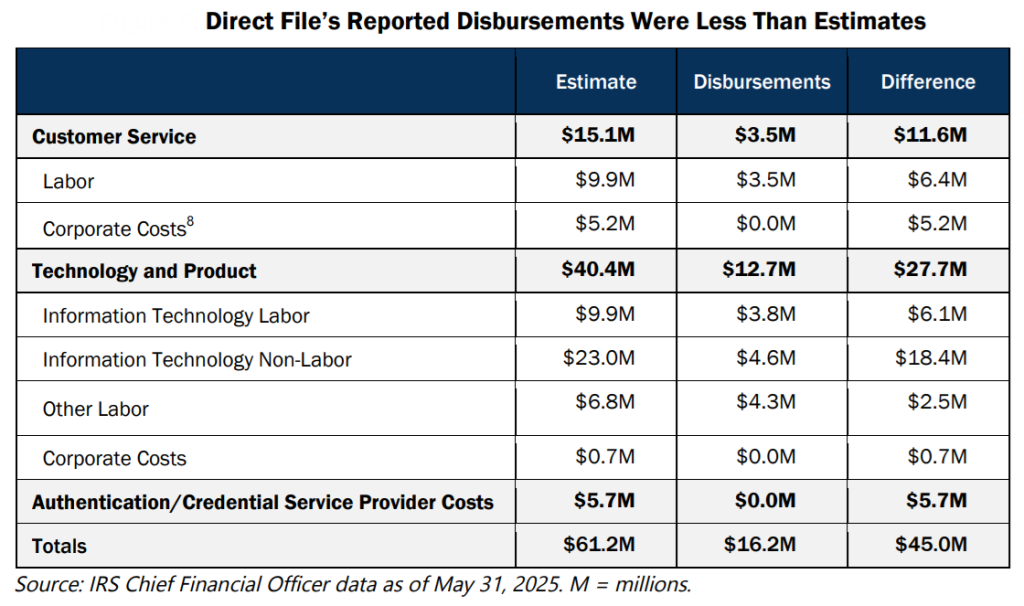
While the IRS estimated that Direct File would cost $61.2 million for fiscal year 2025, the actual cost totaled $16.2 million as of May 2025.
TIGTA says actual costs were less than the estimate because:
- The IRS overestimated the number of Direct File users and IRS assistors needed to support them.
- The IRS didn’t use some of their engineering and design contracts. For example, the IRS expected it would need $30 million for engineering and design contracts. However, Direct File management stated that this cost wouldn’t be realized since Direct File was told to halt development in mid-March 2025.
TIGTA’s report states:
We previously reported that the IRS’s Direct File costs for FYs 2023 and 2024 did not include an estimated $8.8 million in costs incurred by the government. For example, Direct File did not include costs for employees detailed to the IRS by another federal agency to help develop and pilot Direct File, costs for other IRS functions’ employees who supported the program, and authentication costs. The costs of detailed employees and other IRS employees are largely unknown since the IRS did not generally track the time associated with these employees, as we previously recommended. As a result, the IRS’s reported costs for FY 2025 continue to exclude the costs from all support functions.
According to the IRS, Direct File’s costs depend on the number of users. However, management did not report the cost for taxpayers to authenticate to use the Direct File system. To create a Direct File account, users had to authenticate through a Credential Service Provider if they had not previously authenticated to access another IRS system. Management stated that they are unable to determine how Direct File users first authenticated themselves i.e., did they authenticate using Direct File or another IRS system. If all new Direct File users first authenticated using Direct File, we estimate that the IRS would have spent an estimated $2.5 million on Direct File.
According to the IRS, the average costs for a new Credential Service Provider account is $3.64 and a returning user is $1.35. TIGTA’s analysis of Direct File users during the 2025 filing season found that 88% were new users and 12% were returning users. As a result, based upon the 751,000 Direct File users, TIGTA estimated that the actual unreported costs were $2.5 million.
The report also found that during the 2025 filing season, the IRS estimated that 32 million taxpayers would be eligible for Direct File, but only 751,000 taxpayers registered with Direct File—a 78% increase from 423,000 registered taxpayers during the 2024 filing season.
Direct File management attributed the lower-than-expected usage to confusion in media coverage about availability and a lack of outreach. Additionally, 59% of the 751,000 Direct File users didn’t submit a tax return through the system during the 2025 filing season.
Recommended Articles
The Direct File program allowed eligible taxpayers in certain states to electronically file their federal tax returns directly on the IRS website at no cost.
The IRS launched the pilot program in 2024, under then-President Joe Biden, making it available to taxpayers in 13 states. It was later expanded to include 25 states, including California, New York, Florida, Texas, Illinois, North Carolina, and Pennsylvania.
The Trump administration decided to kill Direct File last year.

Thanks for reading CPA Practice Advisor!
Subscribe Already registered? Log In
Need more information? Read the FAQs
Tags: Income Taxes, IRS, IRS Direct File, Taxes, TIGTA