


By Brendan Sanders
Jacksonville Journal-Courier, Ill.
(TNS)
Aug. 8—Yesterday, President Trump signed an executive order that could give those investing in retirement long-sought access to a pool of funds worth trillions.
According to the Associated Press, there is no immediate change in how people invest part of their work earnings. Federal agencies would need to rewrite rules and regulations to allow the expanded choices, and that would take months or more to complete. But once done, employers could offer a broader array of mutual funds and investments to workers, according to the White House. New plans could invest in alternative assets, particularly private equity, cryptocurrencies and real estate.
The president’s order directs the Labor Department and other agencies to redefine what would be considered a qualified asset under 401(k) retirement rules.
Americans’ retirement plans are governed by a law known as the Employee Retirement Income Security Act of 1974, better known as ERISA. Employers are required by law to offer retirement options that are in the best interest of their employees, not Wall Street. Most retirement plans for Americans are made up of stock and bond investments and to a much lesser extent, cash and heavily traded commodities such as gold.
401(k) participants
Some potential impacts include retirement plan exposure to alternative assets such as private equity and crypto alongside traditional options like mutual funds and ETFs.
These alternative assets might offer better long-term returns and diversification and may allow people to tailor retirement investments in ways that previously only institutional or wealthy investors could.
Alternative investments may carry higher fees, longer lock-up periods and higher complexity. While the executive order seeks to democratize these options, there is no guarantee employers or plan providers will immediately adopt them.
Use of cryptocurrency may also increase investment risks.
Use of cryptocurrency
According to the AP, under President Joe Biden, federal regulators were to treat cryptocurrency investments with extreme care because of the extreme volatility of crypto. It is not uncommon for Bitcoin, Ethereum and other major cryptocurrencies to move up or down 10% in a single day, whereas a 2% or 3% single-day move in the stock market would be considered historic.
For cryptocurrency companies, which donated millions to Trump’s campaign as well as his inauguration, one goal was to get their industry qualified under ERISA. Coinbase, one of the largest cryptocurrency companies in the United States, was also a major donor toward Trump’s military parade in Washington this summer. Under Trump, the Securities and Exchange Commission dropped its lawsuit against Coinbase, where the Biden administration said crypto should be treated as a security.
Crypto is particularly popular among young Americans. While volatile, Bitcoin has generally appreciated in value since it was created by an anonymous programmer nearly 20 years ago.
“It was inevitable that bitcoin would make its way into American 401(k)s,” said Cory Klippsten, the CEO of Swan Bitcoin. “As fiduciaries realize Bitcoin’s risk-adjusted upside over the long term, we’ll see growing allocations, especially from younger, tech-savvy workers who want hard money, not melting ice cubes.”
For retirement plan administrators
For administrators, the executive order offers potential regulatory relief and safe harbors.
The order instructs the Department of Labor to review and potentially rescind prior guidance (notably a December 2021 statement) that limited the inclusion of alternative assets in defined-contribution plans.
Safe harbors may be introduced that could lower litigation risk and provide clearer standards for including alternative assets in plans.
According to AP News, even after the regulations are written, it will take time for major retirement plan companies, such as Fidelity, Vanguard, T. Rowe Price and others, to develop appropriate funds for employers to use. Employers are unlikely to revise their retirement plan options quickly, so it may take several years before crypto and private equity investments become mainstream in an individual’s retirement plan.
“While Vanguard has not committed to launching a product for defined contribution plans, Vanguard is dedicated to educating retirement investors to ensure a clear understanding of the opportunities and risks of investing in private assets,” the company said in a statement.
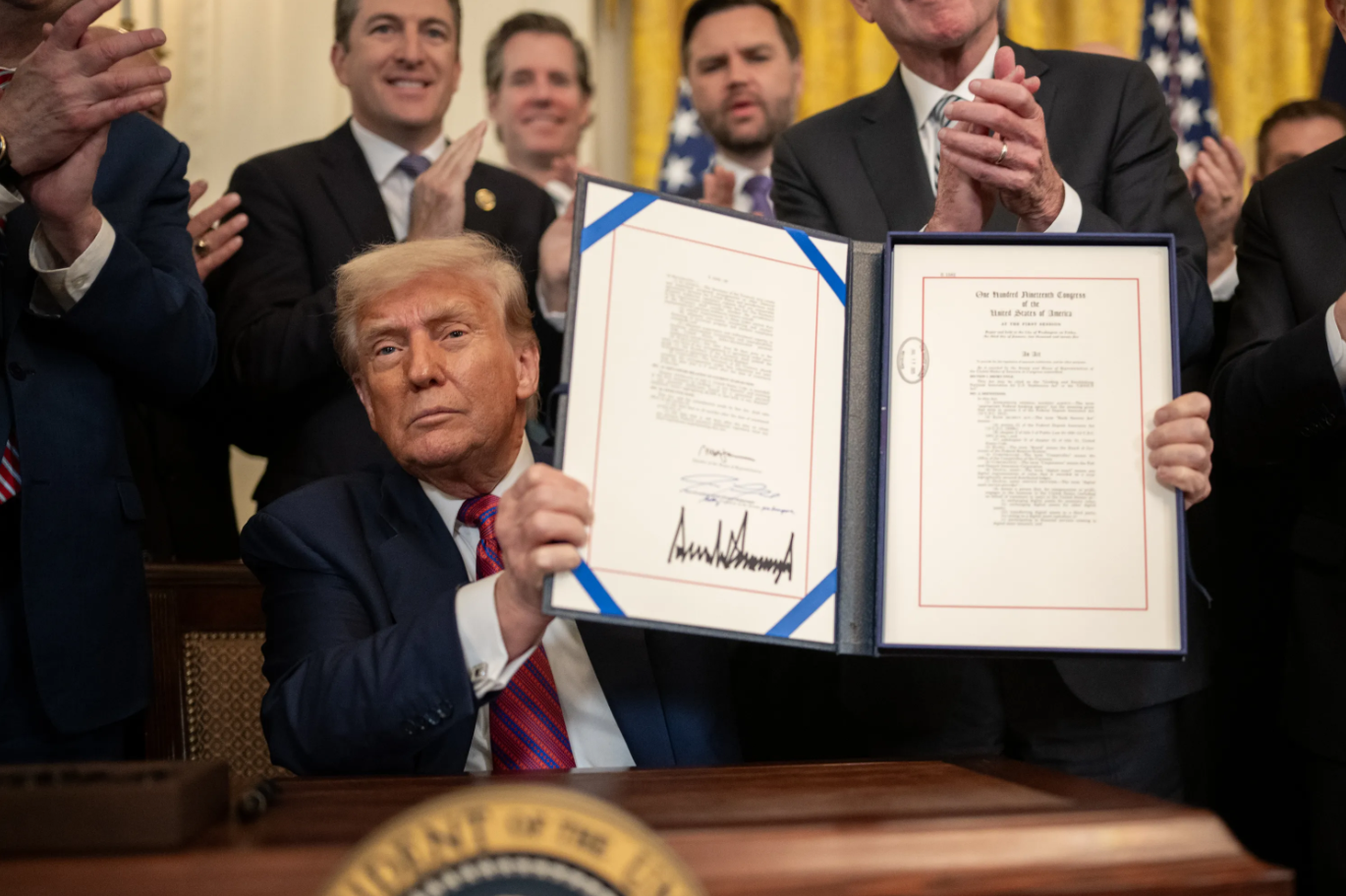
Photo caption: President Donald Trump participates in a signing ceremony for S.1582 GENIUS Act in the East Room at the White House on July 18, 2025. (White House)
________
© 2025 the Jacksonville Journal-Courier (Jacksonville, Ill.). Visit www.myjournalcourier.com. Distributed by Tribune Content Agency LLC.

Thanks for reading CPA Practice Advisor!
Subscribe Already registered? Log In
Need more information? Read the FAQs




CHARLES VOGEL August 15 2025 at 1:26 pm
The only problem is bit coin has no intrinsic value. It is just one of the first in encryption technology. Bit coin is slow,old and has very little use as encryption technology. It is almost outdated as AOL in regards to crypto technology. You can't do much with it where there are other encryption technology that has operating systems and better storage capacity and that are faster for transactions.