The Conference Board Leading Economic Index (LEI) for the U.S. declined by 0.3% in February 2025 to 101.1 (2016=100), after a 0.2% decline (revised from –0.3%) in January. Overall, the LEI fell by 1.0% in the six-month period ending February 2025, less than half of its rate of decline of –2.1% over the previous six months (February–August 2024).
“The U.S. LEI fell again in February and continues to point to headwinds ahead,” said Justyna Zabinska-La Monica, Senior Manager, Business Cycle Indicators, at The Conference Board. “Consumers’ expectations of future business conditions turned more pessimistic. That was the component that weighed down most heavily on the Index in February. Manufacturing new orders, which improved in January, retreated and were the second largest negative contributor to the Index’s monthly decline. On a positive note, the LEI’s six-month and annual growth rates, while still negative, have remained on an upward trend since the end of 2023, suggesting that headwinds in the economy as of February may have moderated compared to last year. However, given substantial policy uncertainty and the notable pullback in consumer sentiment and spending since the beginning of the year, we currently forecast that real GDP growth in the U.S. will slow to around 2.0% in 2025.”
“However, given substantial policy uncertainty and the notable pullback in consumer sentiment and spending since the beginning of the year, we currently forecast that real GDP growth in the U.S. will slow to around 2.0% in 2025.”
The Conference Board Coincident Economic Index (CEI) for the U.S. increased by 0.3% in February 2025 to 114.7 (2016=100), after a 0.2% increase in January. As a result, the CEI rose by 1.2% over the six-month period between August 2024 and February 2025, twice its 0.6% growth over the previous six months.
The CEI’s four component indicators—payroll employment, personal income less transfer payments, manufacturing and trade sales, and industrial production—are included among the data used to determine recessions in the US. They all improved in February, with the largest positive contribution coming from industrial production, followed by personal income less transfer payments, manufacturing and trade sales, and payroll employment.
The Conference Board Lagging Economic Index (LAG) for the U.S. increased by 0.4% to 119.1 (2016=100) in February 2025, after a 0.3% increase in January. As a result, the LAG’s six-month change turned positive, rising 0.2% between August 2024 and February 2025—a reversal of its 0.2% decline from over the previous six months.
The LEI declined for the third consecutive month in February 2025
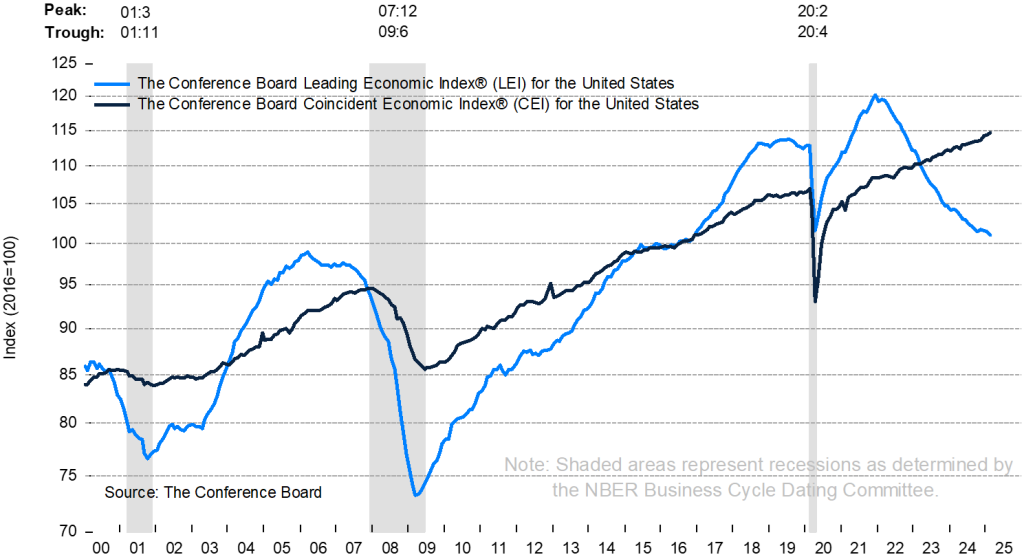
Half of the LEI’s 10 components fell in February, driving its overall decline

Sign in to get access to this free resource, and all of our whitepapers and reports.

Download this content today!
Register Now Already registered? Click here to Log In
Tags: Accounting