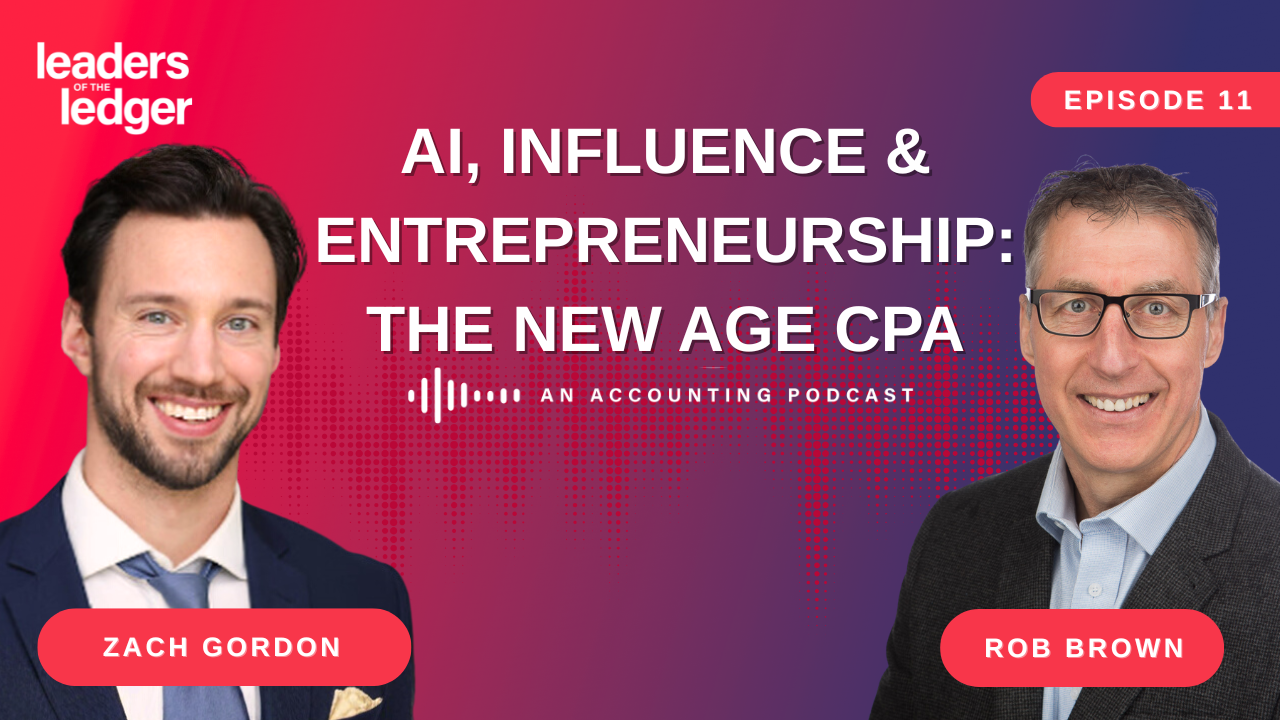




In this episode of Leaders of the Ledger, host Rob Brown sits down with Zach Gordon—CPA, entrepreneur, and thought leader reshaping what it means to lead in accounting.
Zach shares his unconventional journey through big firms, startups, and now running his own practice—all while helping modernize the profession’s reputation. From AI and automation to advising in emerging industries like cannabis and crypto, Zach is part of the new wave of CPAs redefining influence, innovation, and impact.
He opens up about:
- Why accounting’s brand problem needs urgent fixing.
- How AI and automation are transforming firm work.
- Why the next generation of CPAs must think like entrepreneurs.
- The skills accountants must develop to stay relevant.
- His mission to make accounting exciting again.
A must-listen for firm leaders, partners, and ambitious accountants ready to embrace the future of the profession.
Leaders of the Ledger spotlights innovators, firm leaders, and rising stars shaping accounting’s future with practical insights and proven strategies. The podcast is produced and owned by CPA Practice Advisor.
Learn more about episodes and recaps at https://www.cpapracticeadvisor.com/podcasts/.
Or use the below podcast play to listen:
Transcript (Note: There may be typos due to automated transcription errors.)
SPEAKERS
Zach Gordon (Speaker 1) and Rob Brown (Speaker 2)
Speaker 1 (00:00.046)
but I certainly believe in putting in the hard work and most of all I believe in paying it forward. So if I can do right by someone without any expectation of something coming back, and I truly mean this, I want to do the right thing and I know I’ve worked pretty hard to surround myself with people who believe the same thing and it just, it seems to work.
Moving the dial and shaking things up a little bit and here on the Leaders of the Ledger podcast on behalf of CPA Practice Advisor. But that’s the problem, isn’t it, Zach, in a way? The narrative of a career in accounting is way back 20, 30, 50 years ago. We haven’t really modernized that and told a more up-to-date story, have we?
It’s no secret that public accounting is a relatively slow moving engine. doesn’t really, it’s not known for its agility, but I think very quietly a lot of those changes have been made. And now I think it is just telling the story.
need technical skills, need selling skills, need persuasive skills, need advisory skills, you need entrepreneurial mindsets, you need to be a therapist, a coach, a consultant, a shoulder to cry on. of these things. I’ll bring in some of them to bear and showing you what they’re doing and telling their story. I’m filled to have with me today, Zach Gordon. Good day, sir.
Thanks so much for having me.
Speaker 2 (01:09.528)
There are so many people in the accounting world that are doing incredible things and they don’t often get talked about. They are well-kept secrets, but in their own little worlds, they are moving the dial and shaking things up a little bit. here on the Leaders of the Ledger podcast, on behalf of CPA Practice Advisor, we are bringing some of them to bear and showing you what they’re doing and telling their story. I’m thrilled to have with me today, Zach Gordon. Good day, sir. We’re Splendid, Zach. And tell us a little bit about you and your world.
Thanks so much for having me. How are you?
Speaker 1 (01:35.15)
Yeah. Where to begin? It goes out saying and hold your hat, but I am a CPA, of course. I know big shock based out in New York, been through the wringer of the big firm, small firms, private equity startup land. I on the New York CPA’s board, do a little bit with the AICPA as well on the cannabis side, which is a whole rabbit hole. I’m sure we can go down and it’s actually very exciting. Did a bit of a merger recently. We’re just announcing it to the public. So that’s been very exciting.
and then do a little bit on the non-for-profit side as well, just to bounce off the camera a little bit.
Indeed, seems like you’ve got more hours in your day than the rest of us mortals.
I don’t know if that’s true, but they’re definitely packed. There’s no question about it.
If I was being cynical come across as not a typical accountant would that be fair? Zach or do you feel you’re very much in the CPA mold?
Speaker 1 (02:21.934)
heard that phrase once or twice that I believe atypical is probably a good word. I don’t think anyone would argue that I’ve got kind of a big mouth and a bit of a personality, but I think that’s a valuable thing. And I’ll tell you very early in my career, it was just, it was a nice, nice opportunity to be human from time to time, especially with clients and people who can be a bit intimidating, especially early in your career.
True. Being able to speak to the CFO or someone in the management suite of a gazillion dollar company and, how the Knicks do yesterday. Yep, they lost. Okay. Yeah. You know, that’s like the thing is, it’s nice.
Take us back to the Zachary Gordon of maybe 16 years old. Were you a nailed on CPA at that point?
I don’t think there’s any question about that. I didn’t have the three letters yet, but I think it was the most logical path. know, going through all the AP classes and being a very logic driven sort of person. It just made a lot of sense.
When say it makes sense, what stood out for you about a Korean accounting? What made it come over as exciting for you?
Speaker 1 (03:17.656)
I don’t know if exciting is the word I would have used but-
You look excited, so something must be going right.
Well, that I can definitely talk about. Cause you know, we have to find enjoyment and purpose and, you get that excitement in everything we do. And I think part of accounting is putting together that puzzle. So whether that’s a financial statement, a tax return, you know, some manner of fun advisory, you know, you are putting something together that, you know, does have a right answer at the end of the day and that journey to get to the right answer. I don’t know, the nerd in me loves that challenge. I think if we’re talking about enjoyment, that’s the big reason why I get up in the morning.
You might argue that a lot of accounting is tedious. It’s boring. know we can get excited by spreadsheets and double entry bookkeeping and all of that stuff. I’m not an accountant. I’m part qualified, but I’m a former high school math teacher. So the numbers switched me on too. And in my way, I wanted to switch young people on to the numbers. But yeah, a lot of it can be quite tedious, but we’ve got to find a way to tell a better story. Haven’t we make that more exciting?
That is perfectly said. And I know working with NYCPAs, I know that’s one of the big challenges that we’re trying to tackle is making sure that kids in high school, college and beyond are understanding what actual CPA work is like.
Speaker 1 (04:28.232)
So I do think there’s a misconception a little bit that we’re just, you know, we’ve got the green visors and we’re sitting in the, you know, the back room, just cranking that adding machine. And that used to be sort of kind of true, but it’s so far from the truth. I mean, you get deeper into the data science side. You get into some of the fun with the KPIs and dashboarding and even the tax work, the, auditing work. I mean, if you’re not deep into, to AI and just understanding the forward looking side to this and not just being a historian, it’s a very, very different story.
But that’s the problem isn’t it, Zach, in a way. The narrative of a career in accounting is way back, 20, 30, 50 years ago. We haven’t really modernised that and told a more up-to-date story, have we?
I think, well, I, it’s no secret that public accounting is a relatively slow moving engine. It doesn’t really, yeah, it’s not known for its agility, but I think very quietly, a lot of those changes have been made. And now I think it is just telling the story. We’re, at a bit of a unique precipice. You know, the average age of a CPA is, well, not as low as it should be. And that’s not an ageist thing. It’s just for the reality of the situation now. And I think that provides for a lot of opportunity, but I think to your point, we have to tell the story.
Well, let’s put a figure on that. Stats tell us that 75 % of CPAs are at or close to retirement age. So there’s going to be a huge generational shift and you’re part of that as the new generation coming through, you like, thirties and shaping things. How much of a handle do you feel you have on being able to change things in Europe? Well, I think.
We start one step at a time. know, how do you run a marathon? Just take one step and then another and another. Having run a couple of marathons myself, that’s, it sounds silly, but you get to the finish line by doing that. And just at a very micro level, you know, just launching a new firm, Fordfirm.com, shameless plug. Having the right technology in the right place, utilizing automation, telling a better story, moving away from the billable hour, from, you know, sort of the archaic structure of a busy season. I know in the past we would get these emails, big.
Speaker 1 (06:21.89)
blocky red letters, your life is over for the next four months. And then again, for another two months, you know, forget about your family and your friends and, and fun and all that. Moving away from sort of the more classical ideas of what accounting is to something that’s a little more agile that can actually compete with tech entrepreneurship and some of the other areas where talented young professionals are going instead of into public accounting. Doing it from a couple steps on the professional side, and then also from the CPA from the society side from the AICPA.
I mean, they’re big push into sort of that modern approach as well. It’s not going to be solved overnight, but it’s going to get it there.
Well, you were almost born to be accountant. So perhaps I could say you’re an old accountant with a young head on your shoulders. You’ve seen a lot. How much has the game changed over the
years. On one hand, exponentially, but on the other hand, nowhere near as much as it should. Yes. Cause I think the work that we’re getting is so much more fun and it’s things that historically CPAs could never even wrap their heads around. You know, we get to be deeply involved in not just the numbers, but the actual management of companies and &A and being at the forefront of technology, again, we’re historically, we’re not used to.
I’ve had is a good friend.
Speaker 1 (07:33.048)
But at the same time, there’s still quite a bit of resistance to change, to new ideas and to new ways of doing things. we’re, as I said, we’re at a weird precipice right now, but every opportunity is there.
You talked about being in the ranks, being employed, working for the bigger firms and now you sell your own ship. How are those careers different? Well,
there’s no off switch, that’s for sure now. You can just turn your machine off and sail about your day. So I think there’s a certain safety and being in a large firm where you know that no matter what the lights are going to be on and the engine is going to keep rolling. But to have the opportunity to start to keep using the boating analogies here, but to keep the ship going and to direct it in a path that myself, my partners, and all the various stakeholders and most importantly, our clients.
the direction that it makes sense for everybody, but that’s, that’s meaningful. And it’s something that I’m definitely grateful for.
I an episode on my own podcast, Accounting Influencers. We create content to help accountants be more authoritative to personally branding in their roles. And we talked about the need for accountants to be more entrepreneurial in their thinking because their clients are. Now you’ve gone out, started your own business, come away from that employed role. Were you always going to do that? Did you have that entrepreneurial gene in you from the offset?
Speaker 1 (08:47.01)
There’s no question about that. So my dad has been an entrepreneur since two years before I was born actually. so, know, knock on wood that company is still going strong. you have. There was definitely that, that level of independence and that ability to, it sounds cliche, but you know, not miss the little league games and really be able to have that bit of a role is a big deal. So I think, and I think there’s a lot of people that will agree with you that this was always a, especially my wife, this was always the path one way or another.
A role model,
Speaker 2 (09:14.958)
said, most accountants don’t aspire to that. They are quite happy being in the ranks. They like that security ladder paycheck, like the salary, like the hierarchical structure and they know where they’re going. But still thinking entrepreneurially, being little bit more innovative, that’s what’s needed to make accounting relevant to your clients and add value rather than that historical compliance based view, isn’t it?
Psychologically speaking, it is huge because you don’t, you don’t have to go out there and start the next unicorn. That’s certainly shouldn’t be a reasonable expectation for everybody out there. But if you have a new idea to the table, you shouldn’t be afraid to bring it and you shouldn’t be constrained by the old hierarchy and the old way of doing things. I’ll give you good example and I’m so we’ll leave names and places and all that out of it. But it built out a proprietary model and.
Basically it was something that we could reproduce pretty consistently and very quickly. And it’s one of those things that, you know, billable, you’re following the billable hour, not a great model, but if you’re using a sort of fixed pricing and it’s something that all the clients seem to want, you just keep trying on those things out and be happy for it. And there was a lot of conflict over it just because there weren’t the hours individually applied to it. So I think that would, that was honestly very enlightening to
Some people who gain any kind of influence or fame celebrity on a small level, not Hollywood type fame, they have a burden, they have a cause, they have a crusade, they have a wrong that they want to write. They have a change that they want to bring about. Does that apply to Zach Gordon?
I think there is definitely an opportunity and something I would love to be part of the answer. certainly don’t can’t speak to the celebrity side or anything like that, but whether the name is in bright lights or we’re just affecting positive change one way or another, that is absolutely something I’d want to do.
Speaker 2 (10:54.894)
Intentionally, Zach, you’ve been more vocal, more visible. You’ve got your name out there. You’ve not wanted to be a well-kept secret. Tell me the strategy for that. Don’t tell me it’s just happened.
A couple of times it has actually just happened. So I’m very fortunate. I have been put into a few pretty good situations. If you can’t tell over the last few minutes here, I do have a big mouth and I’m certainly not shy by any stretch, but I certainly believe in putting in the hard work and most of all, I believe in paying it forward. So if I can do right by someone without any expectation of something coming back, and I truly mean this, I want to do the right thing. I know I’ve worked pretty hard to surround myself with people who believe the same thing. And it just, it seems to work.
Well there are many ways to build a personal brand, build a reputation, gain some influence. We all have different skills, different weapons, different objectives. How would you say you’ve done it?
A little bit is honestly a good fortune.
Although you can’t teach people that can you? Because that’s just luck. There must be more than that.
Speaker 1 (11:49.358)
No, it’s putting yourself into good situations and not being afraid of the moment. So to give a more specific example of being in a WeWork and just getting to know the people that are around you every day. And it’s so easy to get into the same rut and you walk into your office and you log in, you do your work, you go home, that sort of thing.
But getting to know the people around you and then realizing, wait, they, they know some things I don’t know. Well, let’s, you know, let’s double click on that and get a bit deeper and well our personalities sort of clicked. let’s, let’s see if there’s something that we can talk about here. You end up looking at something for, they make an intro for you and then it just sort of snowballs in a good way from there. It’s, you know, that’s a little bit of what my experience has been like. It just sort of works out in the most fun way when people come together like that.
It was Woody Allen said 90 % of success you’re just showing up.
I that’s nairon.
Yeah, but you’ve got to want to put yourself out there. might call it networking, speaking, going out in public, talking to rooms full of strangers, talking about things that you’re passionate about. That’s not natural for many CPA types.
Speaker 1 (12:47.438)
No, it’s not. I get to pound out on the cliches a little bit, but you grow the most when you’re in those uncomfortable situations. And I think from a, from an early experience, I just try to pull myself into as many uncomfortable situations as possible until they’re not uncomfortable. That’s the best way to get through that public speaking, anything else is just practice. And so if you’re speaking to people and you genuinely listen and engage and participate, you can actually have a lot of fun with it.
Just watching the audience, hearing them in my headphones saying, tell Zach that we’re in the business of risk management and risk aversion alone. In the business of trying things and putting ourselves out there and being out of our comfort zone.
There’s a lot of new and interesting industries out there and I’ve had the good fortune to be involved in a few of them from cannabis to crypto and digital assets. I sit on the board of an AI company, which is a lot of fun. mean, putting yourself out there, you get to meet these people who are doing new and exciting things.
You know, that’s part of the adventure is having a little faith and you’re right. Risk management is a big deal, but nobody needs more risk management than industries like that. Frankly, management, founders, the next movers and shakers, they need trusted advisors. And that’s where we really can come in.
So join the dots a little bit. You’re talking about these emerging areas of accounting. You don’t get on forums and committees and commissions and boards and discussion groups and masterminds and things like that. Unless you are shown to have an appetite for these things, you’ve given yourself a platform. You’ve spoken vocally. You’ve put thought leadership out there and opinion pieces. So people come to you with, would you like to do this? Would you consider this? So you create those opportunities for yourself.
Speaker 1 (14:25.23)
No question about that. And honestly, to circle back to one of the first points we were talking about, it’s fun. Like it is truly engaging, enjoyable, and a lot of fun to see what’s new, what’s exciting, not having that yellow brick road of guidance from the last several decades of history. It’s a unique opportunity to be at the forefront of something. And I don’t know, I think that’s just something I’ve kind of embraced.
Yeah. I mentioned earlier this idea of a cause or a crusade or something you want to put right. Is there anything particular that you’re burdened with that you’re really running with right now?
I mean, if we’re speaking frankly, I am deeply concerned about public accounting as a broad industry. We talked about some of the reasons, the pipeline, while it seems like it’s on a slight uptick, it’s still a big concern. There’s going to be a CPA population issue over the next, well, I mean, it’s already happening, but next five, 10 years, just the mass retirements and consolidations. And there’s a whole lot of work and AI is not the problem. think having enough humans who obviously are familiar with the AI side and can properly manage that. But.
If I have one crusade, I think it’s to get more CPAs involved, to get them trained up on what’s next to stay at the forefront. That’s a flag I will wave without a question.
Whose responsibility is it? Zach the brand of accounting.
Speaker 1 (15:35.854)
All of us. Everyone who has the mantle of those three letters is in one way or another responsible for it. So I think it’s a gift and a curse that we all share, but we should all take our little piece of the pie there.
It’s the complacency that’s built in because I remember back in the day where if you were offered a job in accounting, you were privileged. It was an honor to get that job and plenty of people wanted it. So people were queuing up, but these days people are looking at accounting and the reputation of it and thinking, well, I’m going to go into tech. I’m going to go into finance. I’m going to go into something else.
That’s exactly right. And that’s why, yeah, that rebranding that we’ve been talking about is such a big deal. Cause there is the, you know, a certain level of consistency in this, in this industry, you know, it’s not going away anytime soon, but reputationally it doesn’t have the excitement or theoretically the economic upside of tech finance and all that, even though that’s not necessarily true.
Well you’ve hinted at, well you said the word excitement and fun a few times. So what are the areas of accounting that are fun, are exciting, that are emerging that perhaps people might not be aware of?
I think we get into the data science side to this. I mean, we have so many clients that have access to incredible amounts of data just about themselves, how to make proper data-driven decisions. And just, I mean, this with all respect and love, don’t necessarily use it in the best possible way. So that’s where we can come in and be that guide for them. You know, sometimes I’ll joke that my two most important jobs are as therapist and cowboy and cowgirl wrangler. Like those are.
Speaker 1 (17:02.318)
you know, getting the late night call. no, I thought I had this idea. What are we going to do? And then talking them down from the ledge or one of my partners is doing this or that, you know, what do you think about it? That sort of thing. So while the numbers matter, and obviously that’s a big part of what we do, the intangibles play such a big part.
I’m glad you mentioned therapists because part of the problem with the brand of accounting is that the expectations have expanded because not so long back, you know that you just needed a CPA qualification and you need to be technically good. But now to be a modern day professional trusted advisor, you need technological skills.
technical skills, need selling skills, you need persuasive skills, you need advisory skills, you need entrepreneurial mindsets, you need to be a therapist, a coach, a consultant, shoulder to cry on, all of these things. And on top of that, you need to build a personal brand and have a profile and put out for leadership and have opinions. It’s asking a lot of the accountant that used to be quite happy doing the double entry bookkeeping and the Excel spreadsheet. Talk about that for us.
I think you nailed it perfectly. think the expectations have completely changed, but that’s where honestly, think this next generation is perfectly suited for that. Cause they’re already doing most of that stuff anyway. So it’s not like you’re learning new skills when it comes to brand building, quickly adapting to new and changing situations, new technology. I mean, you know, this newer generation coming is doing that day to day. I think where we have.
You know, something else to talk about, think is from, you know, about my generation and, and a little bit above that. That’s where we have a little bit of work to do. But I do think you make a great point on managing expectations. And that’s the most important thing that I would take away from that is making sure that any clients we have, any of the forums or, you know, anything public facing that we’re involved in that we’re realistic with what we can and can’t do, could and should not do, just putting those parameters in play. Cause it’s so easy to say yes all the time.
Speaker 1 (18:57.388)
The most important word you can learn is no. And I can tell you, I started my own practice a couple of years ago and said yes to basically every new potential client and then quickly learned, that was a mistake.
Learned the hard way for sure. Let’s say I finished with a couple of quick fire questions, Zach. Give us one prediction in the accounting space that’s definitely going to happen that you would put your house on.
I mean, the easy answer is AI. think that’s, that it’s not going to be the death knell of the industry, but that as a complimentary tool, it’s going to be game changing. Things that used to take research, for example, that used to take forever can now be done in under a second. It’s literally just you set the right prompts, the right parameters specifically from the internal revenue code. need to, I need to summarize this situation related to this, you know, this code subsection, you know, they say, read it back to me, that sort of thing.
specific with it.
Speaker 2 (19:29.399)
In what way?
Speaker 1 (19:48.576)
Not making decisions, obviously, because we still need to do that, but as a research tool, I think it’s completely game changing.
And in order to stay relevant and competitive, what skills should accounting professionals be looking to upgrade on for the next few years?
Oh, please see the last 12 seconds. But joking aside, I think there’s a bigger technology to discuss because just having gone through this, this merger situation that we have the last several months here and having pretty much demoed every, you know, quote, you know, modern counting platform out there from, from the CRM side to the ERP side to just, you know, actual tax software, document management, pretty much everything you can imagine. There has been so much improvement yet the.
Prompt engineering at
Speaker 1 (20:32.44)
vast majority of public accounting from CPA firms are still using the same bells and whistles that have been in place since I started, if not from before.
This is great Zach. Last question, what tips or advice would you give to people to push them into being more personally branded, more aware, more conscious of self marketing, putting themselves out there, being more vocal and visible, maybe just to be an ambassador of the brand of accounting, but maybe to push their own service lines, to push their own firm, to heighten their own team. What would you say to them in terms of tips in making it
Make the jump. Don’t be afraid to go to that conference or to reach out to that person on LinkedIn or whatever your platform of favor is and know what you enjoy about the industry. So if you do have that specific thing that you are deeply passionate about, so that could be 1120s or tax returns, or that could be a specific industry, it could be the pipeline, take your pick. But whatever your passion is, take a deep thought about it and then dive right in because I can almost guarantee that there’s plenty of other accounting professionals that are in the same boat.
This is Leaders of the Legend on behalf of CPA Practice Advisor, you’re tuning into the show that shines a light on the people in accounting that are amazing things. It’s been a privilege to speak to you, Gordon. Thank you so much for your insights and your passion today.
Thank you so much for having me. This was so much fun.

Thanks for reading CPA Practice Advisor!
Subscribe Already registered? Log In
Need more information? Read the FAQs