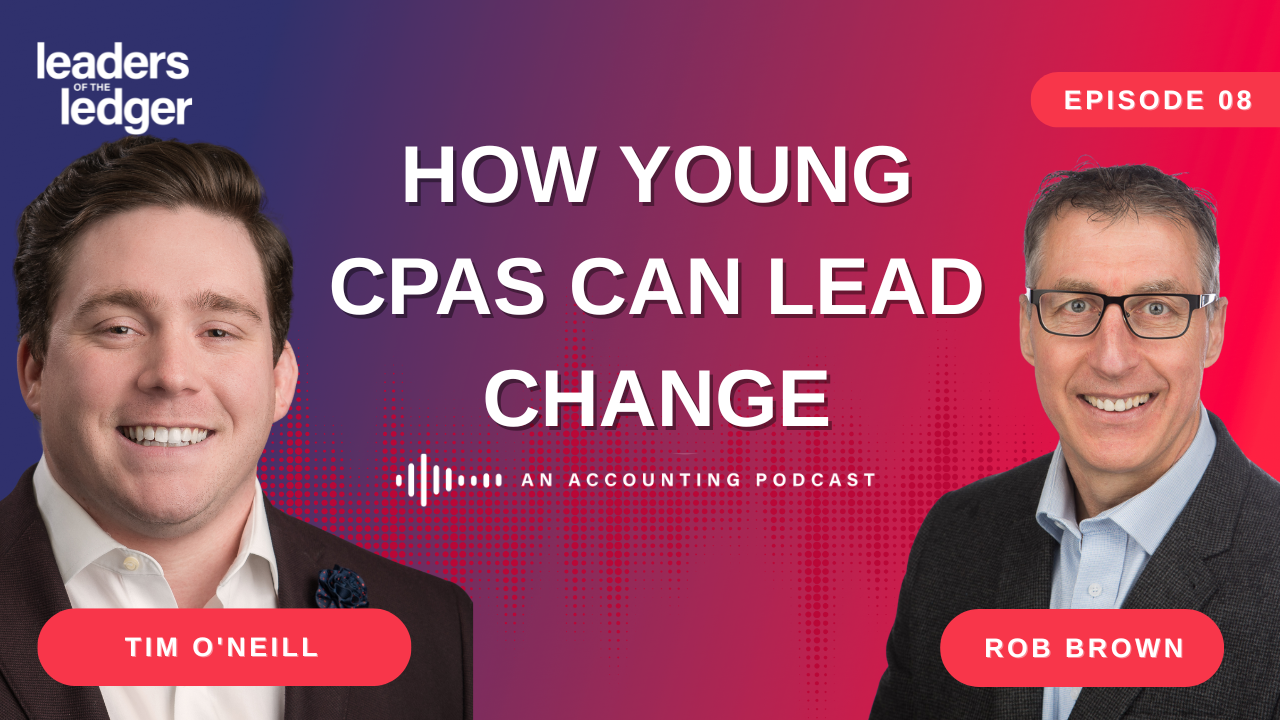



In this episode of Leaders of the Ledger, we sit down with Tim O’Neill, a senior manager at Wipfli LLP, to discuss how young professionals can build influence in accounting. Tim shares his journey from starting in a big CPA firm to becoming a thought leader in the profession, breaking stereotypes, and inspiring the next generation of CPAs.
Topics covered in this episode:
- How to build a personal brand while working at a big firm.
- Strategies to stand out and influence within the accounting profession.
- Balancing technical expertise with leadership, empathy, and innovation.
- Opportunities for young professionals to shape the future of accounting.
- How CPAs can leverage thought leadership, state societies, and networking.
Whether you’re an aspiring CPA, a young professional in finance, or someone interested in leadership and influence, this episode offers actionable insights to grow your career and make a difference.
Don’t forget to like, comment, and subscribe for more episodes on accounting leadership and innovation!
Leaders of the Ledger spotlights innovators, firm leaders, and rising stars shaping accounting’s future with practical insights and proven strategies. The podcast is produced and owned by CPA Practice Advisor. Learn more about episodes and recaps at https://www.cpapracticeadvisor.com/podcasts/.
Or use the below podcast play to listen:
Transcript (Note: There may be typos due to automated transcription errors.)
SPEAKERS
Tim O’Neill (Speaker 1) and Rob Brown (Speaker 2)
Speaker 1 (00:00.142)
If you have thought leadership, if you have a topic you’re passionate about, and you don’t have to, I’m not saying go out and speak in front of 500 people for the first time you ever do it, right? Write an article.
listeners of this show will know that I’m basically nottingham home of Robin Hood here in the UK this is an international show and accounting is very much an international profession so just give us a little bit more on you your role your job your firm team give us some context
I’m on the tax side, I’m a senior manager based out of St. Louis, Missouri in the U.S. I work for Whitley LLP, we’re top 20 CPA.
So I’m interested that you’re working in a big firm because a few people would have on the show, Tim, they sail their own ship, they manage their own firm, they maybe come out of working for a big firm.
when somebody tells me, hey, you did a great job. And so really trying to stand out in a professional setting, I started early on really trying to break the stigma at CPA.
Speaker 2 (00:51.896)
We are thrilled to bring you another episode where we shine a light on an individual that is moving and shaking, Tim O’Neill. Good day to you.
Good day to you, Rob. Thanks for having me.
Speaker 2 (01:06.478)
Who are the influential people in accounting? There are a few of them because it’s such a noble profession making a really big difference in the world. This is Leaders of the Ledger, I’m Rob Brown, your host. And on behalf of CPA Practice Advisor, we are thrilled to bring you another episode where we shine a light on an individual that is moving and shaking and disrupting things in the accounting world. We’re delighted to have with us Tim O’Neill. Good day to you. Tim, CPA, what is so good about you?
Good day to you, Rob. Thanks for having me.
Speaker 1 (01:32.66)
Where do I start? you’re asking my wife, think she would give you a different answer, but I’ll give you my answer. What is so good about me? I am always looking to better myself. I’m always looking to better others. I’m sure we’ll get into this at some point, but one of the huge opportunities that I see in this profession is for future leaders. We have a lot of individuals that are aging out of the profession, if you will, closer to retirement age, and it is the perfect time.
for some of our yoga professionals to step up and fill their shoes.
So speak. in many ways, you’re one of the younger professionals. Many, as you say, accountants are at or close to retirement age. So there’s this new way of coming through that have a chance to do things different. So just give us a little bit more on you, your role, your job, your firm, Tim, give us some context here.
Yeah, absolutely. I’m on the tech side. I’m a senior manager based out of St. Louis, Missouri in the U.S. I work for Whitfley LLP, our top 20 CPA firm, advisory firm. doing this going on 12 years now. So straight out of college, started with a firm called Miller Pros here in St. Louis, and we were ultimately acquired by Whitfley a few years back. A great Midwest based firm. enjoy it.
I’ve been on the tax side my entire life. said my entire professional life, dabbled in some other stuff, but I always got back to the tax fabric because it really is just, it provides so many opportunities to be consultative and really add value to clients. So I’ve always enjoyed that. Outside of professional life, I’ve married, I’ve got three awesome young kids, six, four, and one. I live out in the suburb of St. Louis and…
Speaker 1 (03:05.816)
keep busy. We were talking a little earlier before we started, but a huge rugby fan, a big Ireland rugby fan. We’ve got the British and Irish Lions going on right now. We’re touring Australia, so I’m staying tuned with that. The weekends I keep busy. We’ve, we’ve got a nice little house out here with some land. So I’ve got bees and chickens in the gardens. Everything’s a DIY project. So spare time is hard to come by. That’s a watch set.
You only need to a couple more children you got enough for a seven-a-side rug between there so you’re
That’s two youngest are boys in their absolute cruisers and they have perfect Irish rugby names for you Rory O’Neill and Cullum O’Neill
Well, the regular viewers, listeners of the show will know that I’m basically not seeing a moment of Robin Hood here in the UK. This is an international show and accounting is very much an international profession. So I’m interested that you’re working in a big firm because a few people we’ve had on the show, Tim, they sail their own ship. They managed to run firm. They may become out of working for a big firm.
And in that respect, they do find it easier to build a personal brand to raise their reputation, to be known for things, but you found a way to have yourself a voice, to create a platform, to be a little bit more well-known within the constraints of a bigger firm. Have you done that intentionally?
Speaker 1 (04:14.574)
Yeah, absolutely. I’ve always been one that doesn’t necessarily shy away from the limelight, if you will. I don’t know if this video will show, but I’ve got a couple guitars on the wall here. We can see…
I that,
musician, any chance I can get, if we talk about predictive index, think I’m what they call high C. I’m a golden retriever essentially. I’m constantly looking for pets. I love acknowledgement. That’s what really drives me is when somebody tells me, Hey, you did a great job. And so really trying to stand out in a professional setting, I started early on really trying to break the stigma at CPA.
has. was always under the impression before I got into accounting that I was, gave a certain stereotype of not being the most social and being very good with math. I have completely broken the plus I’m extremely social.
That’s a well-earned stereotype, it Tim? You need those skills.
Speaker 1 (05:05.922)
You do the math, the hit or miss it’s, it’s more analytics, puzzle solving. I always loved when the college professor said, you need to understand this because you won’t ever have a calculator. You don’t always have a calculator in your pocket. Well, fast forward, we, that’s all we have in our pockets. But yeah, from a really early point in my career, I wanted to be a driver for change. And I knew that I was kind of an anomaly. Wanted to use my.
good personality traits to be a better leader, be a better direct report, be a better mentor, be a better peer, and really just drive the profession and my organization forward.
I looked at that accounting is not a career choice you make to drive change. It’s not necessarily is it? It’s safe, it’s risk averse, it’s binary, it’s black and white, yes or no. And I can’t believe at 15 you thought I want to change the world. I’m going to be an accountant.
Yeah, it’s, well, I got into accounting by kind of by luck. I wanted to do something with music. I wasn’t sure what it was, but I wanted to do something. I would say I would have loved to have been a rest. You know, it was anything from choir teacher to, you know, film score composer to music journalist. I ended up taking an accounting class in university and it was, it came very easy to me. I saw a lot of other students that I had known previously that really struggled with it. They were, were smart individuals.
You want to
Speaker 1 (06:26.594)
And it came naturally and kind of, you mentioned, Robbie, you think back to him, it’s like, I’ve always heard this is a safe career path. I’ve always heard that they make a good living. So let’s ride it out and see what happens. And, here we 15 years later, it really was luck. And you’re absolutely right though. It’s not a career that you think of when you ask yourself the question, what profession can I get into and to really be this change champion?
Well, I’m fascinated that you said tax, but you speak very passionately about what you do. Tax is not known for its exciting status. So a big up tax for us. What’s so cool about it?
Again, taxes, just one of those things that Jen earlier, I love acknowledgement. So that’s what really, when I get a feather in my cap, that’s what makes me think to myself, okay, this is good. It’s all worth it.
all long for that recognition, we? That validation that we’re doing something good, we’re making a difference.
Yeah. And to put it in kind of a professional context, tax, you can be very consultative and really provide value to clients where in some other, call them service lines, some of those other service lines, like an audit or maybe some more of the consultative work, there’s not a ton of value add. A lot of it has to be transactional sometimes. And don’t get me wrong, there are plenty of times where tax can be.
Speaker 1 (07:45.368)
transactional, but when you find that planning technique or you find that accounting method change that results in a good tax implication, you communicate that to the client and they communicate their appreciation for your time and for the analysis and really going the extra mile to be an advisor. That’s what really, again, it’s why I get up in the morning and log on is to try and find those.
It’s such a win, completely get that. The audience does too. However, compliance is still the bread and butter of the accounting rule. Obviously there’s a push into those advisory services and that’s where the future is. I just wonder about the brand of accounting because we don’t sell it well enough to speak about the wonderful interest in projects and advisory stuff that you’re getting involved with, we?
Yeah, we really don’t. One of the kind of highlights of my career so far is I was really fortunate to be involved with the AICPA Leadership Academy back in 2000 and really opened a few doors with the AICPA specifically.
with some of their volunteer committees. So I was the chair of the student recruitment committee and I’m the current chair of the academic executive committee. And the real mission of both of those is advocacy, professional advocacy for young and aspiring CPAs and trying to expose students to the profession much earlier. Because again, kind of in my own personal situation, accounting was, it never was really an option and it wasn’t necessarily out of disinterest. It was just out of.
pure ignorance. I had really no idea about the profession. I didn’t grow up knowing any accountants. My parents were accountants. I didn’t know any accountants. It just was never really in my ecosystem. And I think we could do a much, much better job at getting students introduced to the accounting profession earlier, whether that’s middle school and high school. That’s kind of the target right now. Even in college, you know, there are the sexy majors, if you will.
Speaker 1 (09:39.762)
that a lot of people will lean into. I just don’t think that, again, it kind of gets back to the accounting, the stigma behind it, but I don’t think students really understand the breadth of the roadmap. Once you get into accounting, is just, there are so many different paths.
had another show called Accounting Influencers where I talk about what accountants need to do to be more relevant and influential and I’m branded in their roles. And I had on as guests, Lexi Kastler and Sue Coffey to talk about the Talent Advisory Pipeline Committee. And you’ll be familiar with that. We talked a lot about the brand of accounting. What could we do better?
make accounting more attractive at all levels because it’s not just the people we want to get in at the bottom end. It’s for people to stay in. We know they’re leeching out of accounting, going into tech and industry. We know people are getting a little bit disillusioned with the grind and the busy seasons and everything else. So what can we do to brand it better, Tim in your eyes?
Yeah, that’s a great question. And I’d probably tell this story three or four times a year in different settings. Yeah. So with the ASCPA leadership cadmium back in 2016, we had the chance for Barry Polonson to come in and talk with our group. Basically, you know, he called it a fireside chat as well. Great individual. Barry was so…
And it’s great that you are!
Speaker 2 (10:52.92)
good for.
Yeah, it just is super personable again, kind of breaking that accounting stereotype. One of the questions that we had asked him was kind of along the same lines. How do we get people into profession, keep young professionals in the profession and really expand their longevity? And I might butcher this story, so Barry, I apologize if you’re hearing this, but when he was a young professional, he actually started in public accounting from Louisiana and he was invited out to lunch by, I think it was one of the partners and maybe the managing partner of the firm.
essentially told him exactly how much money he makes or how much money you can make in that firm. And he said, it is so important to shed a light on that for young professionals, for young and aspiring CPAs on how financially rewarding it can be to be.
a CPA, he’s like, you know, the, the partners, the CFOs, the houses they have and all the boys that they have, you know, a lot of it kind of comes with the territory and the stereotypes, but some people keep that pretty tight to the chest. you know, the exposure around that and seeing what hard work, you know, how it actually pays off, because some people are driven by that and it kind of brings up another challenge. know, what makes these.
younger professionals tick because what I might find important as, you know, a 20, when I was 23 years old and kind of where I wanted to go and how I wanted my life to look, it might be completely different than how a 22 or 23 year old is now. The financial aspect was a massive piece of that puzzle for me.
Speaker 2 (12:21.16)
Well let’s just examine the finances for a moment. Sure, if you’re in a big firm or you get to partner in a top four, you know you’ll make a few million dollars. However, the starting salaries for graduates are not great. They don’t compare well with say the legal profession or some tech rules. So is that part of the jigsaw puzzle here Tim?
Absolutely. And I think you could probably have an entire session just talking about that particular topic. And I’m not totally familiar with what the starting salary is nowadays. I know when I started 15 years ago, I think my salary right out of school was about $52,000. So about $1,000 a week. I’m sure it’s probably closer to in the 60s, low 70s now. forgive. Yeah.
Maybe 80 if you get a really good opportunity, it will be north of a hundred thousand if you’re in law.
Yeah. Well, law and also engineering is one that think we really, engineering and information systems are two professions that I think we really butt heads with in terms of attracting talent at the collegiate level because engineering and information systems starting salaries are similar, if not better than accounting.
generally speaking, they require one last year of formal education. If we’re talking about the CPA route, we have the 150-hour requirement, which again, there’s probably another entire episode that you could go on on that debate. But generally speaking, that’s one year less education that the student has to go through. And their starting salary is, comparable. It’s not more than it would be in accounting.
Speaker 2 (13:52.334)
So it brings us to the point where advocacy is hard. you’re saying there are opportunities where accounting can be financially rewarding. Yes, there are. There’s no doubt, but that’s more at the top and middle end. So you’ve got to get through a few years, a bit of grind, not necessarily chained to a desk in the dark room in the hope of making partner, but you’ve got to serve your time until you can get to those points. And these generations coming through, they don’t have that patience, do they Tim, for that game?
No, they don’t. think one that I think the accounting world can do better and it has gotten better, at least in my career. One of the things that we can do better is kind of abolishing the hierarchy. We’re talking about advancement within an organization.
partnership model and the hierarchical structures or the comp structure or something.
Again, probably you could have an entire session on that as well, but I’m speaking specifically to the hierarchy of, know, we love our numbers and we love structure. so, you know, for instance, you might be, say you’re in a public firm and you start as a staff. Well, you have to be a staff for two years before you can make senior. And then you have to be a senior for two years before you can make the next level. And then you’re there for two years before you’re manager. And it’s all very structured based on.
If I have a high performer, a high potential individual that’s checking all the boxes and doing everything right, I don’t want to be handcuffed to this two year timeframe to promote them to senior or to promote them to manager. they’re doing everything or close to everything from a responsibility standpoint that they would be at that level. And that’s one thing that I think, you know, one of the things I really love about Whitfield is I think we do.
Speaker 1 (15:26.446)
Well with that, I think we’re very good about rounding up and saying this person is doing everything right. Let’s round up. Let’s give them a shot. I’m not worried if they’ve only been in this role for one year, if they’re performing at that next one. And so that’s where the impatience comes in with, some of the younger professionals is while I’m doing everything that, you know, this person at the next level up is doing, but I am kind of again, tied down to that. It’s a, it’s a tenure thing.
people that way. Well, you’re an excellent advocate for the profession. What are the kind of things that you’re passionate about? You’ve hindered attacks and the data analytics side of it, but you’ve made a name for yourself. You’re outing about things. You’ve been vocal about things. You’re putting yourself out there. Just tell us how you built your personal brand of it.
It really started just when I first came into public accounting, I worked with individuals that were just so, they were so unfaltering from a leadership perspective. They were some of the, you there’s one person that comes to mind, Doug, one of the best tax minds in the country and just an all around great guy. Great. did. He shaped, would, I would go off on a limb and say that he shaped everybody in our firm. Everybody wanted to be at Doug Moore because he was, he used to
perfect combination of just high technical tax expertise and high social presence. Just those two.
at school that really switches subject on for you, isn’t it?
Speaker 1 (16:46.818)
Yeah. And there’s so, you know, I, been involved on the recruiting side for a long time and there are so many students that I talked to that they end up falling in love with accounting, so to speak, because of a class that they took. And it wasn’t necessarily the content of the class, but it was, it was the professor. It was the professor that really, it really drove them to the profession. And we need, you know, talking about the talent pipeline, we need more professors that are really passionate about.
accounting and that’s where the academic executive committee that the ASCPA has, that’s where we kind of bridge the gap between academia and professionals in either public or industry to really kind of make sure that we’re not leaving any stones unturned. How can we continue to build that pipeline?
He was pushing you on tell us how you you started to come out yourself and be almost a spokesperson for what you’re doing. He’s
He’s an extremely charitable guy, very charitable, always looking to give, whether it’s time or services or, you know, he’s always looking to take care of people and really instilled the importance of giving back, no matter what the cause was, but giving back if you’re able to. And I’ve just been presented so many opportunities to give back to the accounting profession, be it through the AS EPA or through the state society, that kind of, that’s been my calling from a community service standpoint.
It’s not looked though, Tim, that you’ve been presented with those opportunities. You’ve earned those. Nobody’s come to you randomly and said, Hey, will you come and sit on this committee or will you come and speak about this? So you must have been vocal and passionate and putting articles out there and thought leadership and speaking to anybody when you could.
Speaker 1 (18:25.486)
You know, luck is when opportunity meets preparation, right? So it was a perfect combination of seeking the opportunities because I wanted to break that stereotype and that stigma. Absolutely. I had stuff that I wanted to say and realistically what I had to say was really, hey, is a good place to be. This is a good profession. This is what we need. One of the things that I love tax, we could talk.
You had stuff you wanted to say, right?
Speaker 1 (18:55.202)
texts all day long, but one of the things that I probably submit more thought leadership related to is leadership and how we can become better, more human centered leaders because that’s what we need right now to strengthen the profession and make sure that we’re attracting and retaining top 10 elements.
I’ll ask you what makes a good leader in a minute, but the big question here is you’re working in a firm, you’ve got billable hours to make, you’ve got bosses, you’ve got accountability there. Thought leadership is not chargeable. Networking is not billable. Nobody gets paid to attend these committees and forums. It might be good for Tim O’Neill, but is it good for the firm? Is it good for the bottom line? So how do you justify this? Or have you just got really great taskmasters that said Tim go and do whatever you do. No problem with the billable.
I guess that depends on who you talk to.
But it is discretionary, isn’t it, this personal branding stuff?
It is, and you know, I’m very fortunate that Whitley is very understanding when it comes to the importance of personal branding, the importance of getting back to the profession. You never know where the next meal is going to come from in terms of growth, right? In terms of ROI. One of my mentors a long time ago said, you know, a billable hour is important because it’s a dollar for me today, but there are plenty of non-billable hours that are just as important because it might be $2 to me tomorrow. Very firmly.
Speaker 1 (20:17.174)
believe in that. so building your personal brand and building your network, again, you never know if we’re just talking about growth, right? If we’re just talking about new business development, you never know where the next one’s going to come from. just to expand that network, that professional network, whether it’s through state societies or through involved with the Rainmaker CPA group, you you never know where it’s going to come from.
Continue.
Speaker 1 (20:43.51)
There is sure there comes, there comes a point where you have to do kind of a look at the ROI and make sure that you’re working at your highest and best use. And the clients come first, Billable hours are important. We need to make sure that our clients are being serviced as, as best as they possibly can. And, and we’re extremely responsive, but it’s a, it’s a balance.
You’ve clearly got a culture there though, Tim, where the firms, the leaders above you see that if you are out there, you’re an ambassador of the brand. You could be opening doors. And although you’re in career terms, feathering your own nest and building your own network, you’re also, every time you appear, you’ve got the firm’s name right there right next to yours. So that’s good for them. What makes a good leader these days? Has that changed over the years? Could I have asked you this 50 years ago and got a different answer?
Absolutely,
Speaker 1 (21:30.21)
You probably could have, and it’s so funny. I talked about the ASCP Leadership Academy and when I was applying that was one of the prompts was something along the lines of what is a future leader going to need to have or be to be successful in the next 10 or 15 years. And I, it’s funny because I actually revisited that about a year ago. I have it saved somewhere on my computer and I was reading it and I thought to myself, boy, did I hit the nail on the head? Cause this was pre COVID. then it talked about.
Yeah, I was talking, it was talking about leading virtual teams and really leveraging technology correctly. And I still think that’s extremely true, but to be a good leader, it really comes down to authenticity. You have to be authentic. You have to be empathetic. You really have to understand that there’s not a one size fits all to leadership.
What drives one person may not be the same driver for another person. So really customizing your approach as a leader, but building authentic relationships and rapport. is absolutely number one.
You’re talking about attributes there Tim that don’t sit naturally in the accounting skillset because it’s highly technical. You’re very driven. Accountants are introverted by nature, by and large, when you’re very unusual, you’re against the grain there.
Are we asking too much of modern day accountants that they’ve got to be technically strong? They’ve got to be masters of technology and AI now too. They’ve got to be great at selling. They’ve got to be empathetic. They’ve got to be counselors and therapists and psychiatrists and friends and shoulders to cry on. They’ve got to be authentic and keep it real. They’ve got to put thought leadership out there and build a brand. Are we asking too much?
Speaker 1 (23:07.074)
No, you’re just asking that of me, I think. I don’t think we’re asking too much because the one size fits all approach to leadership is also, you can say the same thing about being leader. There’s not a one size fits all. One of the things that I think we really do well as a firm is we recognize that people have strengths and people have weaknesses. The person that might be a great business developer might not be the most technical person. The person that’s the extremely technical person might not be the best business developer, but we don’t measure them on the same scale.
We don’t lump them into the same group and say, here’s, here are the metrics that both of you need to hit. This is your new business development goal and this is your billable hour goal. You know, they would have an issue, vice versa. And so by customizing it and really finding people’s strengths, letting them roll with that. That’s, know, we don’t need to be a specialist or an expert in any of this stuff because, and I’ll tell you right now, yeah, I’m technologically savvy. Don’t get me wrong, but when it comes to AI and some of this new cutting edge.
like that’s not my space, but I’ll tell you what, I’ve got four people that I know that they love that, they eat that up. And you know, I have questions, that’s where I utilize them. Need to be the experts. We just need to know who our resources are internally and externally.
Yeah. Couple more quick questions. We’ll wrap this up, Tim. Really enjoyable talking to you because you just use a lot of passion about what you do. Give us one sure fire prediction that you feel is going to happen over the next few years in this accounting game.
One surefire prediction. I’m gonna be prophetic again. is an easy one. I don’t wanna go. I wanna go with that one.
Speaker 2 (24:42.242)
I don’t mind you going with it, you’re going to be specific about something.
No, because I said, told you I wasn’t too, I wasn’t too, I know nothing, know know I know I I I
doing that now, aren’t they? You’re thinking more so. through that a minute. What’s your rationale? Just talk us through that a little bit. What’s your rationale for saying that?
Yeah, absolutely. I was saying, I’m sorry, Rob.
Speaker 1 (25:09.27)
I just think that we’ve already seen it in the industry and it’s going to increase because I think there’s going to come periods for a lot of firms of all sizes that they’re either going to hit a natural stagnation point.
from a growth perspective or maybe some of the smaller firms. We talked a little bit about kind of the current leaders and they’re starting to age out. I think a lot of them don’t have succession plants. And I think it’s just ripe for opportunity for private equity or acquisition. think gone are the days of mid-size, small to mid-size CPA firms. I think there’s going to be a huge gap between the mid-size and large regionals and the mom and pops. don’t know how long that’ll be, but I think there’s going to be a huge gap.
Yeah. Well, you called it here. We’ve got that on record. question, Tim, what advice or words of encouragement would you give to people tuning into the show that do feel they need to be a little bit more vocal and visible? They want to be more influential. They want a voice. They’ve got things they want to share, but they perhaps don’t know how to start or they’re scared of what people might think if they put themselves out there. What would you say to them?
vulnerable. There is nothing wrong with taking a shot, right? You miss 100 % of the shots you don’t take. Be vulnerable. Put yourself in a vulnerable position. If you have something to say, if you have thought leadership, if you have a topic you’re passionate about, and you don’t have to, I’m not saying go out and speak in front of 500 people the first time you ever do it, right? Write an article. There are so many industry publications, state society publications, are online blogs, you name it.
that are constantly looking for thought leadership. Especially one of the things that CPAs have a very distinct advantage is that we’re high trust. The society, when you tell somebody you’re a CPA, they’re like, there’s a really high level of trust. And so you kind of already have that street cred with those couple letters behind your name when you put together something from a content standpoint and share it. So be vulnerable.
Speaker 1 (27:07.458)
something that you’re really passionate about and explore the avenues of how your voice can be heard. And then it goes without saying, get involved with your state society, if possible. Get involved with any professional society, AICPA, SEMA, whomever, because there are just so many opportunities, not only to give back to the profession, but to grow and expand your network. Plenty of opportunities for thought leadership. I’m sure I wasn’t at Engage this past year. They’re rob.
but it’s a great opportunity. They’re always looking for speakers and content. so yeah, be vulnerable. something that you’re passionate about to make your voice heard.
This is leaders of the ledger on behalf of CPA practice advisor. We’ve been talking to Tim O’Neill today as one of the influences that is shaping the future of accounting and changing it right now. It’s been a privilege to hear your passion and your insights. Thank you so much for joining us today.
My honor. Thanks, Rob. I appreciate you having me.

Thanks for reading CPA Practice Advisor!
Subscribe Already registered? Log In
Need more information? Read the FAQs