



The system most firms have filed through since the 1990s is gone. What replaces it is not a new login—it is a different application, a different file format, and in some cases a different certification.
The short answer
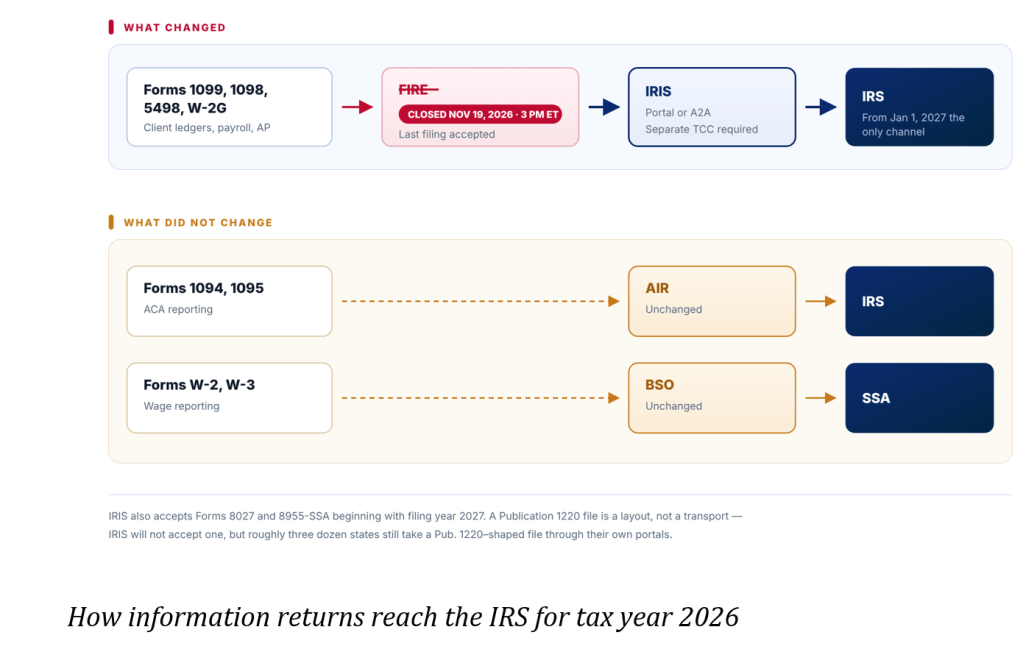
- FIRE accepted its last information return at 3 p.m. ET on November 19, 2026. There is no extension and no grace period.
- From Jan. 1, 2027, IRIS is the only electronic filing system for information returns—current year, prior year, and corrections alike.
- A FIRE Transmitter Control Code does not carry over. A separate IRIS Application for TCC is required, and the IRS quotes 45 business days as typical processing.
- ACA and W-2 filings do not move. Forms 1094/1095 still go through AIR; Forms W-2 still go to the Social Security Administration.
- Publication 1220 did not die with FIRE. It is a file layout, not a transport, and roughly three dozen states still accept a Pub. 1220-shaped file through their own portals.
Most of the commentary on this transition has treated it as a migration—same work, new address. That framing is what will cost firms time in January, because four of the five things that change are not the submission step at all.
What follows is the sequence that matters for a firm filing on behalf of clients, the distinctions that are routinely conflated, and an honest account of where the schedule is now uncomfortable.
What actually closed, and when
Three dates closed in sequence during autumn 2026, and firms that watched only the last one lost their options early.
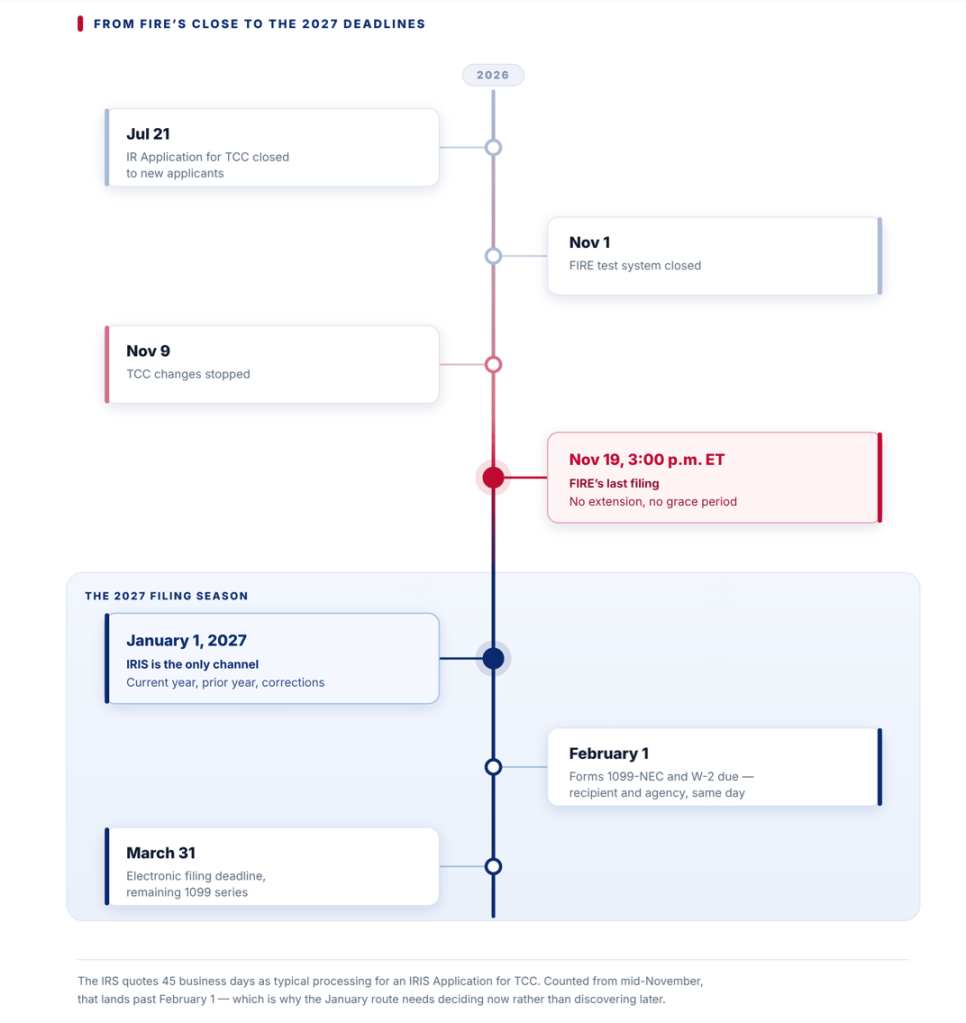
The FIRE-to-IRIS timeline
The IR Application for TCC—the FIRE-era application—stopped accepting new applications on July 21, 2026. FIRE’s test system closed on Nov. 1. TCC changes stopped on Nov. 9. And the production system accepted its final return at 3 p.m. Eastern on Nov. 19, 2026.
The IRS language on what follows leaves no room:
“IRIS will be the only information returns electronic filing system, including current year, prior year, or corrections, after January 1, 2027.”
Read that second clause carefully. It is not only tax year 2026 returns. A correction to a tax year 2023 return, filed in March 2027, goes through IRIS as well. Any firm holding open corrections has them on the new system whether or not it files a single current-year return there.
The TCC is the critical path
Everything else in this transition can be solved in an afternoon. The Transmitter Control Code cannot.
The IRS states in Publication 5903 that “the typical application will be processed within 45 business day[s].” Forty-five business days from late-November may land past the Feb. 1 deadline for Forms 1099-NEC and W-2. Firms that applied in September or October have allowed more time for processing. Firms applying now should allow for that processing window and have a fallback filing route ready.
There are two honest responses to that position, and firms should pick deliberately rather than drift:
- File through a provider that already transmits to IRIS: The provider’s TCC is used, not yours, so there is no application, no processing window, and nothing to migrate. This is what most small and midsized firms will do, and the decision is usually made by the calendar rather than by preference.
- Apply anyway, and have a fallback for January: An application submitted in November may well clear in time. But the firm needs a route that does not depend on it, decided now, while there is still time to onboard clients onto it.
A third option that is not an option: paper. The electronic filing threshold is 10 or more information returns of all types combined, counted in aggregate across 1099s, W-2s, 1095s, and the rest. Almost every firm is past it for almost every client.
Small businesses, accountants, and tax pros can file 1099 forms online directly through the IRS’s free IRIS Taxpayer Portal or through an authorized e-filing provider. Either route should be paired with a separate check of whether a given state requires its own submission, because federal filing alone does not necessarily satisfy state reporting requirements. Filing with third-party providers—usually do not require TCC.
Issuer or Transmitter—and why you cannot be both
This is the single most common error on the application, and it is a structural one rather than a typo.
| Role | Who it is for | Can it file for clients? |
| Issuer | A business transmitting information returns only for the company named on the application | No |
| Transmitter | A third-party business transmitting on behalf of its own company and/or other businesses not named on the application | Yes |
| Software Developer | A business writing software that transmits through A2A | n/a — can be held alongside Transmitter |
Publication 5903 is explicit that an applicant “must select one or more roles but cannot select both ‘Issuer’ and ‘Transmitter.’” A firm filing for clients is a Transmitter. A firm that selects Issuer because it is, after all, issuing returns, has applied for the wrong thing and will discover it at the worst moment.
The authorized-user requirements catch people too. Part 3.5 of Publication 5903 requires at least two responsible officials unless the applicant is a sole proprietor or single-member LLC, permits zero to two authorized delegates, and requires at least two contacts. Every responsible official must sign the submission with a five-digit PIN; until all of them have, the application sits at “Signature Required” and no TCC is issued.
One practical warning worth repeating because it is so easy to trip over: a P.O. box is not accepted as the business address. And government agencies or divisions sharing a single employer identification number may hold only one IRIS Application for TCC between them.
A note on the publication itself: Part 1 of Pub. 5903 gives different minimums from Part 3.5—one responsible official rather than two for sole proprietorships, S corporations, and single-member LLCs, and a contact maximum of 250 rather than 50. The two parts have not been reconciled in the current revision. Where they disagree, apply the stricter reading and keep a note of why.
Portal or A2A
The IRIS Taxpayer Portal is a web application: sign in, key in or upload returns, transmit. Application-to-Application is a machine interface that accepts XML from authorized third-party software.
Each role and transmission method is issued a separate TCC. A firm that wants both routes applies for both. A firm that wants only one should say so, because selecting a method you will not use adds nothing and can add questions.
A2A carries a second gate that the portal does not: an IRIS Technical Conformance Certification before the schema package is released through the Secure Object Repository. Any firm planning to transmit its own XML should treat the TCC and the certification as two separate items on the critical path, not one.
For most practices the portal is sufficient, and for most of the rest the answer is a provider’s A2A connection rather than the firm’s own.
What does not move
A good deal of the anxiety around this transition comes from assuming IRIS swallowed everything. It did not.
| Return | Channel for the 2027 season | Changed by the FIRE closure? |
| Forms 1099 series, 1098 series, 5498, W-2G | IRIS | Yes — this is the migration |
| Forms 1094-B/C and 1095-B/C (ACA) | AIR | No |
| Forms W-2 and W-3 | SSA, through Business Services Online | No |
| Forms 8027 and 8955-SSA | IRIS, beginning with filing year 2027 | New to IRIS |
The W-2 line is the one that surprises people every January. W-2s have never gone to the IRS for e-filing; they go to the Social Security Administration, on a different system with a different credential. Nothing about the FIRE closure changes that, and a firm that lets its BSO access lapse while concentrating on IRIS has solved the wrong problem.
Publication 1220 is not FIRE
This distinction is worth being precise about, because getting it wrong is expensive in either direction.
FIRE was a transport. Publication 1220 is a file layout—a documented fixed-width specification, 750-character records, types T, A, B, C and F. The two traveled together for so long that they are often spoken of as one thing, and they are not.
IRIS does not accept a Pub. 1220 file. That part is real, and it is why an export-and-upload routine built over years of FIRE seasons does not carry forward.
But roughly three dozen states accept a Pub. 1220-shaped file through their own portals, and those channels have no dependency on FIRE whatsoever. They keep working. A firm that concluded its Pub. 1220 export tooling was now worthless has thrown away the most reusable asset it had for state filing.
The same point applies to historical data. A FIRE file from a prior season is still a documented, parseable record of what was filed—payer records, payee records, state totals. It can be read back into a spreadsheet rather than rekeyed. (A free browser-based FIRE file converter will do this without uploading anything, which is useful for firms that want last season’s data back in a reviewable form.) Watch leading zeros on taxpayer identification numbers and ZIP codes when the result reaches Excel.
The 2027 calendar
Three dates shift this season because of where they fall.
| What | Date | Why it moved |
| Forms 1099-NEC — recipient and IRS | February 1, 2027 | January 31 is a Sunday |
| Forms W-2 — employee and SSA | February 1, 2027 | January 31 is a Sunday |
| Forms 1099-MISC — recipient, with box 8 or 10 | February 16, 2027 | February 15 is Washington’s Birthday |
| Information returns — IRS, on paper | March 1, 2027 | February 28 is a Sunday |
| Information returns — IRS, electronically | March 31, 2027 | No shift |
The 1099-NEC remains the trap it has always been: unlike most of the series, electronic filing buys no additional time. Recipient copy and IRS copy fall on the same day, and that day is the first one.
Worth flagging for client conversations in the same season: for payments made during 2026, the reporting threshold for nonemployee compensation rose from $600 to $2,000, indexed after 2026. The old figure still governs tax year 2025 forms—which are the ones filed in January 2026. One January, two thresholds, depending on which year the payment landed in.
A readiness checklist
- Establish which TCC the firm holds, if any, and for which role and method. A FIRE TCC is not an answer to this question.
- If an IRIS application is in flight, check its status for “Signature Required.” Applications stall there silently when one responsible official has not signed.
- Decide the January route now—your own TCC or a provider’s. Then onboard clients onto it before the holidays, not after.
- Confirm ACA and W-2 credentials separately. AIR and BSO access are not covered by anything done for IRIS.
- Keep the Pub. 1220 tooling. It still serves state filing, and it still reads historical files.
- Count returns in aggregate per client against the 10-return threshold, not per form type.
- Identify open prior-year corrections. Those move to IRIS on Jan. 1 regardless of current-year plans.
The firms that will have an uneventful January are the ones that treated the TCC as a procurement item in September. For everyone else, the useful question is no longer whether to migrate—it is which of the two honest routes to take, decided this month rather than discovered in the third week of January.
Frequently asked questions
Q: Can I still file through FIRE for tax year 2026?
A: No. FIRE accepted its final information return at 3 p.m. ET on Nov. 19, 2026. Tax year 2026 returns are filed during the 2027 season, entirely through IRIS.
Q: Does my FIRE TCC work for IRIS?
A: No. A separate IRIS Application for TCC is required, and each role and A: transmission method receives its own TCC.
Q: How long does an IRIS TCC take?
A: The IRS states that a typical application is processed within 45 business days. Applications submitted in late November are unlikely to clear before the February 1 deadline.
Q: Do W-2s go through IRIS now?
A: No. Forms W-2 go to the Social Security Administration through Business Services Online, as they always have. The FIRE closure does not affect them.
Q: What about ACA forms?
A: Forms 1094 and 1095 continue to go through AIR. IRIS does not accept them.
Q: Can I file prior-year returns and corrections through IRIS?
A: Yes—and after Jan. 1, 2027, only through IRIS. The IRS’s wording covers current year, prior year, and corrections.
Q: Is my old Pub. 1220 export tooling now useless?
A: No. Publication 1220 is a file layout rather than a transport. IRIS will not take such a file, but around three dozen states still accept one through their own portals.
Q: Do I need an IRIS TCC if I file through a provider?
A: No. A provider transmitting under its own TCC removes the application from your critical path entirely.
IRS sources
- IRS — Filing Information Returns Electronically (FIRE)
- IRS — E-file Forms 1099 with IRIS
- IRS — IRIS Application for TCC
- IRS — Publication 5903, IRIS Application for TCC tutorial
- IRS — Publication 1220, specifications for electronic filing
- IRS — General Instructions for Certain Information Returns
- IRS — Affordable Care Act Information Returns (AIR)
- SSA — Business Services Online
ABOUT THE AUTHOR:
Nazrul Huda is the founder of TaxFormHero, an IRS-authorized information return e-filing platform.
Disclaimer: This article is general information, not tax advice; filing requirements depend on the return, the year, and the jurisdiction.
Sign in to get access to this free resource, and all of our whitepapers and reports.

Download this content today!
Register Now Already registered? Click here to Log In