Despite technology advancements, accounting firms still use different tools for business growth. Your tax team may use CCH Axcess. On the other hand, your bookkeeping team works in QuickBooks. Client documents are in separate storage systems. Teams still have to email IT teams for incident resolution.
Each tool has its place. But more tools do not mean better operations. Your teams spend more time managing their work. Partners experience fewer operational lags. And handling more clients can mean adding more administrative work and overhead.
An Intuit Accountant Technology Survey found that 41% of accountants struggle with manual data entry because their systems don’t connect. Moreover, 66% say technology complexity is a burden.
For managing partners and firm owners, the dilemma is: Should they keep their old tech stack to support growth? Or prioritize the advanced one?
This is where ServiceNow deserves a closer look. It doesn’t replace your tax, audit, or bookkeeping software. Combines internal HR, IT, and other team services and workflows on one platform. That makes it a strategic option for firms looking to scale without letting operational complexity grow at the same pace.
Why Do Existing Systems Become Difficult to Manage as Accounting Firms Grow?
Growth adds revenue. It also adds complexity. Quietly.
At 50 employees, partners may have a clear view of operations. At 500, across offices and service lines, that visibility becomes harder to maintain.
As your business expands, you may discover:
- Growing demands from IT and employees: more onboarding, access to software, and less visibility into turnaround times for requests.
- Separate service lines: Tax, audit and bookkeeping teams with different tools and processes.
- Approvals in spreadsheets: E-mail and spreadsheets become the reason behind slow routine decisions.
- Bottlenecks that are not transparent: no view of pending requests, unknown owner of a bottleneck, and repetitiveness of a bottleneck.
- Inconsistent processes: Different standards between offices (especially with mergers).
Individually, these things look small. But, in reality, they add extra costs and limit scalability.
How Much Can Your Firm Lose If You Still Use Different Methods for Automation?
Siloed processes don’t just waste time. They reduce your firm’s earning potential. Lower billable capacity, margin pressure, and slower growth.
The 2025 State of Accounting Workflow and Automation Report by Financial Cents found that 55.5% of accounting firm owners still experience workflow inefficiencies.
For managing partners, that’s revenue capacity tied up in administrative work instead of client engagements.
How Can ServiceNow Help Growing Accounting Firms Manage Operations Better?
As your company grows, these internal bottlenecks can affect employee productivity and your cost and delivery timelines for your customers. ServiceNow is a service management platform with connected workflows to help you address these four issues.
1. Grant access to tax season app slowly: When your accountants are in the midst of a filing or audit cycle, they won’t have time to wait for software access. ServiceNow Service Catalog and Request Management enables employees to request access in a single portal. Automated workflows route and track requests for approval.
For a COO, that means fewer delays internally and more control of when the clients receive their work.
2. Onboarding employees slowly: You must involve different departments while hiring and onboarding new employees. It involves HR, IT, and office heads. ServiceNow HRSD, Employee Center Facilities, and (Apps Access/Approvals/Doc Storage) help your teams do the process smoothly.
For a CHRO, that means being agile, consistent, and streamlining the onboarding process.
3. IT teams wasting time on repetitive queries: Your IT team shouldn’t be wasting half of their day answering the same questions about accessing software, system issues, or how your internal processes work.
Knowledge Management and Virtual Agents from ServiceNow allow teams to answer their own questions or direct users to the right answers about how to do something.
This enables a CIO to free IT capacity for technology improvements that back growth of the firm.
4. Inability to see service costs and delays: You don’t have a clear view of where requests are stuck and aren’t able to see where you waste resources.
Service Level Management, ServiceNow Performance Analytics & Dashboards for request volume trends, request resolution speed, and service performance.
It gives CFOs a better understanding of operational efficiency and how to improve it in an effort to help them direct support cost spending.
When Should Accounting Firms Consider ServiceNow Implementation?
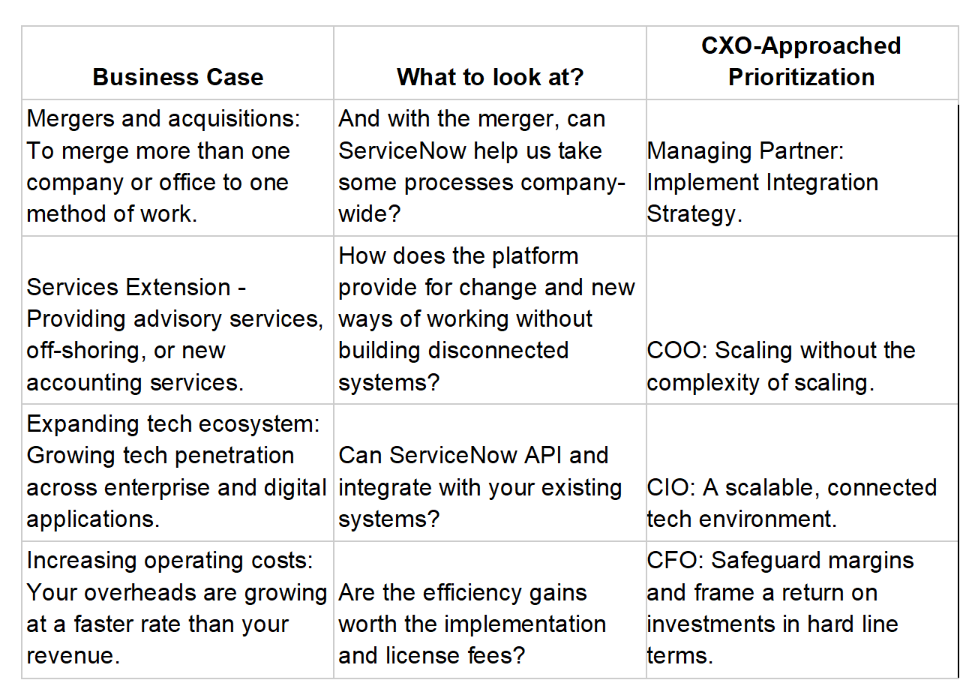
Timing is everything. ServiceNow is an enterprise platform; Only invest if it solves a business challenge that might hinder your company’s growth.
How Should Accounting Firms Choose the Right ServiceNow Implementation Partner?
Your implementation partner needs to understand not only ServiceNow but how accounting firms operate. Coordinated and perform system integration, platform customization, and workflow automation in an enterprise.
They also need to know accounting-specific strains like the race for tax season, audits, data privacy, multiple offices, etc. And most importantly, choose a partner who can balance the implementation with the operational priorities of your firm.
Prioritize Your Technology Wisely!
Growth exposes the weaknesses in your technology long before they appear in your financial results. If you treat ServiceNow as a strategic investment, you can build stronger operational control and scale with confidence. The real risk is not investing in the platform. It is allowing outdated processes to limit your firm’s next stage of growth.
ABOUT THE AUTHOR:
Max Smith is a Content Writer at Suma Soft, specializing in AI, enterprise technology, and digital transformation. He creates research-driven content that simplifies emerging technologies and highlights
Sign in to get access to this free resource, and all of our whitepapers and reports.

Download this content today!
Register Now Already registered? Click here to Log In
Tags: Accounting