CFOs are under increasing pressure to show returns from AI investments, yet productivity gains in most organizations are too marginal to materially impact financial performance or consistently lower headcount, according to Gartner, Inc., a business and technology insights company. Active governance is needed to redirect the additional workforce capacity towards measurable business outcomes.
“CFOs shouldn’t assume that AI productivity gains will naturally flow through to financial performance,” said Grace Gstalder, Senior Specialist Analyst in the Gartner Finance practice. “Unless organizations deliberately redirect the capacity AI creates most of that value will simply leak away.”
Understanding this is important as CFOs assess AI’s impact on workforce costs. While productivity gains are real, they don’t guarantee headcount reductions. In fact, a Gartner survey of 1,303 senior functional leaders, conducted from January 2026 through April 2026, found that some functions are adding roles as adoption increases the need for digital skills (see Figure 1).
Figure 1: Workforce Size Impact Across Functions as a Direct Result of AI
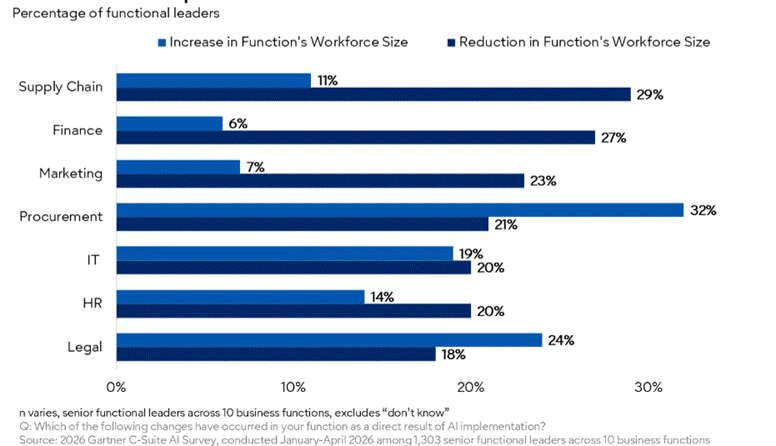
“Twenty-three percent of functional leaders reported a reduction in headcount due to AI, while 17% reported an increase,” said Gstalder. “There are forces pushing both ways with AI driving headcount reductions of staff with insufficient digital capabilities, while simultaneously increasing demand for talent with strong AI and digital skills.”
Gartner analysts advise that CFOs should stop viewing AI as a direct lever for headcount reduction and instead treat it as a catalyst for workforce transformation. The financial benefits of AI are unlikely to come through isolated labor cuts, but through broader changes to how work is structured, scaled, and delivered.
“Most organizations lack mechanisms to convert AI-driven efficiencies into financial impact. Doing so requires treating time savings as a governed resource,” said Gstalder.
Three Steps to Turn AI Time Savings into Business Value
Gartner analysts recommend that CFOs:
- Define high-priority business outcomes where freed capacity should be directed: CFOs should start a board-level discussion to identify where AI-generated capacity can create the greatest value and set clear expectations for how it will be deployed. These priority areas could include insourcing activities previously owned by third-party services or reallocating capacity toward revenue generating activity, better decision support, improved risk management, more accurate forecasting and stronger business partnering.
- Build time redeployment into performance management: CFOs should work across finance and the wider organization to embed expectations for using AI-generated capacity into team objectives and performance metrics. This means holding teams accountable for both generating time savings and showing how that time has been redirected toward higher-value work.
- Establish visibility into how productivity gains impact measurable financial outcomes: Looking at hours saved in isolation is not a true measure of AI’s business value. CFO’s need to understand what happens after the time is saved. This means connecting improvement in productivity to measurable outcomes, such as revenue growth, cost avoidance, improved forecast accuracy, faster decisions or reduced risk.
“AI-generated capacity is a resource, not a return,” said Gstalder. “Without active governance, AI time savings will remain dispersed and unmonetized.”
Sign in to get access to this free resource, and all of our whitepapers and reports.

Download this content today!
Register Now Already registered? Click here to Log In