

By Grace Hase
The Reporter, Vacaville, Calif.
(TNS)
A proposed first-in-the-nation wealth tax on California’s billionaires trailed in early returns Tuesday after a contentious campaign that saw heavy spending by wealthy opponents.
With more than 6.6 million votes counted statewide as of 11:13 p.m., Proposition 40, known as the “Billionaires Tax Act,” had 43.6% voting yes and 56.4% voting no. One of two countermeasures aimed at blocking the tax, Proposition 42, was trending favorably, with 54.5% casting a yes ballot and 45.5% opposed. Another measure, Proposition 41, was trailing with 47.5% in favor and 52.5% opposed.
The results were preliminary, with ballots still to be counted across the state.
As the results came in, Dave Regan, the president of SEIU United Healthcare Workers West and the tax’s architect, told reporters at a virtual news conference that if the initiative doesn’t pass and if Sacramento fails to deliver a solution to recent federal cuts, then they’ll go back to the ballot in 2028.
Proposition 40 would place a one-time, 5% levy on the net worth of the state’s more than 200 billionaires, generally excluding real estate, pensions and retirement accounts. Ninety percent of the money would go to health care, with the remainder supporting food assistance, education-related programs and administration of the tax. The tax payments, due in 2027, could be stretched over five years at additional cost.
But winning a simple majority would not necessarily ensure the tax takes effect. If Proposition 41 or 42 also passes and receives more yes votes than Proposition 40, they could block the tax if courts determine the measures conflict.
Proposed by SEIU United Healthcare Workers West to address recent federal cuts, the tax split California’s Democratic leaders from the start and invigorated tech executives—many of whom had been sitting on the political sidelines—to pour hundreds of millions of dollars into a campaign to defeat it.
The nonpartisan Legislative Analyst’s Office estimates it will bring “tens of billions of dollars” into the state’s coffers over the next five years, but said it could also reduce ongoing state income tax revenues by less than $1 billion per year if billionaires flee the state as a result.
Proponents of the tax, which also included the California Democratic Party, the California Federation of Labor Unions and independent Vermont Sen. Bernie Sanders, argued that without a way for the state to fill the budget gaps stemming from looming cuts in President Donald Trump’s “One Big Beautiful Bill,” some residents on Medi-Cal could lose their coverage and hospitals and community clinics relying on those revenues could face closures.
“We’re either going to watch this train wreck, or we’re going to pass Proposition 40,” Regan previously told the Bay Area News Group. “It’s a solution to a problem that was put in all of our laps.”
But opponents, including Gov. Gavin Newsom, the California Medical Association and the California Teachers Association, viewed the initiative as flawed, and feared it would trigger “tax flight,” driving the state’s wealthiest residents out of California. The governor, who is eyeing a potential presidential bid, tried to broker a deal to keep Proposition 40 off the ballot, but ultimately came up short and floated the idea of a national wealth tax instead.
“Wealth is movable, and it shops for the state with the lowest taxes,” Newsom wrote in a June Substack post. “The fight belongs at the federal level, where this broken system was created in the first place.”
Google co-founders Larry Page and Sergey Brin were among the billionaires who moved last year as talk of the billionaires tax grew, as the tax would only apply to billionaires living in the state as of Jan. 1, 2026.
Brin, who has contributed more than $100 million of his own money to fighting the tax, backed two efforts to kill the tax. Proposition 41 would require the state auditor to review any proposed special tax before it goes in front of voters, auditing each program that would receive funding, while Proposition 42 would prevent any future wealth taxes on personal property, including on retirement accounts and assets.
Those opposing Proposition 40 and supporting Propositions 41 and 42 raised a collective $316 million compared to the proponents of the tax, who raised $33.4 million in support and $22.7 million opposing the other two initiatives.
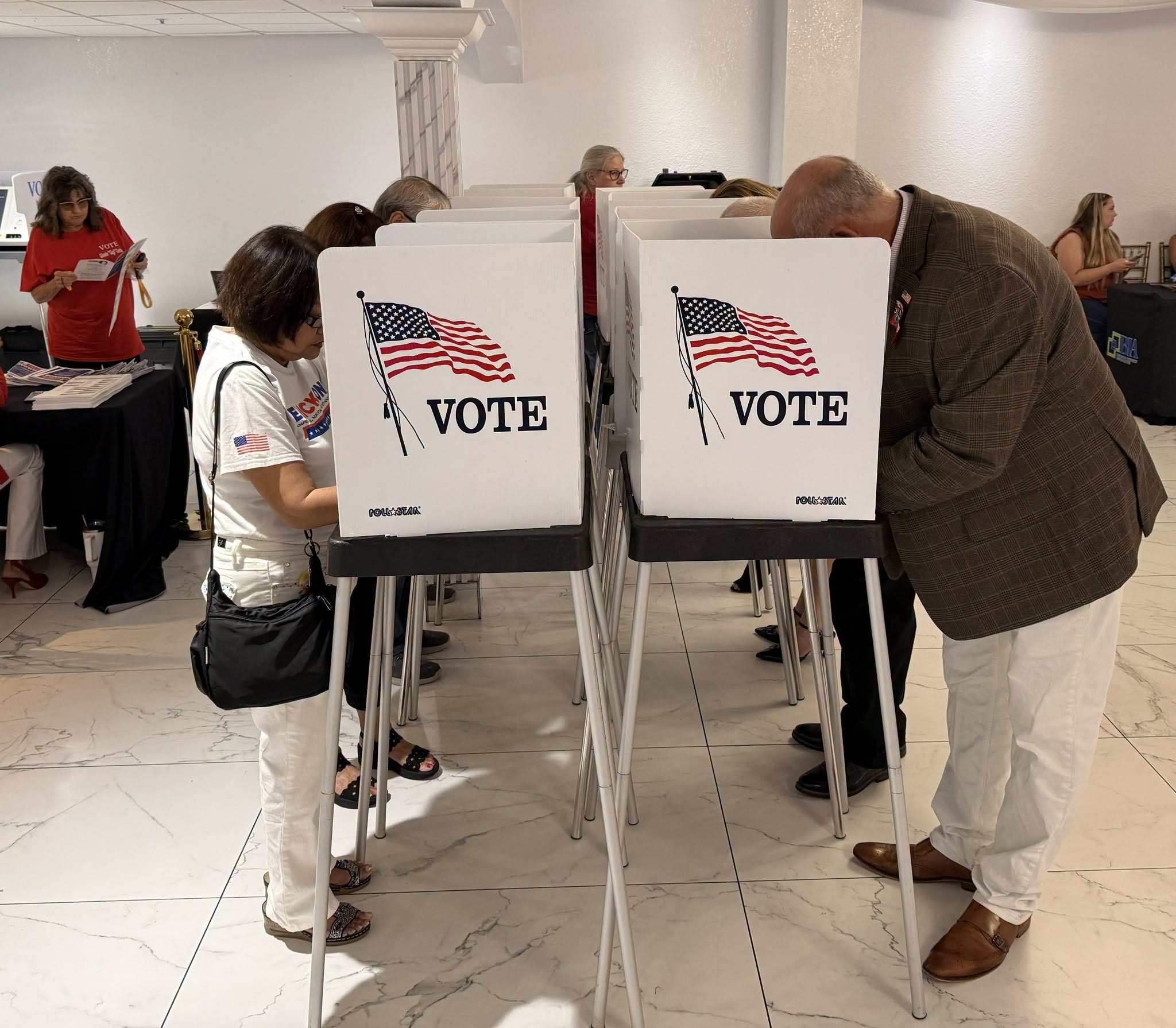
Dimitri Elston, 32, and his wife Ember Elston, 30, of Fremont said they voted ‘no’ on Proposition 40 on Tuesday at the Fremont Main Library.
“It would have a heavy impact on California,” Dimitri Elston said.
But Elliott Brue, 31, also of Fremont, said that the state should “tax the hell out of” billionaires.
“Even if I was a billionaire, I would still try to have a moral compass and pay more than my fair share,” he said.
David McCuan, a political science professor at Sonoma State University, said that backers of the tax were “outspent, outgunned and out-resourced at all levels.” In the final weeks of the campaign, independent polls showed that the billionaires tax was losing ground as its wealthy opponents launched an advertising blitz.
But regardless of the outcome, Proposition 40 being on California’s ballot, he said, will serve as a setup for the 2028 presidential race.
“Many things that get on the California ballot spill over to other elections and to other states,” he said. “The debate over wealth taxes, the debate over inequality related to issues of affordability, we know are going to be pertinent in 2028.”
— Staff writer Kyle Martin contributed to this report.
Photo credit: Element5 Digital/Unsplash
_______
© 2026 The Reporter, Vacaville, Calif. Visit www.thereporter.com. Distributed by Tribune Content Agency LLC.
Sign in to get access to this free resource, and all of our whitepapers and reports.

Download this content today!
Register Now Already registered? Click here to Log In