




Accounting, tax and financial professionals have moved beyond the adoption phase of artificial intelligence adoption, and are now firmly in the tactical phase, according to a new study by Gartner. That said, the survey emphasizes that CFOs, in particular, must take a more disciplined approach to managing their portfolios.
Finance leaders are implementing this more disciplined approach by setting realistic time-to-value expectations, balancing quick productivity gains with broader business outcomes, and strengthening AI literacy across finance teams.
A Gartner survey of 160 senior finance function leaders from January through April 2026 found that data extraction, accounts payable and receivable automation, and report creation generally deliver returns within nine to 10 months. More complex tasks like data management, insight generation, and forecasting typically require a longer development period before realizing value (see Figure 1).
“AI adoption has reached a point where CFOs must adopt more deliberate portfolio management,” said Marco Steecker, Senior Director Analyst in the Gartner Finance practice. “The goal is not to stifle experimentation, but to know where to invest, when to cut underperforming initiatives, and which foundational capabilities to accelerate, especially as AI technology becomes more user-friendly and barriers to experimentation diminish.”
Figure 1: Average Time to Deliver Expected Value for Each AI Use Case in Finance Function
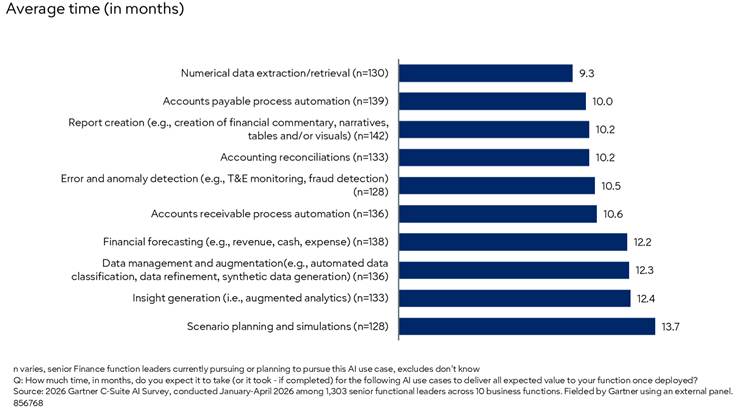
Image Source: Gartner (September 2026)
“Finance AI investments tend to be focused on lower time-to-value use cases that boost productivity (see Figure 2), like report creation and process automation,” said Steecker. “However, CFOs should not let the appeal of quick returns crowd out more complex use cases that take longer to mature but can improve decision making, manage risk and support revenue growth.”
Figure 2: AI Use Case Adoption in Finance Function
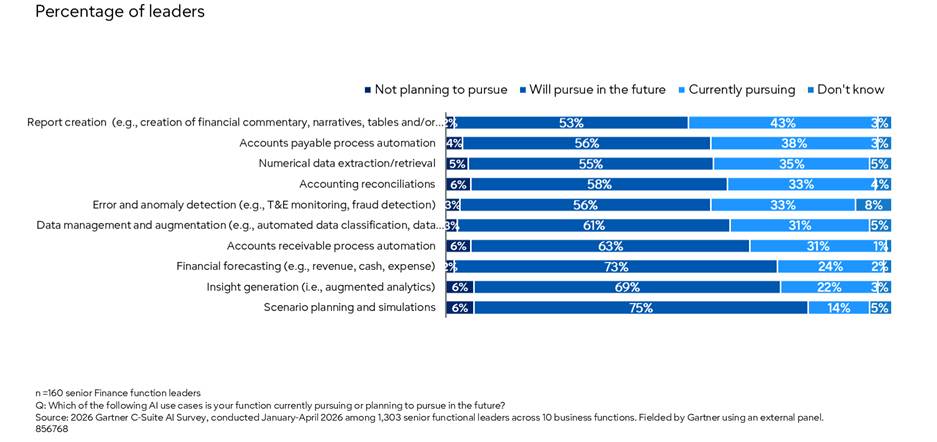
Image Source: Gartner (September 2026)
Acquiring the right talent has historically been a top barrier to the success of AI initiatives in finance. However, the increasing availability of agentic coding tools have shifted AI literacy to the primary barrier that finance leaders must address.
“Low AI literacy is now the most significant barrier finance leaders must address,” said Steecker. “CFOs should give employees practical opportunities to use AI through project assignments, sandbox experimentation and short, on-the-job activities. This will help finance teams build the skills and confidence needed to get more value from AI.”
Sign in to get access to this free resource, and all of our whitepapers and reports.

Download this content today!
Register Now Already registered? Click here to Log In