



What can accountants give to clients that artificial intelligence can’t? The relationship, the accountant’s deep knowledge of their history and goals, their judgment, emotional support, proactive care, and accountability, say small business owners in a new report.
The majority of the 350 business owners surveyed by practice management software provider Karbon didn’t name a technical skill their accountant has. They didn’t name accuracy, tax knowledge, or compliance. They named the relationship itself.
Karbon asked small business owners, “What is the one thing your accountant provides that you believe AI will never be able to replicate?” The majority of answers can be sorted into six consistent themes—all personal qualities that make the accountant the advisor they trust the most.
1. The client relationship itself is the foundation of a firm’s core product: The largest cluster of respondents defined the irreplaceable value as connection itself: friendship, informal conversation, and the feeling of being known, the report says. One client’s answer was simply, “The friendly banter we have about music and bands that we like.” Another said, “Has lunch with me.” The moments clients chose to describe are the ones that focus on the relationship.
2. Clients remember their accountant’s emotional support under pressure: A large cluster of clients spoke of their accountant’s calming presence during difficult moments, describing instances when that support calms them when the stakes are high, the report says.
“No one else sees a client’s full financial picture, including the uncertainty and fragility. The accountant is their life raft in these moments. It explains why the language here is physical (composure, soothe, sense, tone of voice). An accountant can hear anxiety in a client’s voice, and that’s something AI won’t detect,” the report states.
3. The accountant knows the full story (the good, the bad, the challenging): Several respondents spoke of their accountant’s deep knowledge of their history, goals, and specific circumstances—the kind of information that can only accumulate across years of a shared relationship.
This information is found throughout years of conversations, questions asked at the right moments, and decisions made together, the report says.
“Clients think of their accountant not as a historian of the books, but as a participant within the business—someone whose advice is etched into the very fabric of their livelihoods, who has been part of every risk, every investment, every near miss, and every pivot. As a result, that input is deeply valued,” the report adds.
4. Clients value their accountant’s personal judgment in ambiguous situations: Professional judgment remains one of an accountant’s most valuable tools. And when the rules blur, clients want a human reading the situation and translating it, rather than an AI model executing a series of generic motions.
5. Accountants have skin in the game: The client/accountant dynamic is similar to the one shared by an athlete/coach: the plan matters more because somebody who knows the client is watching whether they follow it. Between the two directions of accountability—a professional who answers for the work, and a client who answers to the relationship—it’s a powerful differentiator that can’t be replaced, the report says.
6. Clients value their accountant’s proactive care: Clients also highlight their accountant’s proactive approach: calling ahead of deadlines, adjusting strategies around planned life events, showing up before a problem becomes a crisis.
“Clients rank proactive advice as the area they’re least satisfied with. This means that the clients who are calling out proactivity here are treasuring it and want more. When the rarest behavior is also the one clients single out as irreplaceable, the profession is looking at its clearest instruction for what to do with the hours AI hands back,” the report says.
Other key findings from Karbon’s report include:
Trust remains accountants’ greatest competitive advantage
The accounting profession earned an exceptional +49 net promoter score, with 84% of clients rating their accountant an 8 or higher on a 10-point scale.
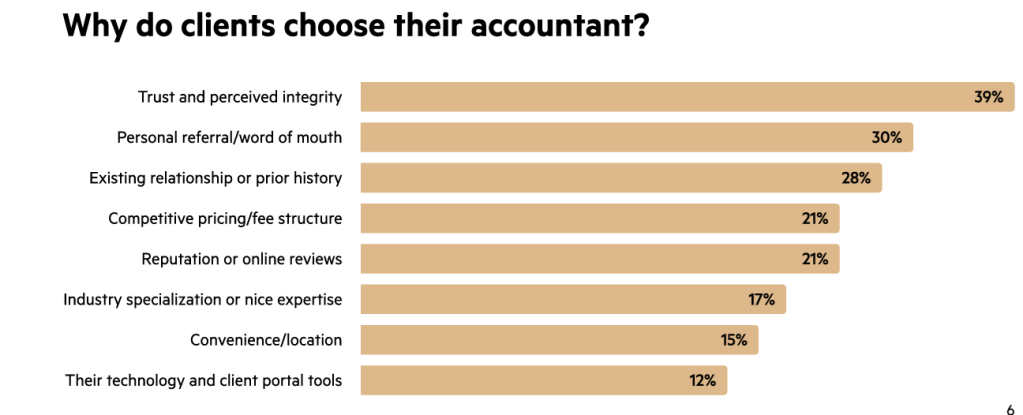
In addition, trust is the No. 1 reason clients choose an accountant, with 39% of respondents saying it matters most in their decision-making.

“Accounting has always been built on trust, and that foundation becomes even more valuable as AI adoption accelerates,” Karbon CEO Mary Delaney said in a statement. “Clients expect firms to embrace new technology while continuing to deliver the judgment, transparency, and personal guidance that have always defined the profession.”
Clients expect AI, but want humans to make key decisions
According to the research, clients increasingly assume their accountants already use AI tools. They care most about how their partners deploy the technology and show transparency about its role in client work:
- The vast majority (89%) of clients want transparency about where AI is used in their accounting work.
- Only 2% of respondents are uncomfortable with AI involvement altogether.
- Clients are comfortable with AI tools streamlining routine tasks. However, they still want human oversight on strategic decisions and prefer sensitive conversations are handled with a personal touch.
“AI adoption is quickly becoming an expectation, but so is transparency,” Delaney said. “Clients want to understand where AI adds value, where human expertise remains essential, and how the two come together to positively impact their businesses.”
AI creates capacity for more valuable client relationships
Rather than viewing AI as a way to reduce costs or speed up existing work, clients see the technology as an opportunity for accountants to deliver greater strategic value. Accounting firms that meet those expectations have an opportunity to deepen client relationships and create new revenue opportunities.
According to Karbon:
- More than 80% of respondents say their accountant becomes more valuable if they accelerate routine work with AI tools and reinvest the time savings into strategic conversations.
- More than half (54%) would pay more for new AI-enabled services, such as real-time dashboards and forecasting.
- Over two-thirds (68%) say they value an accountant who is invested in their long-term success, even if that comes at the expense of speed.
“Efficiency has always been part of the value proposition for AI, but our research shows clients are looking for something bigger,” Delaney said. “They want technology to create more opportunities for strategic advice, stronger relationships, and better business outcomes.”
Photo credit: Yan Krukau/Pexels
Sign in to get access to this free resource, and all of our whitepapers and reports.

Download this content today!
Register Now Already registered? Click here to Log In