



By Ru Rayner
Chattanooga Times Free Press, Tenn.
(TNS)
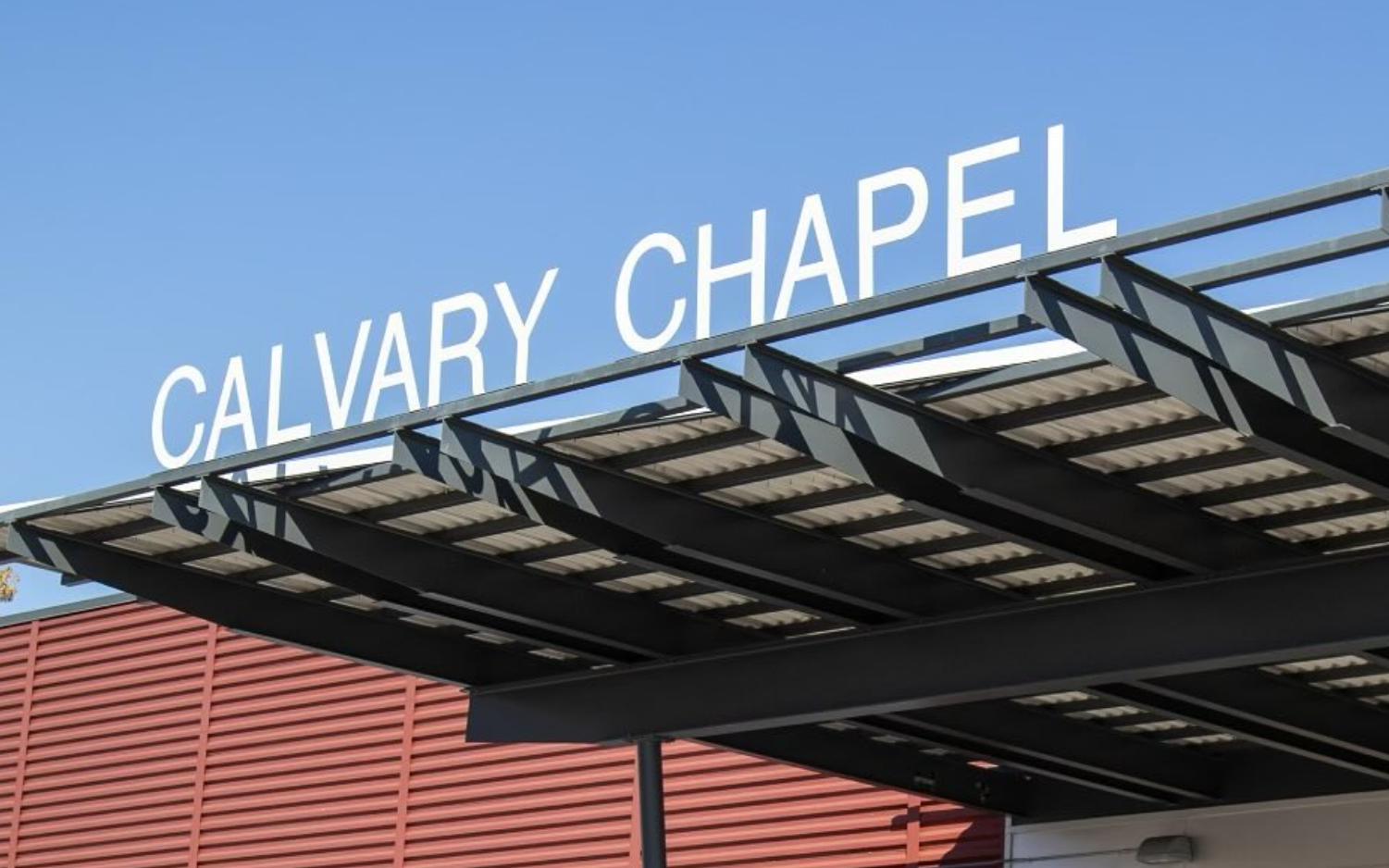
Despite longstanding tax law that prohibits political activity at the pulpit, a Chattanooga megachurch has continued to wield political influence in state and local politics this midterm election.
At the most recent Sunday morning service at Calvary Chapel on Broad Street, Republican candidates for Tennessee State House, Hamilton County mayor, Hamilton County school board and Republican State Executive Committee took the stage beside the non-denominational church’s senior pastor, Frank Ramseur, and the civics and culture ministry leader, Adam Calabrese, who encouraged the worshippers to vote for the candidates.
Calabrese told attendees to view the political arena as a mission field, according to a video of the service posted on YouTube.
“So we have a couple of candidates that are a part of our church that look at their opportunity to run for local office as that very thing, as a mission field. They love Jesus,” Calabrese said. “They have great marriages. They love their kids. We know them. We can vouch for them.”
He invited on stage Republican candidates Weston Wamp for reelection as Hamilton County mayor; Michele Reneau of Hixson for reelection as a state representative; Ashley Dillon for school board and Derek Greene for Republican Executive Committee.
Each of the Republican candidates took a turn speaking on stage during the service, which took place two days after early voting for state and federal primaries and local general elections kicked off in Tennessee.
One tax expert said Calvary Chapel’s explicit encouragement of political candidates at Sunday’s service violated federal tax law involving nonprofits under Section 501(c)(3) of the Internal Revenue Code. An amendment to the code by then-Senator Lyndon B. Johnson was enacted in 1954, prohibiting nonprofits from endorsing or opposing political candidates.
“I’ve seen a lot of sermons that endorse, that try to endorse, that try to endorse without endorsing. This one’s pretty blatant,” said Samuel D. Brunson, a federal income tax expert and associate dean at Loyola University Chicago, by phone. “This is as explicit a violation as you could design. They have done literally everything they could possibly do to violate the Johnson Amendment part of Section 501(c)(3)—like they couldn’t have done a better job violating it if they had tried, and maybe they did try.”
Brunson specializes in federal income tax and nonprofit organizations and in the intersection of religion and the tax system. His research deals with how the federal income tax both regulates and fails to regulate tax-exempt organizations.
Ministry leaders did not respond to questions about the political goals of the church or claims that the service violated nonprofit tax law.
Members of Calvary Chapel hold a wide swath of the area’s elected offices, including at least two seats on the school board, at least one in the state House, county mayor, and at least two leadership positions in the Hamilton County GOP.
The backing of specific Republican candidates by Calvary Chapel follows attempts by conservative Christians nationally to overturn the Johnson Amendment.
This is not the first time Calvary Chapel has expressly supported political candidates at the pulpit. In 2024, the church backed Reneau for state House and Ben Daugherty for a local school board seat. Both candidates won their elections. Reneau won the Republican primary, unseating longtime incumbent state Rep. Patsy Hazlewood, R-Signal Mountain, by 137 votes.
Election opponents criticized the politicking as an inappropriate role for a church to play.
“I think me and a lot of people feel like that’s not appropriate for a church to be that hyper-political,” said Tony Hullender, who is running against Reneau in the Republican primary. “It’s mind-boggling to me, but you know, I was brought up in the era when you didn’t see that. I can’t ever remember one of my pastors talking about, you know, a political race.”
A majority of Americans are opposed to churches and places of worship being allowed to endorse political candidates, according to a 2023 poll by the Public Religion Research Institute.
Civics ministry
In 2020, Calvary Chapel formed a civics ministry that zeroed in on political topics, Calabrese, who brought the candidates up on stage on Sunday, said at the service. Calabrese leads the church’s civics arm, which he said has been rebranded as Issachar Institute, Civics and Culture 2.0.
Standing center stage on Sunday, Calabrese said the aim is to bring the gospel of Jesus Christ and the truth of the word into the political arena. Calabrese singled out local politics as a focus.
Through the church’s civics arm, ministry leaders, including Anne Lowery—elected as secretary of the Hamilton County GOP in 2024—have held talks critiquing COVID vaccinations and regulations, threats of communism and critical race theory, among others.
“You may share the conviction, you may not. I just don’t think, as a Christian, as a church, you can really vote Democrat anymore,” Calabrese said, followed by applause from the Sunday service-goers at Calvary Chapel. “But if you just pay attention, it’s really hard to go into the voting booth and circle D. So we don’t have any Democrats up here this morning by design. We do have some incredible conservatives.”
Calabrese encouraged the Sunday worshippers to scan a QR code on bookmarks in the backs of seats to access pre-filled election ballots. He said the pre-filled ballots are a partnership with Activate Hamilton, a local grassroots conservative group.
Gail Greene, Calvary Chapel member and chair of the Hamilton County GOP, headed Activate Hamilton when she was running for chair of the party in 2024. The organization is now led by Travis Flenniken, Greene said.
Carol Grohn, a Calvary Chapel member until May, when she moved out of the state, said politics and religion should be mixed. Grohn door-knocked for Reneau and said she had attended the chapel’s civics meetings.
“It’s a Christian church, truly Christian,” Grohn said by phone. “There is an understanding that politics is part of our life, and we have to make sure that we have people who are Christians who are in place and help to get them elected.”
There has been growing politicization of religion, said Brooklyn Walker, a professor at the University of Tennessee in Knoxville who studies religion and political attitudes.
Walker said that in the ’50s and ’60s, politics was not as deeply tied to faith, but by the ’80s and ’90s, it became more deeply connected, particularly between conservative Christians increasingly connecting themselves to the Republican Party.
“At this point, that tie between Christianity and Republican politics in the U.S. is pretty tight,” Walker said by phone. “There’s some political science research that indicates that it’s so tight that if you get people thinking about their partisanship, they’ll actually report different levels of commitment to their religion. Even the last five years or so, you know, when I’ve started studying this kind of thing, I’ve noticed an uptick of assertiveness in terms of how some Christians, in particular, are thinking about politics.”
Carve-out
The Johnson Amendment has applied for decades to all tax-exempt organizations, including churches, charities and universities.
But in 2025, under the second administration of President Donald Trump, the IRS stated in a court filing that houses of worship can endorse political candidates. The statement was part of a settlement of a lawsuit filed by churches in Texas, and with it, the IRS essentially carved out an exception to the Johnson Amendment for churches.
However, in March of this year, a federal judge in Texas dismissed the case and with it the settlement with the IRS carve-out for churches, sowing more ambiguity about where the law and its enforcement stand.
Today, the IRS website still states political campaign activity by churches is a violation of the law.
Recommended Articles
The IRS did not respond to questions sent by email about the ruling or whether the service at Calvary Chapel on Sunday violated the provision. This story will be updated online if a response is received.
The IRS has a lot of discretion when it comes to enforcing the law and has seldom taken action against churches, Brunson said. Brunson said, to his knowledge, that in the over 70 years the law has existed, the IRS has enforced the provision once or twice against churches.
The Trump administration has not enforced the law at any point against a church, and Trump issued an executive order in 2017 directing against enforcement and has called for the repeal of the amendment.
Brunson said even if the Trump administration doesn’t enforce the law, it’s possible another administration could.
“If a new administration came in and they decided that they wanted to focus on enforcing this aspect of 501(c)(3), the church would potentially be able to lose its tax exemption because the statute of limitations wouldn’t have run out,” Brunson said. “So even if it’s not enforced, there’s always the danger that the next administration will enforce it.”
Walker said conservative Christian organizations have pushed back against the Johnson Amendment, arguing that the amendment violates the free speech of churches and their ability to exercise their faith. A risk of church electioneering is deepening partisanship, she said. Churches have tended to have some amount of political diversity where conversation and social capital are built, she said.
“One of the concerns I would have is that if partisanship and political endorsements become a bigger and bigger part of churches, that those spaces will become less and less politically diverse, and that we’ll lose out on one of those sites where we can build that social capital, right?” Walker said. “And that’s not good for democratic health.”
‘I need your vote’
At the Sunday worship, candidates took the stage and made a pitch for support to the congregation.
“I need your help. Not only do I need your vote, but I need some of your time, and then I need you to help me spread the word. Early voting is going on right now,” Reneau said on stage.
She said there was a table set up at the church for more information on her campaign.
Reneau said that she is a principled conservative in Nashville and that there are not many of those.
Some of the Calvary Chapel-backed candidates’ opponents responding to the event said they thought what the church did was inappropriate and that politics and faith should be separate.
Hullender, Reneau’s primary challenger, said people should be at church to practice faith and worship God, and that he believes that just like the government shouldn’t interfere in people’s religious freedom, churches shouldn’t be involved in politics.
Reneau did not respond to questions about the support from the church or Hullender’s comments.
While on stage, Dillon, a Republican candidate for school board in an area that spans from Ashland Terrace to Lakesite, said it’s important to have people on the school board who respect parents and love Jesus.
“This is a divisive race,” Dillon said from the stage. “There’s a Democrat who is very smart, but she has a completely opposing worldview from me and from people who love Jesus, and so we’re up against the Democrat.”
Dillon did not respond to a request for comment.
Ruth Walker, the Democrat running against Dillon, said she is a good Christian.
“My understanding is that churches aren’t supposed to be doing that kind of endorsements and telling people who to vote for,” Walker said by phone.
Walker said she hopes voters will educate themselves on where candidates stand on issues and align themselves based on that rather than party.
While on stage Sunday, Dillon also mentioned her other opponent, Sandy Pricer, who is running as an independent, and said she is concerned because it’s unclear how Pricer would vote on the school board.
Pricer said in an interview by phone that Dillon’s comment is a scare tactic and a sign of how well Pricer is doing as an independent candidate. Pricer said she doesn’t think Calvary Chapel’s support for Dillon will impact the race, but that it’s not right to give one candidate a platform and not offer it to others.
The issue, Pricer said, is selecting a few candidates and giving them a platform at church when church isn’t the place for that.
“It’s for prayer and worship and fellowship, not for politics and pushing agendas,” Pricer said.
Derek Greene, who was brought on stage during the service, is running for the State Executive Committee of the Tennessee Republican Party, an intraparty office that sets the rules of the state GOP.
Greene is married to the chair of the Hamilton County Republican Party, Gail Greene, and is attempting to unseat incumbent David Queen.
Derek Greene said during the Sunday service that Queen is part of the establishment and he plans to be a bull on the State Executive Committee.
“Right now, we’ve got a bunch of weak people across Tennessee serving on the state Executive Committee, and I will not be one of those people,” Greene said on stage.
Queen declined to comment on questions in response to Greene’s comments and the church’s support. Greene did not respond to a request for comment about the backing from the church.
On Sunday, Wamp spoke to the congregation last, urging people to show up to vote.
“We are in charge of our community, but only if y’all show up to vote,” the county mayor said. “Only if we assert ourselves. Only if we lead with competency and joy. And here’s what we’re up against: We’re up against, particularly in this community, a left-wing movement that is motivated by resentment, frankly, of people like me and Derek and Michele who have big families, we are up against a group of people who are motivated by what they don’t like about our community, what has not gone right in their own life.”
The Times Free Press asked Wamp for comment about the election support from Calvary Chapel, claims of tax law violation and criticism over the church engaging in politics.
“Shelby and I were honored to be guests at Calvary Chapel, where many of our closest friends are members, ” the mayor said by text, referring to his wife. “We are grateful for the warm welcome we received.”
Wamp’s Democratic opponent, Mark Herndon, declined to comment.
Photo credit: Calvary Chapel Chattanooga/Instagram
_______
© 2026 the Chattanooga Times/Free Press (Chattanooga, Tenn.). Visit www.timesfreepress.com. Distributed by Tribune Content Agency LLC.
Sign in to get access to this free resource, and all of our whitepapers and reports.

Download this content today!
Register Now Already registered? Click here to Log In
Tags: churches, IRS, Johnson Amendment, political candidates, Taxes