The consulting, tax and assurance services firm RSM US LLP has released the RSM Middle Market AI Survey 2026: U.S. and Canada, finding that middle market companies across the U.S. and Canada have moved decisively from AI experimentation to AI execution, with broad adoption, high satisfaction and growing investment across the market.
The survey of 1,030 senior business leaders found that 86% of organizations have partially or fully integrated AI into their operations, while 97% report satisfaction with their AI investments. More than half (54%) say AI investments have exceeded ROI expectations, and 58% plan to invest $1 million or more in AI during the current fiscal year and 84% expect AI spending to increase next year.
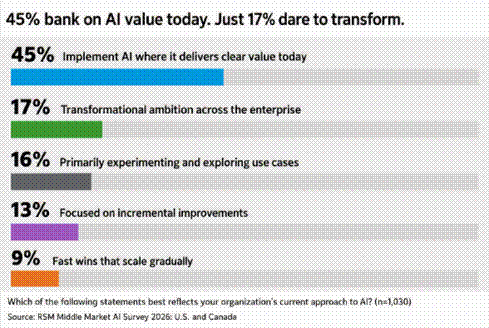
Yet the findings also point to a more complicated reality: AI is producing value, but adoption alone is not translating into enterprise-wide transformation. Nearly half (45%) of respondents say their organizations are focused on implementing AI where it delivers clear value today, compared to just 17% pursuing transformational initiatives across the enterprise.
“The middle market has largely moved beyond asking whether AI works,” said Ana Minter, principal, consulting AI go-to-market leader at RSM US. “The more important question is whether organizations are ready to make it repeatable, trusted and scalable. That requires being honest about both sides of the equation: where AI is creating value today, and where data, governance, workforce readiness and operating models still need to catch up.”
AI Forcing Tough Budgetary Decisions
Middle market organizations increasingly view AI as a proven business capability rather than an emerging technology. Survey findings show strong satisfaction levels, successful pilot outcomes and growing investment plans, signaling that many organizations have entered a new phase of AI adoption, defined less by experimentation and more by measurable business execution.
Key findings include:
- 45% prioritize implementing AI where it delivers clear value today, compared to just 17% pursuing transformation initiatives across the enterprise
- 97% report moderate or high success from AI pilots conducted over the past two years
- 73% currently use generative AI, followed by language AI (64%) and prediction AI (61%)
As AI spending rises, organizations are also making harder choices about where to allocate capital. Among those increasing AI spending, respondents most often report reallocating budgets from business intelligence and analytics initiatives (43%), cybersecurity investments (41%) and external consulting services (40%). This finding reflects both the significant investment organizations making in AI as they balance competing technology and business priorities.
AI Passed the Test. The Enterprise Needs to Scale the Rest.
While adoption is widespread, organizations continue to face challenges scaling AI initiatives across the enterprise. The survey suggests that the biggest barriers are no longer about whether to invest in AI, but whether organizations are operationally ready to make AI work at scale.
Among organizations reporting moderate or limited pilot success, the leading barriers to scaling AI include:
- Data quality issues (53%)
- Integration challenges (47%)
- Unclear ROI (33%)
- Security and compliance concerns (33%)
Across all respondents, data quality and availability issues remain the top inhibitor to AI deployment (34%), followed by security and privacy concerns (30%), legacy systems integration (28%), and talent and skills gaps (28%).
“The next phase of AI will be won or lost in the operating model,” added Minter. “Organizations have proven that AI can work in targeted use cases. The harder challenge is building the data quality, governance, infrastructure and workforce readiness needed to scale those successes across the enterprise.”
The survey also points to a growing disconnect between leadership ambition and organizational readiness. Eighty-five percent of respondents agree that executive leadership is more enthusiastic about AI than employees, while 88% believe their workforce size and composition will look fundamentally different within the next two to three years because of AI. At the same time, 91% expect humans and AI systems to work together as integrated teams during that timeframe.
“Those findings suggest that the next phase of AI adoption will be as much about trust, training and workforce design as it is about technology deployment,” said Minter.
While 67% of organizations say they apply AI governance controls before pilot or production stages, the findings indicate that governance will become increasingly important as AI moves from isolated use cases into core business processes. Organizations that strengthen governance early will be better positioned to manage risk, build trust and scale AI responsibly.
The Next Deduction: Tax Shows AI Progress
For the first time, the survey examined AI adoption within organizational tax functions, offering a closer look at how AI is moving into complex, highly regulated and judgment-based areas of the business. Among respondents:
- 83% say their tax function currently uses AI tools
- 45% are pursuing AI-enabled tax planning and optimization use cases
- 45% are using or planning AI for tax compliance monitoring and reporting
- 41% are applying AI to tax data extraction and validation
- 98% expect AI to affect the nature of tax work within the next two to three years
The findings suggest tax leaders increasingly view AI not simply as an efficiency tool, but as a strategic capability that can enhance decision-making, improve compliance processes and help teams focus on higher-impact activities.
“AI is reshaping how tax departments operate, creating opportunities to improve efficiency, enhance insights and allow professionals to focus on more strategic work,” said Brad Collins, principal and leader of tax digital services with RSM US LLP. “Realizing that value requires more than adopting AI tools. Tax functions need reliable data, integrated systems and professionals who can apply both technical tax judgment and AI-enabled insight. Ultimately, the next phase of adoption of AI will be defined by how effectively organizations embed AI int the functions, workflows and decision that drive business performance.”
For more details on the survey’s findings, the full report can be found here.
Sign in to get access to this free resource, and all of our whitepapers and reports.

Download this content today!
Register Now Already registered? Click here to Log In