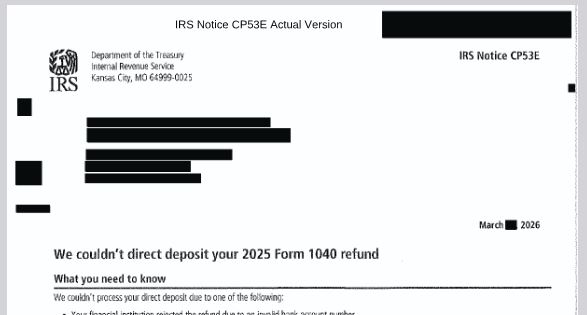




During the recent tax filing season, the Internal Revenue Service sent over 3 million CP53E notices to taxpayers – a notice that is issued by the IRS when a taxpayer is owed a refund but must provide or correct direct deposit information before the IRS will release it. The American Institute of CPAs submitted a letter to the IRS providing recommendations to improve the IRS’s use of CP53E notices to implement Executive Order 14247 (EO 14247), Modernizing Payments To and From America’s Bank Accounts.
The issuance of these notices has caused significant confusion to taxpayers and their practitioners regarding the purpose of the notices, the status of refunds, and the steps needed to resolve the notices. Failure to provide direct deposit information was the most straightforward reason for receiving a CP53E notice, but taxpayers also received notices when they:
- Requested overpayments be applied to the following tax year.
- Filed a return indicating either no balance due or balance due to the IRS.
- Provided valid direct deposit information.
Taxpayers not expecting a refund were particularly confused, since such notices did not provide any explanation. Some unexpected notices were properly issued due to tax return adjustments resulting in refunds, but others may have been issued erroneously. In many instances, the reason for issuing a CP53E notice to taxpayers requesting that overpayments be credited to the following tax year remains unclear.
Additionally, EO 14247 provided that the electronic payment and refund requirement would include exceptions for certain categories of taxpayers, including individuals without access to banking services or electronic payments and other circumstances as determined by the Secretary of the Treasury. Regulations have not been issued providing a list of these exceptions or properly defining the categories of taxpayers eligible for such exceptions.
The AICPA has recommended that the IRS:
- Issue further guidance clarifying the reasons that a CP53E notice would be issued, indicating whether taxpayer action is needed in each circumstance and explaining the IRS’s limitations when using direct deposit information.
- Review the criteria for issuing a CP53E notice to eliminate erroneous notices.
- Establish a process to request an exception from the direct deposit requirement prior to filing the return, such as adding a checkbox to income tax returns to allow taxpayers to self-identify as an excepted taxpayer.
- Publish and define all categories of excepted taxpayers in regulations or other guidance.
- Implement policies to prevent the issuance of CP53E notices to taxpayers that qualify for a paper refund check exception in prior tax years.
“The recommendations provided by the AICPA, coupled with increasing public outreach, will help reduce confusion and protect taxpayers who are exempt from the electronic refund requirement,” said Daniel Hauffe, AICPA Senior Manager, Tax Policy and Advocacy. “If implemented prior to the October 15th extended filing deadline, these changes could serve to reduce the administrative burden on the IRS and provide clarity to taxpayers and their advisors.”
Sign in to get access to this free resource, and all of our whitepapers and reports.

Download this content today!
Register Now Already registered? Click here to Log In
Tags: AICPA, cpe53e, Income Taxes, IRS, irs notice, Taxes