




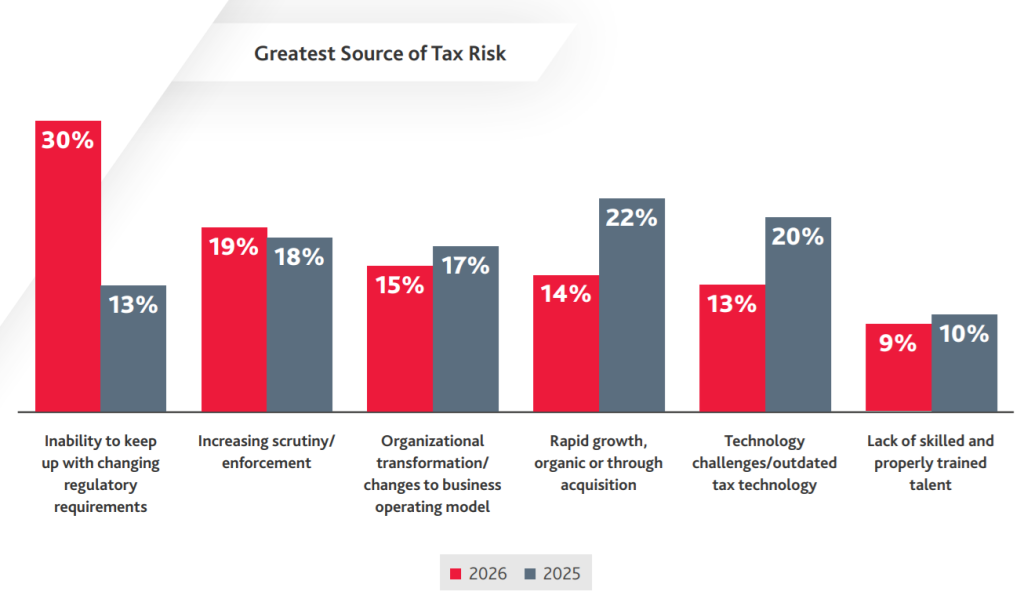
Senior corporate tax leaders surveyed by top 10 accounting firm BDO USA identify the inability to keep up with changing regulatory requirements as the greatest source of tax risk in the next 12 months, cited by 30% of respondents—more than double the 13% who said the same in 2025.
Tax leaders’ rising concerns about regulatory complexity tie directly to increases in total tax liability: 82% of companies say their total tax liability increased in the last 12 months.
“Regulatory change is not just a compliance challenge; it is a direct driver of rising tax costs, as new rules expand what is taxable and drive up the cost of compliance,” BDO USA says in the report, 2026 Tax Strategist Survey. “When multiple jurisdictions change at once, the risk and cost compound.
“Companies operating in multiple U.S. states face a patchwork of requirements,” the report continues. “Fifty states and countless local jurisdictions create complexity with disparate rules and timelines. States face fiscal pressure that shapes tax policy and compliance enforcement: Many states are decoupling from federal rules to protect their own revenue bases and are increasing audit activity, both of which compound compliance burdens and create additional work for tax teams. Differing interpretations of economic nexus, including where a company has employees, houses inventory, or conducts sales, add further layers of operational complexity, as does the need to apportion income across states.”
The report finds that only 38% of companies have a defined process for cross-functional teams to engage the tax function on matters that may carry tax implications, which may limit tax leaders’ ability to mitigate financial risks, strengthen resilience, and deliver strategic guidance.

“The pace of regulatory change, global economic shifts, and business transformation has made tax one of the most strategically important functions in an organization,” Mathew DeMong, national managing principal of tax at BDO USA, said in a statement. “The opportunity is real, but so is the risk: without the right processes, infrastructure, and organizational integration, tax’s impact remains person-dependent and reactive. Leaders who institutionalize the tax function across the enterprise will be better positioned to bring a total tax approach to every business decision.”
The BDO USA survey, which draws on responses from 300 senior tax leaders at middle-market organizations and was conducted in early 2026, reveals that tax leaders continue to serve as strategic leaders within their organizations, even as they navigate tariff volatility, One Big Beautiful Bill Act implementation, global tax reform, and rapid technological change.
The report finds that tax’s influence continues to grow in critical areas of business strategy. In line with last year’s report, tax leaders continue to report high levels of involvement in enterprise decision-making. Ninety-four percent of tax leaders report being asked to weigh in before business decisions are made—up four percentage points from the prior year. Involvement in strategic transactions, such as mergers and acquisitions, has increased by nine points, while involvement in organizational risk management has increased by five points.
Recommended Articles
“The shift in focus reflects a growing recognition that tax risk—such as transparency and reputation concerns, audits, and noncompliance—is enterprise risk, not simply a finance function issue,” the report states.
The report also uncovers several key findings related to tax’s operating models, technology investment, and regulatory complexity at the state, federal, and global levels:
- Fifty-four percent of tax teams are responding to increased risk by investing in outsourcing and co-sourcing: The share of organizations outsourcing primarily due to regulatory and compliance requirements grew from 33% in 2025 to 47% in 2026.
- Seventy-nine percent of tax leaders plan to increase technology investment this year: But 29% cite both interoperability with legacy systems and implementation ahead of data management readiness as the top reasons technology initiatives fall short of expectations. “While enterprise leaders recognize the potential of AI and automation to fundamentally change how the tax function operates, the data reveals that most are not leveraging the technology for the complex analysis necessary for planning, forecasting, and navigating today’s compliance landscape,” BDO USA said.
- Despite ongoing tariff exposure, most organizations have not yet broadly deployed the management strategies available to them: Forty-nine percent of respondents report pursuing transfer pricing reviews, while 42% report conducting a tariff code review and 25% report pursuing duty drawback strategies.
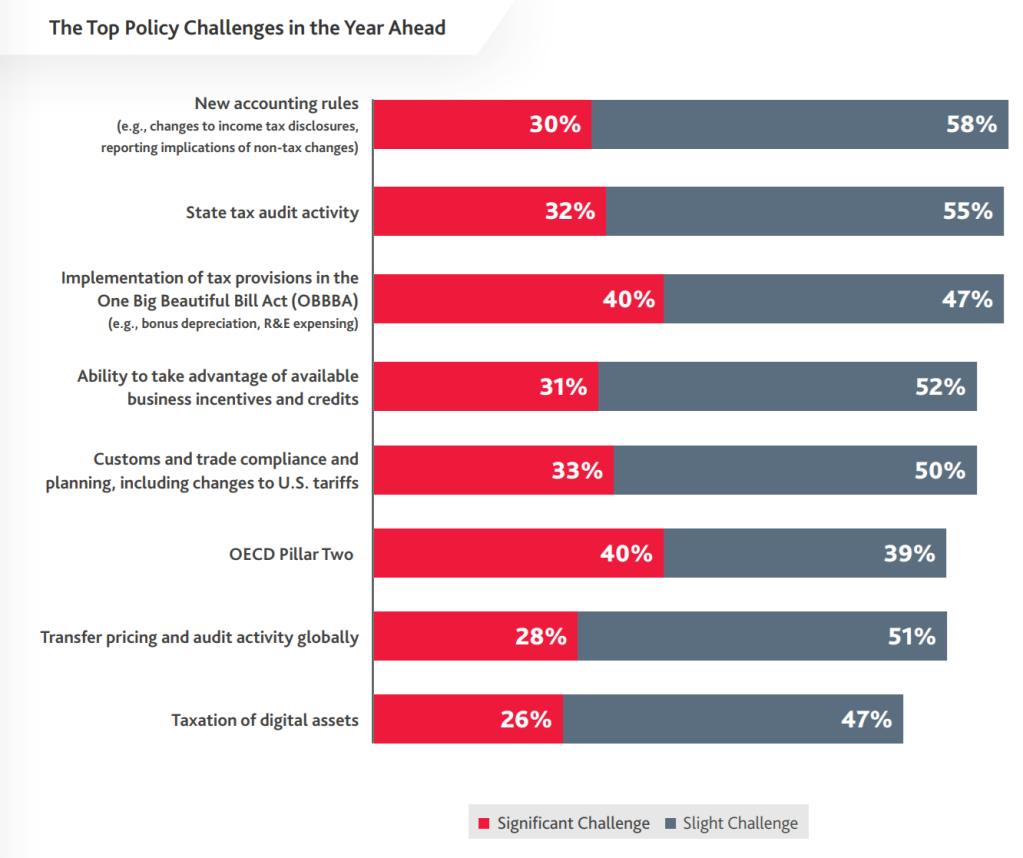
- Eighty-six percent of tax leaders say implementing tax provisions in OBBBA is a challenge: State decoupling from federal OBBBA provisions introduces additional complexity. Varying regulatory and compliance requirements by jurisdiction compound the issue, with state and local income and franchise tax cited as the largest contributor to total tax liability by 36% of respondents.
- Ninety-two percent of multinational tax leaders say global tax complexity has substantially increased in the past two years: Multinationals cite both OECD Pillar Two requirements (88%) and transfer pricing audit activity (87%) as key challenges. Ninety-three percent of multinational tax leaders say that global tax complexity has led to increased costs, and 91% say that it has increased their reliance on external advisors and technology solutions.
“Tax leaders have proven that they belong in the rooms where enterprise decisions are made. Now, the question will be whether they can sustain that influence. This means mandating a total tax approach that embeds tax technology and processes across functions and building operating models that are positioned for what’s next,” DeMong said.
Sign in to get access to this free resource, and all of our whitepapers and reports.

Download this content today!
Register Now Already registered? Click here to Log In