



By Rick Green
The Keene Sentinel, N.H.
(TNS)
New Hampshire has never had a broad-based state income tax, and there has been no shortage of legislative proposals this year aimed at ensuring it never does.
Republican Gov. Kelly Ayotte, who is running for reelection, released a statement Wednesday supporting one of these proposals and emphasizing two of her big political refrains—opposition to new taxes and criticism of Massachusetts.
“New Hampshire is a beacon of freedom and opportunity because we’ve held the line against an income tax,” she said. “A constitutional amendment to make it permanent ensures our state won’t go the way of Massachusetts. No income tax—not now, not ever!”
Former N.H. Executive Councilor Cinde Warmington, a Democrat running for governor, does not support instituting an income tax.
“Cinde Warmington will veto an income tax or sales tax—end of story,” a spokesman said.
Among the many issues the N.H. Legislature has considered this year, the idea of a ban on a potential income tax has been one of the most discussed.
The N.H. Senate on Feb. 19 passed 16-8, CACR 12, a proposed constitutional amendment that would require a two-thirds vote in each chamber of the N.H. Legislature in order to enact any broad-based taxes.
The House is considering revising the bill to make it a proposed constitutional amendment prohibiting state representatives from ever adopting an income tax.
On March 5, the House voted, 194-158, in favor of an anti-income tax proposal, but that was less than the three-fifths majority required for placing it on a statewide ballot, where a two-thirds voter majority would be needed for passage.
Public opinion polling shows Granite State voters overwhelmingly oppose adoption of a state income tax.
New Hampshire also does not have a broad-based sales tax. Instead, it relies heavily on local property taxes to support local and state government, resulting in one of the largest average property tax rates in the nation.
Republican politicians often blame high property taxes on excess local spending, but an April 9 analysis by the N.H. Fiscal Policy Institute found that New Hampshire’s local governments ranked 40th in public revenue per resident in 2022.
“New Hampshire’s cities, towns, counties, school districts, and village districts raised about $5,076 per capita, which was nearly $2,000 less than the nationwide figure,” the analysis by NHFPI Research Director Phil Sletten said.
New Hampshire also ranked near the bottom in state aid provided to local governments, according to the report, which noted that local tax bases and rates vary widely by community.
Republican-led efforts in recent years have reduced state revenues by making cuts in business taxes and ending the state’s interest and dividends tax.
N.H. Rep. Jason Osborne, R-Auburn, the House’s majority leader, released a statement last week critical of the NHFPI, a nonpartisan policy organization.
He said the nonprofit “was busy trying to figure out how to leverage burgeoning property taxes to institute an income tax.”
“If your property tax bill looks like a ransom note, don’t let the NHFPI lie to your face,” Osborne said. “They want you to believe your town has a ‘revenue problem.’ In simple terms, that means: ‘we want an income tax.’
“Our towns don’t have a revenue problem; they have a spending problem.”
For his part, Sletten said in an email on Wednesday that his organization “promotes opportunity and economic well-being for all New Hampshire residents by producing and disseminating independent research and analysis to inform public policy.
“We do not support or oppose legislation. There are no policy recommendations in the report.”
Meanwhile, two former Democratic candidates for governor, Andru Volinsky and former state Sen. Mark Fernald, unveiled a proposal last month to increase state support for public schools, as courts have ordered, while reducing property taxes.
That proposal, which Republicans have panned, calls for a 3 percent income tax and a $3 per $1,000 of assessed valuation property tax.
Republicans have a 16-8 majority in the N.H. Senate. The House has 214 Republicans, 178 Democrats, one independent and seven vacancies.
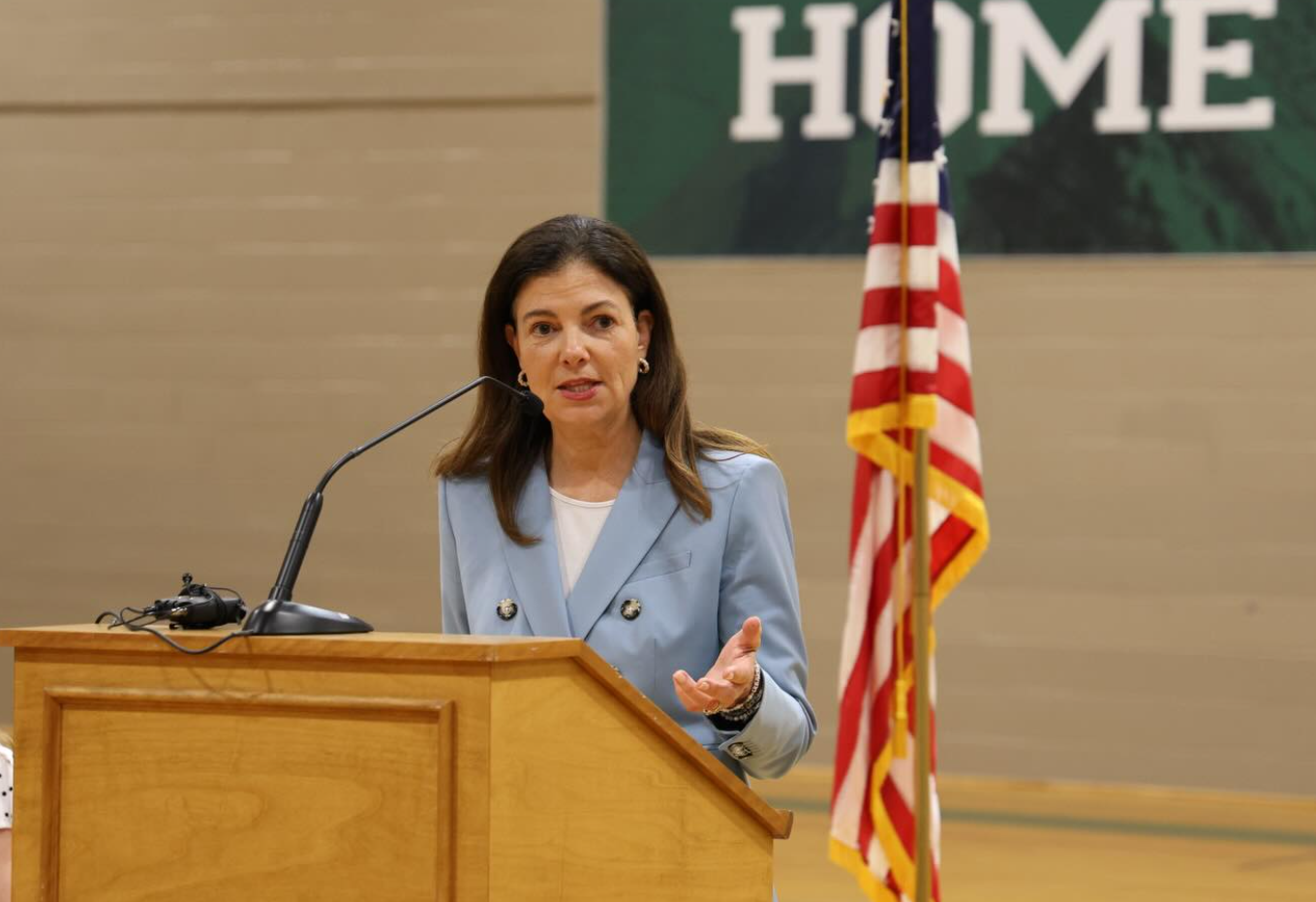
Photo caption: New Hampshire Gov. Kelly Ayotte (Kelly Ayotte/Facebook)
_______
© 2026 The Keene Sentinel (Keene, N.H.). Visit www.sentinelsource.com. Distributed by Tribune Content Agency LLC.
Sign in to get access to this free resource, and all of our whitepapers and reports.

Download this content today!
Register Now Already registered? Click here to Log In