By Jim Brunner
The Seattle Times
(TNS)
In 1932, the Great Depression left a third of Washington workers jobless. Shantytowns sprung up throughout Seattle. There were hunger marches on the state Capitol.
That fall, Washington voters joined a national populist wave in electing Democrat Franklin D. Roosevelt as president, ushering in the poverty-fighting New Deal.
They also overwhelmingly approved a progressive state income tax, aiming to fund schools and other public services with a levy that rose based on a person’s ability to pay.
But several months later, as income tax forms were getting mailed out, the state Supreme Court killed the tax, ruling 5-4 that it violated the state constitution.
The 1933 Culliton v. Chase decision still reverberates more than 90 years later.
It spawned Washington’s often-criticized tax structure, which relies heavily on sales and business taxes. The tax code ranks as one of the nation’s most regressive, placing a high burden on poorer residents compared with the rich.
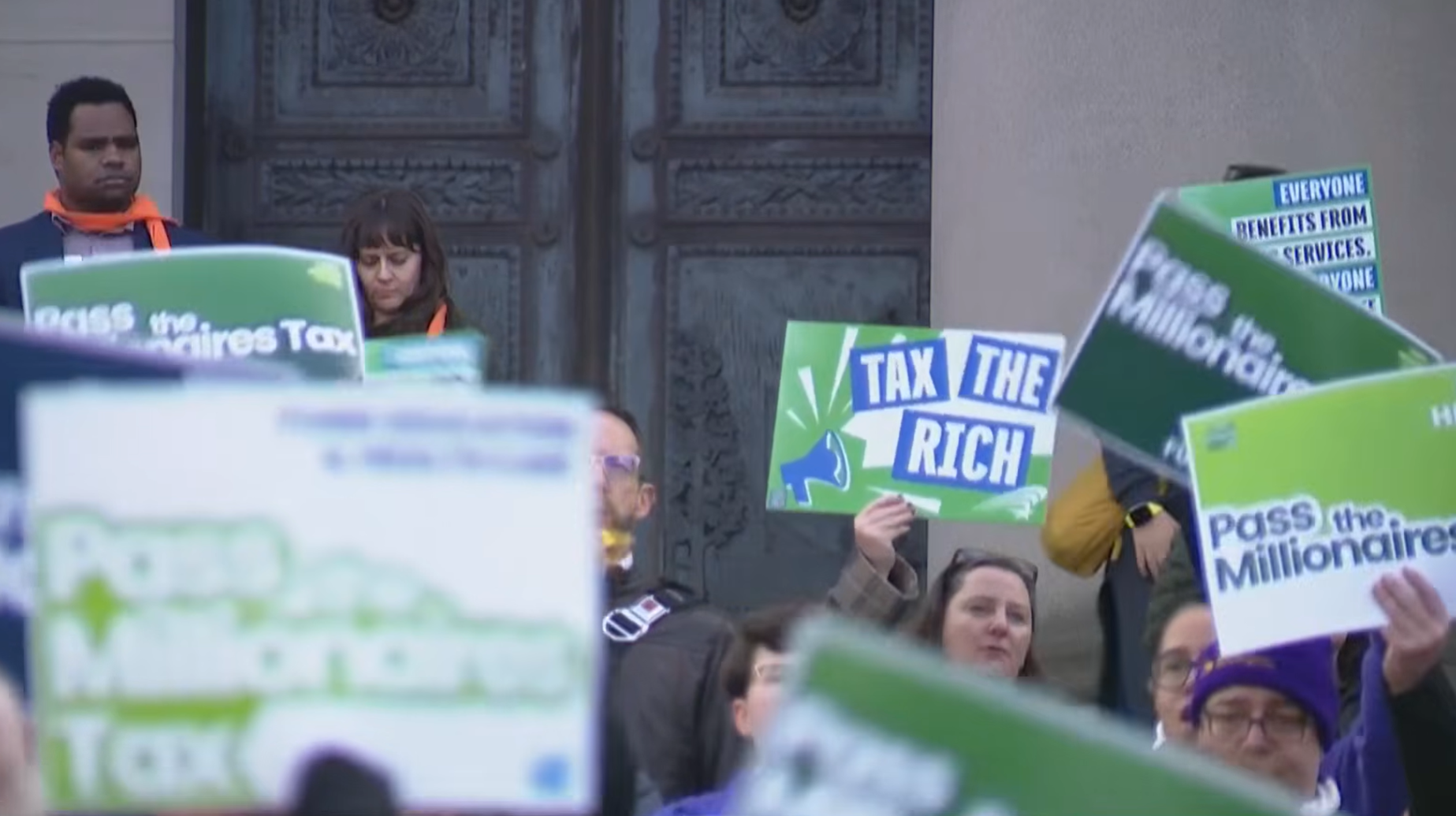
As Democrats in the Legislature advance an income tax on people making more than $1 million a year, opponents argue the plan is blatantly illegal, citing the 1933 ruling, which has never been overturned.
If the tax is enacted and passes legal muster, it could bring in roughly $4 billion a year.
Former Attorney General Rob McKenna, a Republican, said that what Democrats are attempting goes against decades of established legal precedent.
This is actually not at all complicated. This is a bill which clearly conflicts with the language of the (state) constitution, its plain meaning,” said McKenna, now an attorney for the Orrick law firm, who has written a legal brief for tax opponents.
But supporters of the so-called “millionaires tax” are itching for a legal fight. They believe the Culliton decision was flawed and would be overturned if taken up by the current state Supreme Court.
“The reasoning of the court in Culliton was wrong. It was based on suppositions that were not accurate,” said Paul Lawrence, an attorney with Pacifica Law Group, who has represented groups pushing for the tax. “What we want the court to do is to say OK, we can throw those out and make a clean decision.”
To be clear: The 9-decade-old court ruling is not the only barrier that has prevented Washington from imposing an income tax.
While voters said yes to the tax in 1932, they’ve spurned income tax proposals 10 times since then. Most recently, in 2010, a proposed tax on people earning more than $200,000 a year was soundly defeated, losing in 38 of 39 counties.
If lawmakers approve the high-earners income tax proposal in the final week of the legislative session, opponents are expected to seek another public vote.
The 9.9% tax on earnings over $1 million would affect roughly 30,000 taxpayers, with collections beginning in 2029. It would not apply to home values or retirement savings.
Recommended Articles

1933 ruling: Income is property
The 1933 decision came with some drama.
More than 70% of voters had backed Initiative 69, which created an income tax with rates of between 1% and 7%, rising based on a person’s income. The initiative had been pushed by farmers who were getting walloped by property taxes while newer forms of wealth escaped taxation. A companion proposal, also approved by voters, capped property taxes.
The tax was immediately challenged by business owners who didn’t want to pay it. The lead plaintiff was William Culliton, who owned a small Seattle insurance agency. He sued Samuel Chase, the head of the state’s tax commission charged with implementing the new levy.
When it initially heard the case, the state Supreme Court reportedly deadlocked 4-4 on whether to strike down the tax or uphold it. The ninth justice was in poor health and could not participate. He stepped down, and Democratic Gov. Clarence Martin appointed a new justice who was seen as supportive of it.
But when the court’s decision came down in September 1933, one of the previously supportive justices had changed his mind. The ruling was 5-4 to overturn the tax.
The majority decision, written by Justice Oscar Holcomb, said income is a form of property under the state constitution, which defines property broadly as “anything, whether tangible or intangible, subject to ownership.”
“It would certainly defy the ingenuity of the most profound lexicographer to formulate a more comprehensive definition of property,” Holcomb wrote.
The state constitution requires property to be taxed at a “uniform” rate. So a flat income tax would be fine, the majority opinion said. But the graduated-rate tax that voters had just approved was unconstitutional.
“Income is either property under our fourteenth amendment, or no one owns it. If that is true, any one can use our incomes who has the power to seize or obtain them by foul means,” Holcomb wrote.
In a dissent, Justice Bruce Blake called the majority ruling “sheer sophistry” that showed “total disregard” to the history of the constitution and development of state taxes.
There has long been speculation that the ruling was influenced by people, including the justices, seeing the first income-tax forms show up at their homes.
The Seattle Times in a front-page editorial on Sept. 9, 1933, said people would welcome the decision: “One glance at the dreadful blanks mailed by the State Tax Commission was sufficient to convince them they did not want the new system nearly as much as they previously assumed they did.”
Critics say decision flawed
That debate continues to this day, with some state legal experts picking apart the Culliton ruling, saying it relied on faulty legal assumptions that have only grown even more outdated.
Most states do not treat income as property, and even at the time, the decision in Culliton misstated how such a tax was treated by courts in most of the country, said Hugh Spitzer, an emeritus law professor at the University of Washington and a state constitutional expert.
Holcomb, in his 1933 majority opinion, said most courts nationally had reached a consensus that income is a form of property.
“He was incorrect. It was untrue at the time. A majority of states took the position that income is money in flow. It is not an asset,” said Spitzer, who wrote a 1993 law review article dissecting and criticizing the Culliton decision.
In the decades since Culliton, the legal gap between its reasoning and that of courts nationally has only grown, he said.
But income tax opponents say the legal picture in Washington is different simply because the wording of our constitution is different.
McKenna argues supporters are doing contortions to escape that simple truth. “It’s an argument only a lawyer could love, because it defies common sense. You clearly have a property right to your income,” he said.
Pennsylvania has similar wording in its constitution, and like in Washington, a court in the 1930s there struck down a graduated income tax that taxed wealthy people at higher rates. As a result, Pennsylvania has a flat 3.07% income tax.
Washington lawmakers could avoid the legal issue altogether by proposing a state constitutional amendment. But that would require two-thirds of the Legislature to pass—a majority that Democrats do not quite have. And some in the party are nervous about the tax proposal.
State Rep. Amy Walen, D-Kirkland, has proposed imposing the tax through a constitutional amendment that would lock in the $1 million threshold, adjusted for inflation, ensuring lawmakers could not expand the tax to less wealthy residents.
“I think the only way they are going to trust us is if we set these things in the constitution. I think that’s what we should do,” she said. Her proposal has not picked up any co-sponsors.
Precedents are not forever
Critics of the income tax plan advancing in Olympia frequently refer back to the Culliton ruling and say it’s irresponsible of Democrats to advance a bill that goes against the long-standing court precedent.
Senate Republican Leader John Braun quoted from the ruling during a floor debate on the proposal last month, saying it settled the question and that the “only way” to impose the tax Democrats are pushing is through a constitutional amendment.
But old court rulings can be overturned. Otherwise the U.S. would still be bound by rulings that, for example, allowed racially segregated schools.
For decades, conservative-led states passed bills that went against the U.S. Supreme Court’s landmark 1973 Roe v. Wade decision, which said abortion was a right protected by the U.S. Constitution.
Those efforts were unsuccessful for a long time, with abortion bans and restrictions getting struck down. But in 2022, the Supreme Court, with a conservative majority, overturned that precedent in the Dobbs v. Jackson Women’s Health Organization decision, opening the door for states to impose bans.
In Washington, progressives have long chafed at the Culliton ruling, saying it has been an unjust restriction that has harmed public services and exacerbated income inequality.
John Burbank, the former head of the Economic Opportunity Institute and a longtime income tax supporter, said courts are influenced by politics just like other branches of government.
“The idea that the justices are completely neutral, or partyless or nonpartisan is not correct,” he said. “The decision in 1933 was completely political.”
This year, eyeing a court that has been stacked with justices appointed by Democratic governors and supported during elections by liberal interest groups, backers see a chance for their own version of a Dobbs-style reversal.
Three years ago, the court upheld the state’s new capital gains tax on investment income, rejecting arguments that it was an unconstitutional income tax. That decision did not revisit Culliton but said that Democrats had legally imposed the tax as an excise tax.
Spitzer said that politics aside, there are solid legal justifications for another look at the legality of a graduated state income tax.
“Precedent is very important in assuring that law moves methodically and changes methodically and carefully, but it doesn’t mean that the law can’t change, Spitzer said.
Photo caption: The Washington State Supreme Court, which is known as the “Temple of Justice,” in Olympia, WA. (mrod/iStock)
______
© 2026 The Seattle Times. Visit www.seattletimes.com. Distributed by Tribune Content Agency LLC.
Sign in to get access to this free resource, and all of our whitepapers and reports.

Download this content today!
Register Now Already registered? Click here to Log In