



By Scott Shindledecker
The Western News, Libby, Mont.
(TNS)
Feb. 6 — The Internal Revenue Service announced Tuesday tax relief for individuals and businesses in Montana affected by severe wind storms and flooding that occurred the second and third weeks of December 2025.
Following the disaster declaration issued by the Federal Emergency Management Agency in mid-December, individuals and households that reside or have a business in Lincoln and Sanders counties as well as the Blackfeet Indian Reservation, qualify for tax relief.
These taxpayers now have until May 1, 2026, to file various federal individual and business tax returns and make tax payments.
The declaration permits the IRS to postpone certain tax-filing and tax-payment deadlines for taxpayers who reside or have a business in the disaster area. For instance, certain deadlines falling on or after Dec. 10, 2025, and before May 1, 2026, are granted additional time to file.
As a result, affected individuals and businesses will have until May 1, 2026, to file returns and pay any taxes that were originally due during this period.
The May 1, 2026, deadline applies to individual income tax returns and payments normally due on or after Dec. 10, 2025. The May 1, 2026, deadline also applies to 2025 contributions to IRAs and health savings accounts for eligible taxpayers.
This relief also applies to the estimated tax payments normally due on Jan. 15, 2026, and April 15, 2026. Penalties on payroll and excise tax deposits due on or after Dec. 10, 2025, and before Dec. 29, 2025, will be abated as long as the tax deposits are made by Dec. 29, 2025.
The May 1, 2026, deadline also applies to affected quarterly payroll and certain excise tax returns normally due on Feb. 2, 2026, and April 30, 2026.
If an affected taxpayer receives a late filing or late payment penalty notice from the IRS that has an original filing, payment or deposit due date that falls within the postponement period, the taxpayer should call the telephone number on the notice to have the IRS abate the penalty.
The IRS automatically identifies taxpayers located in the covered disaster area and applies filing and payment relief. But affected taxpayers who reside or have a business located outside the covered disaster area should call the IRS Special Services toll-free number at 866-562-5227 to request this tax relief.
Tax practitioners in the covered disaster area, who maintain records necessary to meet a filing or payment deadline for taxpayers located outside the disaster area, may contact the IRS Special Services. If the practitioner maintains the necessary records of ten or more clients, please refer to Bulk requests from practitioners for disaster relief for additional guidance at irs.gov.
Affected taxpayers in a federally declared disaster area have the option of claiming disaster-related casualty losses on their federal income tax return for either the year in which the event occurred, or the prior year.
Taxpayers have extra time – up to six months after the due date of the taxpayer’s federal income tax return for the disaster year (without regard to any extension of time to file) – to make the election. For individual taxpayers, this means Oct. 15, 2026.
A preliminary assessment for flooding damages said the cost is currently $9.69 million and county officials expect the figure to be much higher.
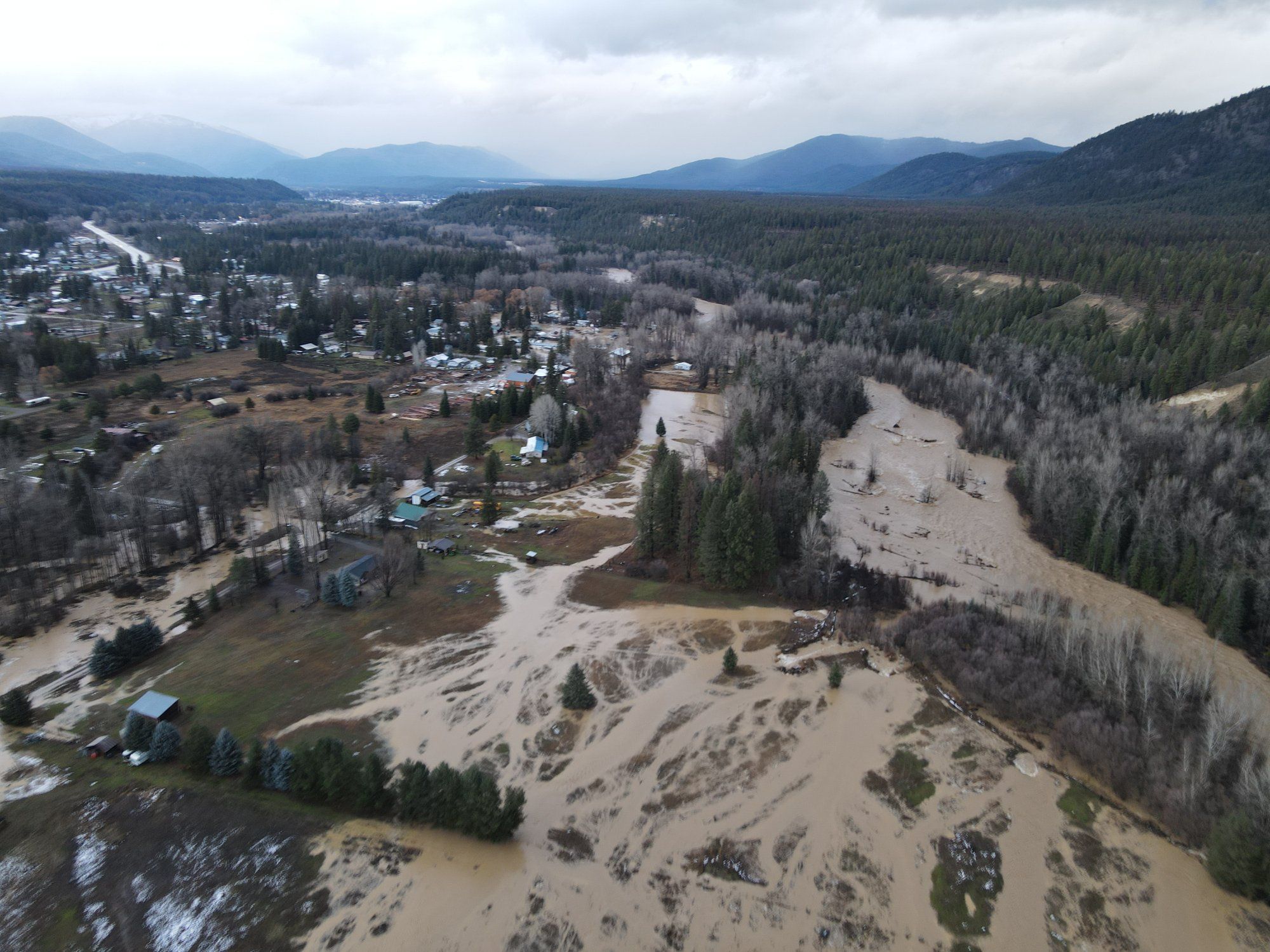
Several inches of rain fell on the region during the week of Dec. 8. It was coupled with warm temperatures that caused high elevation snow melt and led to widespread flooding.
The extreme conditions led to infrastructure damage, including the failure of the Lower Flower Creek Dam in Lincoln County and numerous roads and bridges.
According to Montana Disaster and Emergency Services, assessments on the costs of a severe wind storm the third week of the December are $6.5 million.
A presidential emergency declaration authorized up to $5 million in federal funds for emergency response measures to support the health and safety of those impacted by flooding in Sanders and Lincoln counties as well as the Blackfeet Indian Reservation.
Gov. Greg Gianforte is seeking an additional $16.3 million in federal funds for Lincoln County through two major disaster declaration requests submitted to the White House this month.
Montana only sets aside $16 million a year in disaster appropriations, the governor said, placing the state “in a financially precarious position without additional federal support.”
“These recent historic disasters impacted the state of Montana within one week of each other,” Gianforte said in a statement last week. “This is unparalleled for this time of year and occurred before the anticipated spring runoff. Consequently, over one third of the verified windstorm damage occurred in Northwest Montana, which is the focus of my preceding Major Disaster Declaration request.”
The first request, submitted Jan. 9, asked for $9.986 million for flood damages to Lincoln County. A second request submitted Jan. 16 seeks an additional $6.5 million for wind damage repair for the county.
Photo caption: Flooding in Libby, Montana, in December 2025. (Nathan Cernick via Facebook)
______
© 2026 The Western News (Libby, Mont.). Visit www.thewesternnews.com. Distributed by Tribune Content Agency LLC.
Sign in to get access to this free resource, and all of our whitepapers and reports.

Download this content today!
Register Now Already registered? Click here to Log In
Tags: Income Taxes, IRS, Montana, natural disasters, tax relief, Taxes