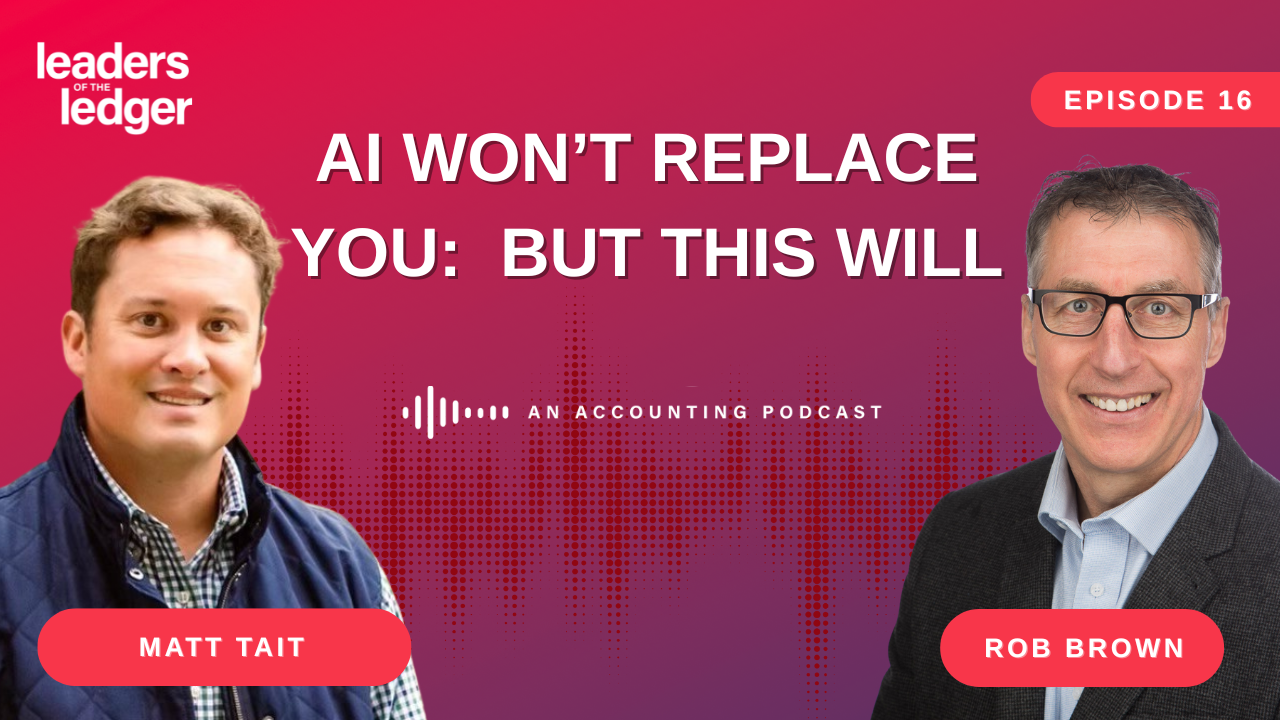




In this episode, Rob Brown sits down with Matt Tait, a recovering attorney turned entrepreneur who has built and scaled multiple companies, including Decimal. Matt shares how he accidentally became an accounting influencer. He explains why honesty and transparency outperform perfection. Leading through change matters now more than ever as accounting experiences its biggest transformation since the shift away from paper ledgers.
Matt discusses the shift from startup mode to company-building mode. The accounting industry’s resistance to change is real. Adopting AI isn’t optional anymore. Matt believes that “if you think change is hard, try not changing.”
Identity, authenticity, and building your voice online matter, even if you’re an introvert or an employee. Matt reminds listeners that “building trust and credibility is the one thing AI will never replace.” From the future of accounting firms to personal branding, this episode is packed with practical insights and no-nonsense truth about leading through change.
Key Topics Covered
- Matt’s journey from attorney to multi-company founder
- Why vulnerability builds trust more than pretending to know everything
- AI adoption and what happens to firms that ignore it
- “Choose your hard” – a philosophy for leadership and growth
- Building a personal brand authentically as an introvert
About Leaders of the Ledger
Leaders of the Ledger is an ongoing podcast series spotlighting the innovators, firm leaders, and rising stars shaping the future of accounting with practical insights and proven strategies.
This podcast is produced and owned by CPA Practice Advisor. You can learn more about the podcast, episode recaps, and more at https://www.cpapracticeadvisor.com/podcasts/.
Or use the below podcast play to listen:
Transcript (Note: There may be typos due to automated transcription errors.)
SPEAKERS
Matt Tait (Speaker 1) and Rob Brown (Speaker 2)
Rob Brown (00:01.272)
Hi, it’s Rob Brown here, host of the Leaders of the Ledger podcast. On behalf of CPA Practice Advisor, we are bringing you the influencers, particularly the younger generation that are coming through that are shaking the trees and ripping things up and creating new playbooks. I’m thrilled to have with me today from Indianapolis, Matt Tait. Good day, sir.
Matt Tait (00:20.171)
Well, thanks for having me. I really appreciate it. It’s a little weird for a recovering attorney like me to be called an influencer in the accounting space, but I guess it’s a hat I’ll wear.
Rob Brown (00:31.746)
Well, we’re going to find out how that all came about, Matt. But just for clarity, how does the term influencer sit with you? Is that something you seek or something that’s happened accidentally?
Matt Tait (00:42.875)
totally accidental. It’s not one I’m, I’m comfortable with. I joke with my family that someday I hope to, I hope to sell a business, make a lot of money and disappear from the internet. I’m an introvert, a hundred percent of the time. And my, my team asked me about 18 months ago to start posting on LinkedIn and just to be me. And, that.
led to, I think about 21,000 followers at this point. And apparently something is resonating. you know, for me, it’s just, I’m willing to be honest and upfront and transparent and to not pardon my French, but bullshit people. and I am okay doing that, but it certainly is not comfortable. I’d rather just not talk.
Rob Brown (01:29.784)
Well, accounting, legal types, you’re known for your honesty. I don’t know so much about your transparency and your vulnerability because that is something you bring up interest in. As the trusted advisor, whether it’s an attorney or an accountant, you want to have all the answers. You want to be absolutely 100 % correct. You are in the business of risk mitigation. You don’t want to get things wrong. You want to be liked by everybody. So
There’s a certain courage, isn’t there, in putting your stuff out there and maybe busting some myths, right, and some wrongs.
Matt Tait (02:01.045)
Yeah, you know, one of the things I teach my team is not knowing the answer is actually a really good way to build trust because there’s no way you’re going to understand and know everything. And when you admit to, I don’t know, but I’ve got a great team. Let me circle with them. Let me ask them questions and let me get back to you. And too many people on the sales side. And I think even too many people on the legal and accounting side, they, they think I got to have the answer. Like right now I have to have it right, right away.
And that’s an unbelievable characteristic. I mean, it is actually not believable. And so being vulnerable and saying, I don’t know is a really good way to build trust. And it’s being honest with yourself too. And I think both of those characteristics play out really well with people in general, but definitely when you’re trying to build a trusted client relationship.
Rob Brown (02:56.686)
Yeah, tell us a little bit about your journey, Matt. What were you doing at 16 years old? What was the young Matt Tait like?
Matt Tait (03:03.809)
I don’t think I’d like the young Matt Tait, but he had a lot of fun, did a lot of crazy things. My body is now recovering from a lot of sports, a lot of extreme sports, like jumping out of airplanes and off of cliffs and stuff like that. a hundred percent. Entrepreneurship is the old person’s adrenaline, adrenaline seekers thing to do. So for me, that was it. I, you know, I grew up in a family of entrepreneurs.
Rob Brown (03:06.167)
Yeah.
Rob Brown (03:12.161)
Okay.
Rob Brown (03:18.936)
Were you an adrenaline junkie, man?
Rob Brown (03:27.746)
Okay.
Matt Tait (03:33.345)
And I actually was at a family reunion about two years ago and I looked around, there were 60 of us in one house. So it was a big, it’s a big family. And I looked and I saw and I said, Hey, you know what? There are 12 people in this room that have either run or are currently running large businesses. And that’s just kind of the world I grew up in. So it’s, it’s always what I wanted to do.
Rob Brown (03:42.744)
Yeah.
Matt Tait (03:59.361)
I actually started out in law because my dad and my grandpa separately gave me the same piece of advice. They said, go to law school. You’ll save a heck of a lot on legal fees throughout your career. And, and that training was really helpful for me. I was a terrible lawyer though. Yeah. I’m a much better boss than I am an employee. and so I’ve, I’ve kind of spent my career running and starting companies. This is my fourth decimal is my fourth company. And we’re actually, on our
Rob Brown (04:14.243)
Ha ha.
Matt Tait (04:26.881)
It’s almost, it’s almost a separate company coming up. That’ll be my fifth. And, and some of them have succeeded and done well, and some of them have failed completely. So, my journey hasn’t been straight or linear, but, we’ve had decimal for now almost six years. And, and it’s been a really fun journey helping almost a thousand businesses, with their bookkeeping, with their accounting, with their taxes, and just trying to do.
Do it better. And I think it’s been a good journey.
Rob Brown (05:01.262)
That’s a very full answer to what you were like at 16, but appreciate the context there. And what’s fascinating there is how you had entrepreneurial blood in you, but you still went down the employed route, working for the man, getting your qualifications. A lot of entrepreneurs, they just skip that part. They don’t even go to university right out of the gate. They’re selling lemonade on the street corner and they are going their own way, but you wanted some education, you wanted some structure, some foundation, you were well-advised there.
What was that transition like coming out of that paid secure role and doing your own thing?
Matt Tait (05:38.853)
was scary and exhilarating at the same time. I was married. I’m lucky that my wife is way cooler and more stable than I am. She’s a partner at a big international law firm. at the time she was running the gaming commission in Indiana, kind of looking over and policing all the casinos and sports betting and all that stuff. a hundred percent. I definitely outkicked my coverage. But
Rob Brown (05:40.811)
haha
Rob Brown (06:00.364)
Way smarter than you then, Matt.
Matt Tait (06:08.158)
You know, for me, it was, I was excited. I was ready to do it. I had absolutely no idea what I was doing. but it was also scary. and for somebody like me who’s jumped out of quite a few airplanes, it was kind of that same feeling of, Hey, I’m pumped to do this, but holy cow, I could die. And, and it’s the same in entrepreneurship. It’s like, I’m excited to do this. I think it’s going to go well, but man, it could fail. And, and so I was, you know, I would say I was ready, but I wasn’t anywhere close to ready, but I did it.
Rob Brown (06:38.826)
ship do feel the accounting profession is in right now?
Matt Tait (06:43.837)
It is in a transitionary period, probably the single biggest transitionary period since the ledger moved off paper. and I think that it’s a lot of factors at once. It’s AI is certainly heavily talked about, technology is changing and adapting at a faster rate than it ever has before by exponential factors. I think you also have a globalized workforce. You also have the ability to, and I would say that
the need to service clients remotely. You don’t have to drive to their office. And you also have a workforce of people coming in that want to do things differently. I saw this in law and I see it in accounting where so much of the first couple of years of an employee’s life cycle at a big firm is almost like hazing. You gotta do it the way that I did. I had to go through it. You’ve gotta grind this out. And those aren’t actually reasons, they’re excuses.
Rob Brown (07:33.326)
Hmm.
Matt Tait (07:40.895)
I’m not saying they don’t learn things and there aren’t important parts of it. Yeah. But I think it’s time to reimagine how we do the work for clients and what that relationship means, what tools we use, how we structure things. So I think it’s at a transitionary point, which is very uncomfortable for the type of people that go into accounting who fundamentally don’t love change.
Rob Brown (08:04.054)
No, that’s very so. Accountants are not known as a breed for their agility and capacity to pivot on a dime. And if I was being cynical, I’d say accountants don’t change anything unless they’re mandated by law to do so. And probably lawyers are the same. But things are happening too, accounting. You alluded to a lot of them there. How coachable or adaptable do you feel accountants will have to be to stay relevant and competitive?
Matt Tait (08:17.973)
They need a forcing function.
Matt Tait (08:34.143)
I think they’ll have to be, let me say something else. I think this is the single most exciting time to be in accounting. Like I love this time period. I think it is an amazing time to have an impact, to create a good economic structure for yourself, to not have to go through all the hard parts to get to the good. I think it is a truly, truly good time to be in probably the best time to be in accounting.
Rob Brown (08:41.004)
Okay.
Matt Tait (09:04.671)
But I think the fact is we just have to accept that things are going to continuously change. The evolutionary cycles used to be decades long. Now they’re quarters, maybe annual changes. Just that’s kind of the way things are going. And it’s a good thing because it’s improving. But it’s a hard thing. Change is never easy. But the right type of change can have an amazing, amazing impact on people.
Rob Brown (09:31.983)
saw a TikTok video just recently that says, choose your hard. And the essence of the message was life’s hard whichever way you go. If you want to be really fit and healthy, that’s hard. If you want to be lazy and fat and overweight and unhealthy, that’s really hard too, because you’re going to recoup a whole load of pain there. If you want to be rich, that’s hard. If you want to be poor, that’s hard too. If you want to be an entrepreneur, that’s hard. If you want to be employed and secured, that’s hard too. So…
I guess you resonate with that choose your hard message.
Matt Tait (10:03.397)
I think it is. mean, I tell my kids all the time that life’s not easy and it will always be work and there’s joy in that work. And I think finding that is really, really important. I mean, to me, we exist at a time in accounting where the number of things coming at us at once is becoming overwhelming. And it’s why we’re pivoting our company.
to saying, we’ve been helping businesses, small businesses. We’ve done really, really well at that. But now we’re transitioning to helping the helpers. We want to make it easier for accountants running their own firms to deal with all of that, to take it away and let them kind of simplify their aperture, simplify their focus, because it’s becoming so crazy.
Rob Brown (10:55.95)
I’m increasingly seeing that, particularly on this Leaders of the Ledger show, it’s an international podcast. The people I interview, they do have a burden, a crusade of cause, as well as just running their own firm or doing their own thing. They wanna help their peers. They wanna help the profession. They wanna be a better ambassador for the brand of accounting. So you’re not just running decimal, you’re pouring something into the profession as a force for good.
Matt Tait (11:23.807)
I think that’s a hundred percent. mean, to me, trying to help people is why I do what I do. Every business I’ve started, every business I’ve run has been trying to help people. Started with nonprofits, then it became lawyers, then it became restaurants. Now it’s, then it was small, all small businesses. Now it’s accountants and people starting and running accounting firms. Like to me, that’s the joy that I have is, is trying to make an impact and, and it’s fun.
When I see clients from old companies and I’ll talk to them and be like, man, I really loved what you guys were doing or I still use that software or, you know, I still do this. And I want to be able to have that impact with decimal and say like 10, 15 years from now, like, Hey, you changed how I thought about things. And you guys really helped me help me figure out how to be better and to do better.
Rob Brown (12:17.058)
What frustrates you most about accountants?
Matt Tait (12:23.131)
I think what frustrates me most
Rob Brown (12:24.428)
You’re not one of them so you can speak from the outside. And actually neither am I. I’m a former high school math teacher and I’m a part qualified accountant. So I’ve got some external perspective as much as we love them and they are superheroes without capes. There are frustrations, aren’t there?
Matt Tait (12:41.355)
Yeah, I think what it gets me frustrated is that inability to change is how hard it really is for people to change. And the excuses that I hear for the reasoning. And I think that’s what really gets to me is when people say like, hey, I’m not going to use AI because it’s not secure. And then you ask them what else they’re doing and you realize that everything they’re doing is so insecure that
Rob Brown (13:06.474)
Hahaha
Matt Tait (13:08.649)
Adding an AI, if the front door is open and all the windows are open, locking the back door isn’t going to help. And so like it’s these, it’s these excuses that I don’t like. It’s the inability to be honest about like, I’m afraid of change. I don’t want to have to figure it out. And I think other professions have a tendency to be a little more honest about their reasoning. And I think those of us in accounting, see these, these bad excuses.
When we first got into and we’d sell against people in the space, we’d hear so often like, well, that’s just not how we’ve always done it. And I hate that sTait. And I tell my kids all the time. I hate that. My kids have grown up to just despise that sTaitment because it’s not a reason. It’s an excuse. How we have always done it is fundamentally not a reason. It is an excuse. Anything else could be a reason. And that’s kind of what frustrates me most is
It’s not just the inability to change. It’s the excuses that I hear that are so bad and just dishonest that I really don’t like.
Rob Brown (14:17.555)
our earlier point, choose your hard. If you think change is hard, try not changing, right?
Matt Tait (14:24.09)
my gosh. The ostrich that puts its head in the sand during a stampede gets run over.
Rob Brown (14:27.991)
you
So paint a picture for us Matt, for what will happen to the accounting professionals or the firms, the outfits that are unwilling or unable to change. What does the future look like for them?
Matt Tait (14:46.763)
I think they’ve picked the hardest of hard because what’s going to happen is, look, do we use AI? Do I firmly believe that AI is going to continue to have a great impact and a big impact on accounting? And I would just say on society in general, I absolutely do. I do not think that that is a tidal wave that can be stopped. How it’s going to impact is going to be different.
We don’t really fully understand what that impact is going to be yet. But what I do know is that accountants and firms that adopt and use AI are going to continue to beat firms that don’t. Because there’s a couple of different things. Number one, for the next two years, it’s not going to make much of a difference. Because prices are going to stay the same. Those firms that aren’t using it are just going to eat the margin, the changes.
Those that are using it are going to see greater margins because their costs are going to go down. Like how hard it is to scale by hiring is going to decrease. eventually there will be pricing compression and the prices will come down for the services that we do. And those people that have prepared for it are going to still achieve the margins they need to run a successful firm. Those that don’t are going to continue to shrink their margins. And so they’re going to struggle. They’re going to end up working harder.
and harder and making less and less money. And eventually that will burn them out and that’ll just become a tough thing. And their employees will see what it’s like at other firms and they’ll leave because they want to be able to match what they see in the marketplace. then advisory is coming. How to upskill. know, here’s the biggest thing. What people do, what accountants do, that is uniquely human that is not going to change is building trust and credibility.
Those are things that AI and technology are never going to do. But to build trust and credibility, you have to have the time to do it. If you’re stuck doing all the other things, all the work that is necessary, that work will always take up time instead of building trust and credibility, instead of the relationship side. And so that’s ultimately where you’re going to see a breaking point is you’re going to be caught doing things that
Matt Tait (17:12.073)
either outsourced employees could do at a lower cost point or technology could do at a lower cost point. And when you do that, you’re going to be running a much poorer economic infrastructure than those people that are using it. And that will eventually create a tipping point of exhaustion and failure. And I don’t know what the timeframe will be, but I think that’s an inevitability.
Rob Brown (17:37.549)
As so beautifully put, you must have been reading my mind. Another show I host, it’s my own show called Accounting Voices. the thrust of that show, Matt, is equipping accounting finance leaders to be more credible, more authoritative, more declarative, more visible, more vocal. So they’ve got a say in their own career. They can be a vanguard of the profession. You talk there about trust and credibility. Those are currencies for attention, for influence.
Matt Tait (18:05.494)
They are.
Rob Brown (18:07.864)
Tell me how you’ve built your brand. talked about putting stuff out there on LinkedIn, some accountants, business owners wouldn’t know where to start with something like that. But you’ve, whether intentionally or in a more structured way, you found a way to get your message out.
Matt Tait (18:26.667)
Well, it just started with being honest about the journey. mean, being an entrepreneur is really hard. And I think, like I said before, I’ve had success and I’ve had complete failure. And I just started talking about that and at Decimal, we’ve had successes and we’ve had failures. And being honest and transparent about that. And then talking about how lonely it can be to be a CEO or a founder of a company. Talking about how to deal with that, how to go through that.
talking about, you know, one of the things I’ve always found as hard is, is as you grow a business, when you’re in startup mode, the things that work, stop working when you start scaling a business. was talking to a guy earlier this week and we’re talking about how he’s just kind of switched into company building mode and the skillset necessary for company building mode is much different than the skillset necessary for startup mode. And that can be really hard on those of us that lead because at some point we have to look in the mirror and say, wow.
we really kind of suck at some of these things. And we have to find other people to do that and be willing to be honest about it. So that’s where I first started talking. And then I just started talking about some of the things that you and I have hit on with accounting of kind of what I see in the future, like how we do things, how we view things. Our next phase of growth at Decimal and that pivot for us is we just started franchising. We…
Rob Brown (19:28.366)
you
Matt Tait (19:52.799)
are now in the business of helping people start their own firm and doing it in a way that they can focus on client relationships and growth and decimal itself can help with all that other noise with AI and technology and outsourcing so that they can focus and kind of decrease what they need to look at. Because as a business owner, I’m juggling a million things a day and wearing a thousand hats. And, you know, if I can help people start a firm and take 90 % of those hats and the things they’re juggling.
they’ll be more successful. And I think that’s kind of where our content started and really where we focused all of it is towards that.
Rob Brown (20:33.352)
What would you say to professionals listening that say, it’s okay for Matt. He’s the boss. He’s an entrepreneur. He’s a business owner. I’m employed. I’m working for the man. I’ve got responsibilities. I’ve got a corporate brand. I’ve got to adhere to. I’ve got certain policies and procedures. I can’t really say what I want to say. I’ve got to be careful with my personal brand. I recognize it’s important. Is the hope for people like that?
Matt Tait (20:59.125)
I think there absolutely is. It all starts with looking in the mirror and deciding who you are and who you want to be. And you can talk about that in a good way. You know, I may be the boss, but guess what? I’ve got a family. I’ve got a wife who’s a lawyer. She reads all my posts. I’ve got a board and investors. They read all my posts. So.
Rob Brown (21:17.23)
You
Matt Tait (21:23.463)
I have to also think about other factors as well. I also have to think about am I being a good person when I post? Yeah, look, not everybody. My last boss called me an irreverent little shit. So I would not recommend people that work for others to take any advice that I have, but you can still be you. You know, there’s a really cool company in the accounting tech space called Rillet, and they hired a VP of Finance.
Rob Brown (21:35.374)
Wow.
Matt Tait (21:51.657)
And that VP of finance is now an accounting influencer and lead some of their branding and marketing efforts because he just started authentically posting. He is an employee. And yet within the scope of being an employee, he started posting about their journey, about what he sees in the world. He does it in a fun and lighthearted way. Like me, he loves hats. So I totally empathize with that, but he’s figured out how to do it.
There are ways for you to use social media as an outlet. There are also ways to just be your authentic self without social media. And I think that’s the biggest thing I would encourage people, whether you’re running a business or not, is take time and figure out who you are and who you want to be and figure out what you need to do to bridge that gap.
Rob Brown (22:41.976)
I’m glad you use the word authenticity because too often we try and copy somebody else. I want to be Matt Tait. I want the following he’s got. I want the engagement he’s got. And it’s not congruent, is it? But what about the courage you acquired to put something out there and tumbleweed? Or an echo chamber or nothing? There’s a journey there, isn’t there? Because at the beginning it’s very sparse. It’s barren land.
Matt Tait (22:47.87)
yeah.
Matt Tait (23:06.186)
yeah.
I mean, the first couple of times you do it, it’s like anything. You have to build the habits around it. And so for me, the first habit that I did was my team convinced me to start posting on LinkedIn. And we started talking about what that would look like. And I said, okay, I’ll make you a deal. I will start posting every day for 90 days and I will track it. And I built a little habit tracker and I made sure that 90 days and
I didn’t pre-write any posts. Sometimes I’d kind of come up with an idea a few days earlier, but I wrote it all and I tracked and for 90 straight days I posted. at the end of that, I started getting engagement. then around the six month mark, I did something that went viral and that was what made it all worth it. And you never know what it is. It’s funny. The minute you think you’re writing a viral post, I guarantee it’s not going to go viral.
Rob Brown (24:05.304)
Yeah
Matt Tait (24:06.465)
and so it was, it was just something that was calling out a hypocrisy that I saw in the industry. Yeah. My viral posts almost inevitably get me in trouble with somebody, but, it was that 90 day habit building. And I’ve used that tactic in getting in shape in, starting to read more in spending more time with my wife.
in other aspects of my life, that 90 day habit building stretch, I find that if you can do something consistently for 90 days, you’ve locked in a habit that you can continue going forward.
Rob Brown (24:40.728)
Very sagely advice. And I want to wrap this up. You’re such an inspiration to implied and self-employed people because you’ve had a foot in both worlds and you’re very honest about your journey and your ups and downs in it. What gives you hope for the accounting world that we’re in?
Matt Tait (25:00.609)
There are a lot of amazing people and I know we’ve talked about a lot of the things that we don’t like and a lot of the problems, but we exist in an industry that likes to help each other and that exists to help businesses and to help people. And we will get there. It’s not going to be easy. It’s going to be messy. There are going to be a ton of mistakes, but we are at a really cool tipping point and evolutionary point for the accounting industry. And it’s the people.
and the quality of the people that are in the industry that’s going to lead us through that. And hopefully somebody like me that’s an outsider can play a role in holding up a light in the dark and saying, hey, follow me this way and let’s see if we can get there together.
Rob Brown (25:43.854)
final question for you in a minute, Matt, but let’s bring this to a close. If people want to contact you, you’ll be on LinkedIn. They can find out all the great things Decimal are doing, the franchise opportunities and the other ways you’re changing the world and just get a handle on your journey. So we really appreciate you sharing your passion and your insights on Leaders of the Ledger podcast from CPA Practice Advisor. What are the benefits of having a voice?
What are the benefits of where you’ve got to in having some influence now, having some gravitas, some weight, a following. You can make things happen and change stuff, can’t you? Just leave us with that inspirational thought.
Matt Tait (26:21.791)
You can, when, when people listen, you can say things they listen to and you have to be careful with that, but you can start to lead and you can start to give them a path forward in a time where they’re scared. And, and that’s something that I hope in, all these changes and all the stuff that’s going on. If every once in a while I can say something that somebody says, gosh, that really helped me that stuck with me. Then that means I made an impact and.
Nowadays I go to a conference and I’ll have one or two people come up to me and say like, I still remember this post or I listened to your podcast that did this. And I hate posting on LinkedIn and I really don’t love doing a bunch of this non introverted stuff, but those are the conversations or emails that make it worth it to me and why I do enjoy some aspects of
Rob Brown (27:15.31)
It’s been a privilege to shine a light on you and all the great things that you’re doing You’ve really moved the dial for us today. Thanks so much for appearing on the show
Matt Tait (27:24.661)
Thanks for having me, I really appreciate it.
Sign in to get access to this free resource, and all of our whitepapers and reports.

Download this content today!
Register Now Already registered? Click here to Log In