




Direct File—the free, online service that allows eligible taxpayers to prepare and file their federal income tax returns directly with the IRS—won’t be available for the 2026 tax filing season, the Associated Press reported on Wednesday.
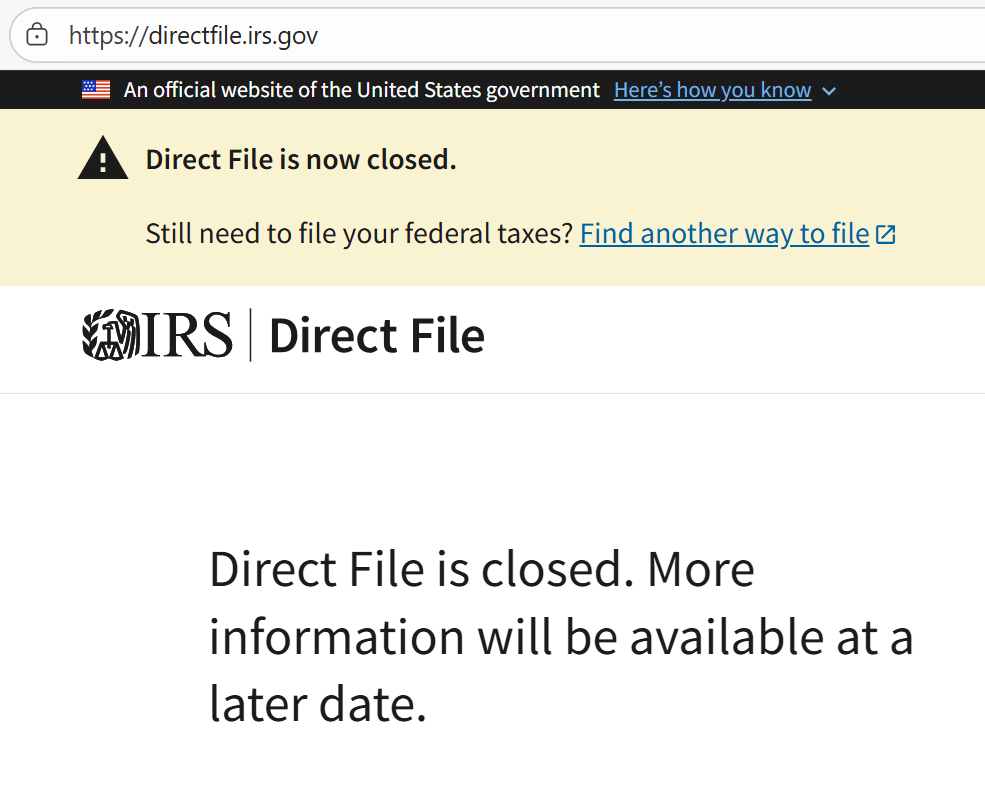
A message on the webpage for Direct File currently says, “Direct File is closed. More information will be available at a later date.” The webpage also has a link to the IRS’s “File your tax return” page.
In an email sent to comptrollers in the 25 states that partner with the agency on Direct File, the IRS said the program won’t be provided next year and “no launch date has been set for the future.”
According to the Associated Press, Treasury Secretary Scott Bessent, who is also the acting IRS commissioner, told reporters at the White House on Nov. 5 that there are “better alternatives” to Direct File and said that “it wasn’t used very much.” He added that “the private sector can do a better job.”
The Center for Taxpayer Rights filed a Freedom of Information Act request for the IRS’s latest evaluation of the program, and the report says 296,531 taxpayers submitted accepted returns for the 2025 tax season through Direct File, up from the 140,803 submitted accepted returns in 2024, the Associated Press reported.
Other data published in the Center for Taxpayer Rights report includes:
- Eligibility doubled to 32.2 million taxpayers in 2025, up from 15.4 million last year.
- Direct File rolled out to 25 states, up from 12 last year, including 12 new partnerships with income tax states.
- Despite eligibility increases and availability for all of filing season, traffic was flat, only up 16% year over year.
- 94% of taxpayers described their experience as “excellent” or “above average,” up from 90% in the prior year.
- Direct File’s Net Promoter Score increased to +80, up from +74 in 2024.
- The average wait time for live chat with customer support was 44 seconds, up slightly from 40 seconds in the prior year.
- Direct File’s submission acceptance rate increased to 87.9%, up from 73.4% in the prior year, and 91.2% of returns were accepted on the first attempt.
- Identity theft and refund fraud using Direct File remained negligible.
- The IRS spent $41 million on Direct File for filing season 2025, up from $24.6 million for the 2024 pilot.
The tax agency launched the pilot program in 2024, under then-President Joe Biden, making it available to taxpayers in 12 states. It was later expanded to include 25 states, including California, New York, Florida, Texas, Illinois, North Carolina, and Pennsylvania.
Residents of these 25 states reporting W-2 wage income, Social Security income, retirement income, and other credits and deductions were able to use the service this filing season. But taxpayers with business, rental, or gig economy income were ineligible.
Many Republicans have expressed criticism of the Direct File program, arguing it poses a number of problems.
“The program’s creation and ongoing expansion pose a threat to taxpayers’ freedom from government overreach,” a group of 29 House Republicans said in a December 2024 letter to Donald Trump before he took office for his second term as president in January.
They argued that the IRS faces a conflict of interest in preparing tax returns because it simultaneously acts as the tax collector and enforcer.
The agency “has little incentive to ensure hardworking Americans do not pay more than they owe in taxes and may instead benefit from families and small businesses paying greater amounts than they are required by law,” the letter said.
Sen. Mike Crapo, an Idaho Republican and chairman of the Senate Finance Committee, has also said it’s unclear whether the program is legal without congressional approval.
Rep. Adrian Smith (R-NE), a member of the tax-writing House Ways and Means Committee, said in a statement on Wednesday, “IRS Direct File was an expensive, duplicative program which was never authorized or funded by Congress, and I want to express my appreciation to President Trump, Secretary Bessent, and [IRS] CEO [Frank] Bisignano for bringing this chapter to a close. American families and family businesses by-and-large pay their taxes accurately and on time. The Biden administration and congressional Democrats’ vision of a supercharged IRS monitoring Americans’ bank accounts, assessing tax, and targeting anyone who disagrees, especially farmers, ranchers, and small businesses, for audits, is inconsistent with our longstanding voluntary compliance system and with basic standards of fairness. The Department of Treasury has correctly identified the need to improve access to new and existing free file options for basic family tax returns, and I look forward to working with the Trump administration and my congressional colleagues to ensure it happens.”
Democrats, on the other hand, have long defended the pilot program, contending it saves taxpayers time and money.
In a statement on Wednesday, Sen. Ron Wyden (D-OR), who is ranking member on the Senate Finance Committee, said, “The Trump administration operates like a laser-guided weapon aimed at any useful public service that saves Americans time and money. The only thing Trump accomplishes by doing this is stealing from working-class taxpayers to pad the profits of giant, rent-seeking tax software companies.”
Sen. Elizabeth Warren (D-MA), who also sits on the Finance Committee, wrote on X Wednesday, “Thanks to Donald Trump, giant tax prep companies are popping champagne, while Americans are forced to spend more time and more money to file their taxes. Filing your taxes should be free and easy. This fight isn’t over.”
The IRS has faced intense blowback to Direct File from large tax preparation companies that have spent millions lobbying Congress. The average American typically spends about $140 preparing returns each year.
The Washington Post and NextGov first reported on the email to state comptrollers confirming the program wouldn’t be offered next year, according to the Associated Press.
Tribune News Service contributed to this article.
Sign in to get access to this free resource, and all of our whitepapers and reports.

Download this content today!
Register Now Already registered? Click here to Log In
Tags: Income Taxes, IRS, IRS Direct File, tax returns, tax software, Taxes