




CFOs and finance leaders grappling with the volume and pace of AI developments in corporate finance should focus on three areas in the near term, according to new findings from Gartner Inc., a business and technology insights company.
“The pace and potential of AI developments in finance can be overwhelming,” said Alex Levine, Director Analyst in the Gartner Finance practice. “The AI in Finance Hype Cycle aims to help finance leaders cut through the noise and focus on technologies likely to have the most impact in the near-term.”
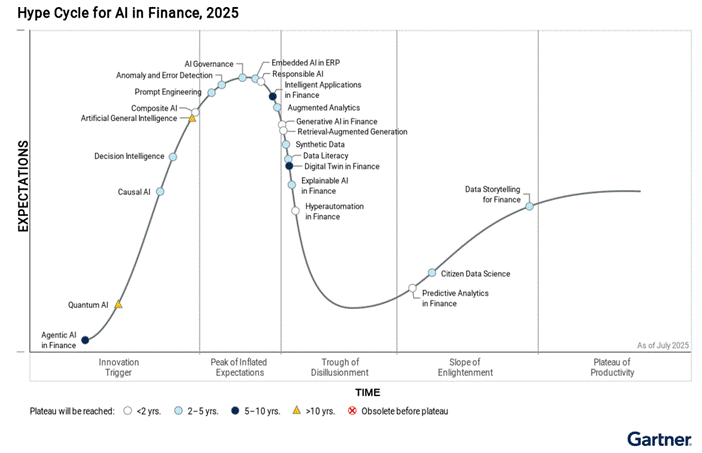
Gartner Hype Cycles provide a graphic representation of the maturity and adoption of technologies and applications, and how they are potentially relevant to solving real business problems and exploiting new opportunities. Gartner Hype Cycle methodology gives a view of how a technology or application will evolve over time, providing a sound source of insight to manage its deployment within the context of specific business goals.
Three areas stand out as having the potential for transformational impact while reaching mainstream adoption within two years: Generative AI in Finance, Composite AI and Responsible AI (see Figure 1).
Figure 1: Hype Cycle for AI in Finance, 2025
Source: Gartner (Septmber 2025)
Generative AI in Finance
Generative AI (GenAI) has been advancing rapidly with the rapid adoption of consumer-facing public tools, such as ChatGPT, Microsoft Copilot, and Google Gemini. As a result, 80% of independent software vendors are expected to have embedded GenAI capabilities in their enterprise applications, up from less than 5% in 2024 – according to the Gartner 2025 Finance Technology Bullseye Report.
“Finance leaders are looking for technologies that help them to collect, review and assess the growing amount of data in the increasingly complex world of finance operations,” said Levine. “Top finance technology vendors know this and see GenAI as a top competitive area, differentiating their products on enterprise readiness, pricing, infrastructure, safety and indemnification.”
The rapid arrival of new GenAI models alongside tools that improve model robustness are quickly increasing the range of viable finance use cases and making it more accessible to a greater number of finance functions, leading Gartner experts to expect an impact on most finance functions within two years.
Composite AI
Composite AI, also known as hybrid AI, is the integration of multiple AI techniques — such as machine learning, deep learning, rule-based reasoning, and optimization methods — to broaden the scope and effectiveness of AI solutions. This approach recognizes that no single AI technique is sufficient for all business problems, and by combining methods, organizations can address a wider range of challenges and improve knowledge representation. Composite AI is foundational to emerging areas like GenAI, decision intelligence platforms, and agentic AI.
“The business impact of composite AI is significant, as it enables organizations with limited historical data but strong domain expertise to leverage AI for more complex reasoning tasks,” said Levine. “It’s especially valuable for organizations seeking to move beyond narrow, data-driven models to solutions that incorporate human expertise and adapt to diverse scenarios, making it a key driver behind the latest GenAI implementations.”
However, adopting composite AI comes with challenges, including a lack of expertise in combining multiple AI methods, the complexity of deploying and managing various models (ModelOps), and concerns around trust, security, and ethical behavior.
Responsible AI
Responsible AI (RAI) is a comprehensive framework that ensures AI is developed and used in ways that are ethical, transparent, fair, and accountable. It encompasses a wide range of considerations, including risk management, trust, explainability, bias mitigation, privacy, safety, sustainability, and regulatory compliance.
“RAI currently flies under the radar for many finance leaders, but it is vital to understand and get right for long-term AI success,” said Levine. “The importance of RAI has grown as AI becomes more deeply integrated into business and society. RAI practices are increasingly formalized through governance structures and industry regulations, requiring organizations to address both organizational and societal responsibilities.”
Organizations should balance business value with ethical and regulatory boundaries, safeguard intellectual property, and ensure fairness for customers and citizens. Corporate finance functions must also consider auditability and reporting accuracy. Societal drivers, for example legal mandates such as the EU’s Artificial Intelligence Act, make RAI not just a best practice but a necessity for organizations deploying AI technologies.
Gartner clients can read more in Hype Cycle for AI in Finance, 2025, and nonclients can read The CFO Report.
Sign in to get access to this free resource, and all of our whitepapers and reports.

Download this content today!
Register Now Already registered? Click here to Log In