


By Alexandra Kukulka
Post-Tribune (Merrillville, Ind.)
(TNS)
Former Portage Mayor James Snyder was sentenced to three years probation Tuesday, his 48th birthday, on his federal conviction for obstructing the IRS.
U.S. District Court Northern District of Indiana Chief Judge Holly Brady read the sentencing and said she reached the decision based on many factors, including Snyder being “embroiled in this case” for nearly 10 years.
Snyder will have to pay $78,111.57 in restitution, which is what he still owes for obstructing the IRS, Brady said, made in monthly payments of $570 a month. Brady said Snyder has paid $18,000 of his debt.
Ahead of his sentencing, Snyder addressed the judge in a question-and-answer session with his attorney Josh Minkler. When asked, Snyder said he believed “this crime is extremely serious.”
Over the years, Snyder said the indictment, trials and media coverage have been taxing on him and his family. Snyder told Brady about his wife, four children and his work at his church, and he assured the judge he would be committed to his family, church and work if he was spared jail time.
Addressing his family, Snyder said, “I think that I could’ve done better.”
Brady asked Snyder how the case impacted him. Snyder told her the experience has “humbled” him.
“Every time you seem to fight, you think you win and you don’t,” Snyder said. “I just want to be done, get it right and get it behind me.”
Assistant States Attorney Julia Schwartz said the prosecution requests a 21-month prison sentence. Schwartz said the sentencing guidelines for the charge range between 33 months and 36 months, so 21 months is lower than that and consistent with Snyder’s previous sentencing in the case.
Minkler said Brady should consider three years probation or probation and home confinement instead of prison time.
Schwartz outlined the $96,111.57 in business and personal taxes that Snyder failed to pay to the IRS the payroll and income taxes, Medicare and Social Security from employees’ paychecks at his company, First Financial Trust Mortgage LLC, a mortgage loan origination business.
Then a company called GVC acquired FFTM, after which “FFTM looks like it has no assets, so (Snyder) is avoiding tax liability,” Schwartz said. While with GVC, Snyder issued invoices to SRV, which he owned, Schwartz said.
Snyder lied to the IRS by hiding wages from GVC and his ownership of SRC, Schwartz said. Further, Schwartz said SRV gave a $73,000 loan to Snyder’s mayoral campaign in 2013, she said.
“That $73,000 should’ve been going to the IRS but went to his campaign,” Schwartz said, adding that elected officials should be held to a higher standard.
Snyder’s legal team called IRS agent Jerry Hatagan to testify ahead of the sentencing in an attempt to decrease some of the sentencing enhancements that Snyder faced, like Snyder acting as a leader of a criminal enterprise.
Hatagan testified that if an IRS obstruction charge like Snyder’s was considered “solely on number” and not the manner it was committed, it wouldn’t be prosecuted.
“But it was all the other aggravating factors in this case that caused it to happen how it happened,” Hatagan said. When asked by Schwartz, Hatagan elaborated that those factors were that Snyder was an elected official and that the tax scheme lasted multiple years.
Snyder didn’t own GVC, Hatagan said, and GVC told IRS agents that it was common practice for the company to acquire other companies. But, “the problem we had,” Hatagan said, was that under GVC ownership, Snyder was using SRC to invoice FFTM.
While Snyder “painted a dire picture to the IRS,” Hatagan said, he was receiving a paycheck from GVC and getting payments from invoices to SRC.
Brady ultimately ruled that Hatagan’s testimony didn’t alter her opinion on the sentencing enhancements.
Prosecutors dropped the bribery charge at the start of the hearing, but gave background on the facts that led to the bribery charge for Brady to consider in her sentencing. Minkler said the U.S. Supreme Court ruled in the case about gratuities versus a bribery, so “the book needs to be closed on that issue.”
In arguing against prison time, Minkler said without the bribery charge, Snyder’s crime, while still serious, is less serious than the last time he was sentenced.
“This is a serious offense, we’re not trying to say it’s not. But as tax cases go, this isn’t a tax fraud case,” Minkler said.
While the case has gone on for nearly 10 years, Minkler said Snyder “had to keep pushing to get it right.”
“Getting it done right is more important to getting it done quickly,” Minkler said.
Minkler said that the IRS obstruction charge “seems to be an apparition” in Snyder’s otherwise crime-free life. Brady interjected that Snyder evaded the IRS for years.
“It wasn’t just a one-off,” Brady said. “I struggle with that.”
Snyder asked for a new trial on his conviction for defrauding the IRS in federal court filings in October 2025. Federal prosecutors, in their response, said his request is untimely and without merit.
This is the latest chapter in a saga that began more than nine years ago when Snyder was indicted on one count of defrauding the IRS and two counts of bribery, one involving towing contracts and the other involving garbage trucks.
A jury in U.S. District Court in Hammond found Snyder not guilty on the charge involving the towing contract, and convicted him twice on the garbage truck charge, a case that made its way to the U.S. Supreme Court, which deemed in June 2024 that the $13,000 payment Snyder received over a garbage truck contract was a gratuity, not a bribe, because the payment came after the contract and not before. The case was remanded to the lower courts.
A jury convicted Snyder on the IRS charge, which involved his personal business and not his duties as mayor at the time, and that conviction had remained unchallenged.
Snyder was scheduled to go to trial for a third time on the charge involving the garbage truck contract, but prosecutors have said they would like to sentence Snyder for obstructing the IRS and forgo a third trial on his bribery charge.
Snyder, awaiting sentencing on the IRS conviction, which has been repeatedly pushed back, argued in an Oct. 31, 2025, filing that he wanted a new trial on the IRS charge because the information presented on the bribery charges could have improperly swayed the jury.
The U.S. Attorney’s Office argued that Snyder’s request was “both untimely and meritless.”
In the sentencing memorandum, prosecutors argued that between January 2010 and April 2013, Snyder executed a scheme to obstruct the IRS’s collection of his unpaid business and personal taxes.
In 2007, Snyder created First Financial Trust Mortgage LLC, a mortgage loan origination business, where he withheld a portion of employees’ paychecks for payroll and income taxes, Medicare and Social Security, prosecutors said.
But, in 2007, 2008 and 2009, Snyder didn’t pay the IRS those funds taken from employees’ paychecks. Snyder also didn’t timely file IRS forms, prosecutors said.
By November 2009, the IRS discovered that the company owed approximately $97,000, prosecutors said, while Snyder paid himself approximately $110,000 from the company bank account.
In January 2010, Snyder signed an employment agreement with a mortgage company called GVC and opened a “branch office” out of the First Financial Trust Mortgage LLC office. Under the agreement, GVC hired Snyder as an employee and hired and paid all his employees, prosecutors said.
In 2010, GVC paid Snyder approximately $141,891.27, prosecutors said. Also in 2010, Snyder began creating “phony invoices” from a company called SRC to bill First Financial Trust Mortgage LLC for “consulting” work, prosecutors said.
GVC paid SRC over $400,000 in 2010, 2011 and 2012, and SRC received deposits totaling over $640,000 in that same time frame, prosecutors said.
“By routing GVC’s payments through SRC instead of FFTM, (Snyder) concealed FFTM’s true financial status from the IRS. It was a shell game to obstruct the IRS in its tax assessment and collection obligations,” prosecutors said.
On his personal taxes, Snyder owed the IRS $31,369 for tax years 2005, 2006 and 2007. But, under penalty of perjury, in March 2010 Snyder stated his personal tax debt was uncollectible and instead offered to pay $1,000, prosecutors said.
Snyder didn’t disclose to the IRS his employment at GVC, didn’t list his income from GVC and didn’t disclose his ownership of SRC or its bank accounts. The March 2010 tax form didn’t disclose, for example, that Snyder received $141,891.27 in wages from GVC, prosecutors said.
In total, the total tax loss in this case is $125,149.57: $96,111.57 in what FFTM failed to pay and $29,038 in Snyder’s personal taxes, prosecutors said.
Snyder, a Republican, was first elected mayor in 2011 and reelected in 2015, a term cut short by his federal conviction in February 2019.
Snyder received a sentence of 21 months in prison for the bribery and IRS convictions and a year on supervised release from U.S. District Court Judge Matthew F. Kennelly of the Northern District of Illinois.
Snyder successfully argued that the start of his sentence should be postponed until his bid to have the Supreme Court hear his case was complete.
As Brady read the sentence, Snyder’s family cried silently and church friends smiled. Brady wished Snyder good luck.
“I certainly trust you won’t be back in front of this court,” Brady said.
After his sentencing was read, Snyder went to his wife and four children, and they had a group hug and wiped away tears.
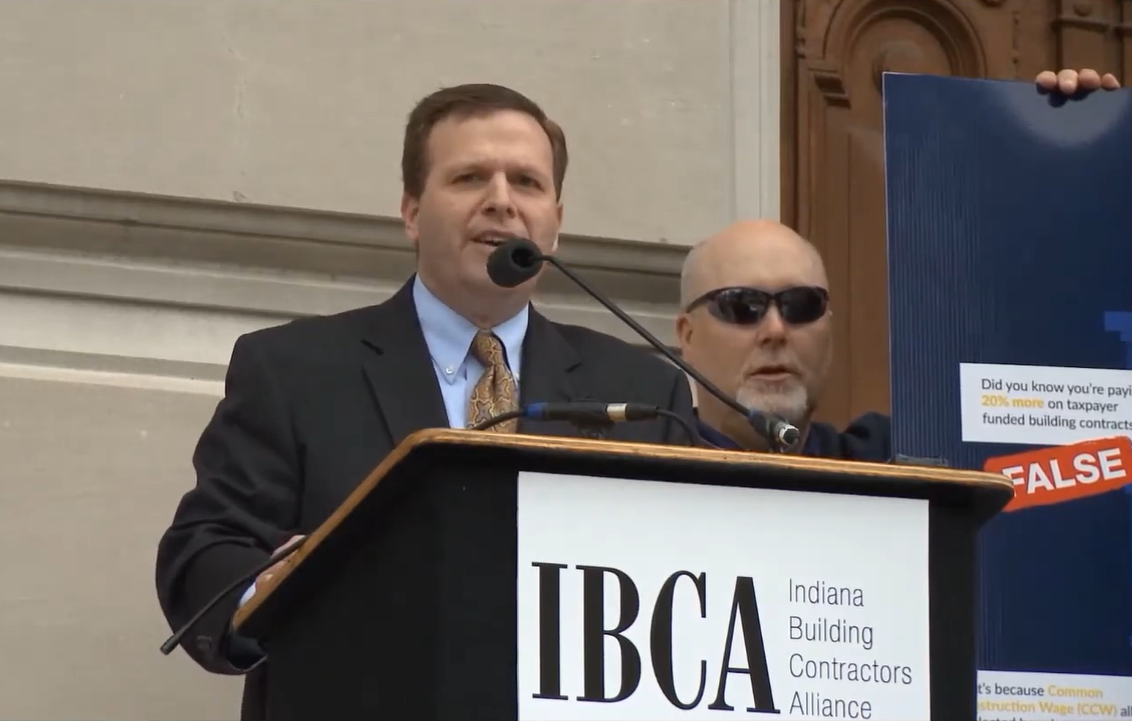
Photo caption: James Snyder, mayor of Portage, IN, delivers a keynote speech at the Indiana Building Contractors Alliance Rally on the Indiana Statehouse steps in defense of Indiana workers on April 27, 2015. (YouTube page of Mayor James Snyder)
_______
©2026 Post-Tribune (Merrillville, Ind.). Visit at chicagotribune.com/suburbs/post-tribune. Distributed by Tribune Content Agency LLC.

Thanks for reading CPA Practice Advisor!
Subscribe Already registered? Log In
Need more information? Read the FAQs
Tags: Income Taxes, Indiana, IRS, James Snyder, obstructing the IRS, sentencing, Taxes