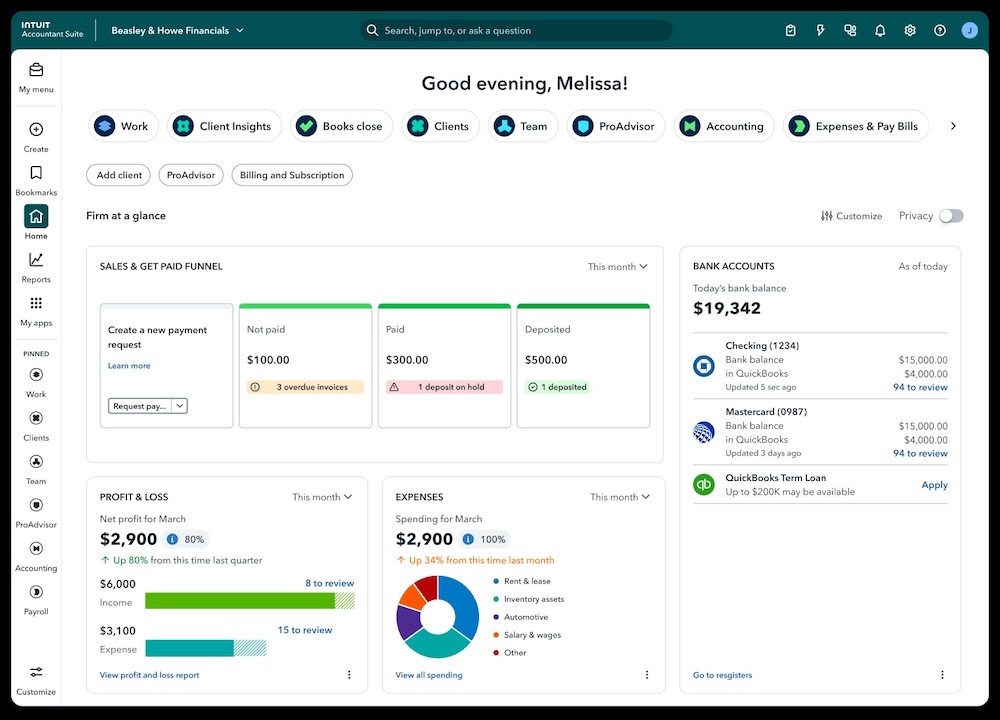




Even though you may be in the middle of busy season, helping your clients grow their businesses by providing deeper, impactful advisory insights never stops.
By now, you’re probably familiar with Intuit Accountant Suite and Intuit Enterprise Suite, each designed to transform the books-to-tax workflow from a seasonal grind into a high-powered engine. Still, you may not know their differences and how they empower you to provide proactive, data-driven guidance to your clients.
Elevating Practice Management: New features in Intuit Accountant Suite
You can think of Intuit Accountant Suite as the central system for firms; it is a step-up from QuickBooks Online Accountant, which will fully transition to Intuit Accountant Suite at the end of this year.
The February 2026 updates introduce several key features designed to streamline operations and enhance the professional development of your staff.
Intuit Intelligence (Beta)
Firms can now beta test Intuit Intelligence. This AI-powered assistant provides instant answers regarding firm data and delivers personalized insights. In addition, firms on the Accelerate plan have beta access to query specific client files without switching between accounts, providing a powerful tool for deep-dive advisory sessions.
Enhanced control and team organization
One of the most significant operational updates is the introduction of Team Groups. This feature, also in beta, allows firm owners to organize their practice by bulk-assigning teams and clients to custom, role-based access groups. This ensures that the right staff members have the level of access needed for their specific client base, reducing administrative overhead and strengthening internal security protocols.
Professional Development and Training
To support the ongoing growth of your talent, Intuit has integrated the ProAdvisor Training Manager Dashboard directly into the Suite. This centralized hub allows firm leaders to:
- Assign specific training modules to team members.
- Set reminders for upcoming deadlines.
- Track real-time completion status for professional development.
A new Intuit Accountant Suite product training is now available within this dashboard to help teams quickly master the platform’s latest capabilities.
Recommended Articles

Client Acquisition and Hub Management
The newly launched Customer Hub provides a dedicated space for firm growth. Practitioners can now manage leads, gather referrals, and automate follow-up tasks from a single interface. This helps strengthen client relationships from the very first point of contact, ensuring that no potential business falls through the cracks during the busy season.
Streamlined Month-End Processes
Currently in beta, the Books Close feature has received substantial enhancements to accelerate the month-end process. These updates offer greater customization, including:
- Customized templates tailored to specific firm review processes.
- Multiple assignees for complex close tasks.
- Custom statuses to track the exact stage of every client’s books.
- In-flow collaboration tools that allow team members to ask and answer transactional questions directly within the workflow, eliminating the need for external email chains.
Intuit Enterprise Suite: Mid-Market and Complex Clients
For firms managing mid-market and complex clients, Intuit Enterprise Suite offers an AI-native experience that scales alongside organizational growth. The February 2026 release focuses on deepening operational power through four main pillars: industry-specific functionality, multi-entity management, business intelligence, and workforce management.
Solutions for Construction Clients
The Suite now includes a comprehensive construction module (beta), allowing businesses to manage projects end-to-end, from winning bids to project close.
- Project Phases and Cost Groups: Users can plan and track budgets against project phases and designate industry-standard cost groups such as labor, materials, equipment, or subcontractors.
- Proposals and AIA-Style Invoicing: The new proposal document builder includes integrated e-signatures and a client portal for deposits. AIA-style invoicing format provides transparency by tracking total contract value, amount invoiced to date, and remaining balance at the phase level.
- Negative Change Orders: The platform now handles negative change orders automatically, eliminating the need for offline calculations when project scope is reduced.
Advanced Business Intelligence and Reporting
To turn data into strategy, the Suite has introduced several sophisticated reporting tools:
- Improved Modern Report View: This is now the standard for all reports, offering automatic refreshes, zero-balance visibility, and alignment with GAAP standards.
- Calculated Fields: Practitioners can now create custom formulas and perform calculations directly on top of existing report data without exporting to spreadsheets.
- Management Reports: Multi-entity management reports can now be customized with KPI widgets, charts, and smart chips that automatically update figures across the document.
- Expanded Integrations: The suite can now pull in variables from third-party CRM and workforce tools, consolidating disparate data into a single source of truth.
Multi-Entity Financial Management and Automation
Managing multiple entities is simplified with five new consolidated reports, including Invoice lists and Transaction details by account. The Suite’s AI capabilities have also been enhanced:
- Finance Agent: Provides a parent-level view of performance across all entities with the ability to drill down into individual organizations.
- Accounting Agent: Scans and analyzes incoming bank feed transactions, automatically matching vendors and categories for group review.
- Parallel Approvals: Firms can now create complex workflows with up to five parallel approvers, ensuring robust governance and accountability.
Inventory and Workforce Management
The Suite continues to evolve its operational core with features such as Item Receipt, which serves as the official record of physical goods received to ensure financial accuracy. For those migrating from QuickBooks Desktop, the option to use Moving Average Cost (MAC) valuations is now available, maintaining consistency in inventory records.
In the realm of workforce management, QuickBooks Payroll customers can now handle the full garnishment lifecycle in one place. In addition, the Consolidated Employee List provides unified visibility of all W-2 and multi-entity employee information, while assignments in QuickBooks Time help improve job-costing accuracy.
A New Standard for Accounting
The updates to Intuit Accountant Suite and Intuit Enterprise Suite are an important shift in how accounting professionals interact with financial data. By unifying practice management, complex multi-entity reporting, and industry-specific tools into a single ecosystem, Intuit is providing the infrastructure necessary for firms to do more than compliance and bookkeeping; they will serve as true partners to their clients.
Embracing these new capabilities is the solid step toward a smarter, more profitable practice.

Thanks for reading CPA Practice Advisor!
Subscribe Already registered? Log In
Need more information? Read the FAQs