



By Betsy Hammond
oregonlive.com
(TNS)
On a party line vote Monday, Oregon Democrats advanced their plan to generate more than $300 million for the current state budget by ending several state tax breaks copied from President Donald Trump’s big 2025 tax- and budget-cutting bill.
The plan also contains two new state tax credits: an increased Earned Income Tax Credit for low- and moderate-income working households and a $1,000-per-worker break for any employer that creates up to 10 new well-paying jobs in Oregon.
The plan, crafted by Senate Revenue Chair Anthony Broadman of Bend and his House counterpart, Nancy Nathanson of Eugene, both Democrats, generated huge amounts of public testimony.
Broadly, left-leaning fans of public services like education, food assistance, child care, and support for people with disabilities praised it for generating a net $312 million to patch what they said could be significant hits to such services due to Trump’s bill.
Champions of small and large businesses, meanwhile, primarily criticized the bill as harmful to Oregon’s drive to create a more welcoming climate for business creation and expansion.
They took particular aim at the bill’s largest single financial impact in the current two-year budget: elimination of accelerated deduction for businesses that buy large amounts of machinery and equipment. Corporations are expected to pay $267 million more in Oregon taxes by June 2027 if lawmakers approve Senate Bill 5107.
Recommended Articles

That’s money those businesses would still be able to write off gradually over the life of the equipment. But businesses will lose most of the state portion of their immediate tax incentive to spend big on equipment that could make their businesses more productive, business leaders said.
“Capital investment makes our businesses competitive and viable,” J.L. Wilson, lobbyist for the Oregon State Chamber of Commerce, told lawmakers. “We’re going to have to be intentional about creating a place that is welcoming for business investment.”
Oregonians from across the political spectrum praised the bill’s plan to increase the size of a family’s state Earned Income Tax Credit by as much as 55%. That increase, which is expected to help roughly 230,000 households, is key to improving affordability for families hit hardest by rising costs of food, rent and utilities, they said.
A family with two children living on minimum-wage earnings might get an additional $350 if the bill passes, said Daniel Hauser, deputy director of the Oregon Center for Public Policy, which advocates for low-income Oregonians.
“I don’t want to pretend that an extra $300 or $400 is going to dramatically change their ability to afford child care,” he said. “But it could help them get something fixed on their car or help pay down a debt or get back in good standing on their electricity bill.”
SB 5107 would preserve the tax breaks for tips and overtime income in Trump’s bill, something that drew praise from lawmakers in both parties. It would also preserve two complicated tax policies related to offshoring corporate income, something progressive advocates who follow tax code had urged lawmakers to change.
Annie Narango-Rivera, state director of the Oregon Working Families Party, said removing those “handouts to multinational corporations” would raise $190 million for the current state budget. She said she thinks that money is likely needed to preserve services vital to working families, including subsidized child care and food aid, given changes in requirements and funding under Trump’s bill.
Broadman said he and Nathanson consciously decided to maintain those two corporate tax policies for now. “There’s a need to be very cautious when you’re making broad-scale tax policy changes,” he told The Oregonian/OregonLive. “This short session, this is a balanced, narrow approach to providing the resources that our state needs for education, health care (and) public safety.”
Broadman and Nathanson originally estimated the bill would raise a net $291 million. But the estimated cost of the job creation tax credit in the current two-year budget fell by about $20 million, to $4.6 million, as the bill was finalized.
The bill also would end two much more limited tax breaks copied into state law from HR 1. One lets individuals deduct interest payments of up to $10,000 a year if they buy a new car. The other provides a tax break to people who sell certain corporate stocks, primarily from start-up businesses. Ending those breaks would add $36 million and $26 million, respectively, to the current state budget. Taxpayers would continue to be able to deduct car interest and avoid taxes on capital gains from selling those stocks on their federal returns.
In addition to Broadman, the two other Democrats on the Senate Revenue Committee also voted to advance the bill to the full Senate. The committee’s two Republicans voted no.
One of them, Sen. Mike McLane of Powell Butte, called the bill’s removal of accelerated depreciation on equipment “just another continual signal to investment communities and businesses that we’re not willing to cooperate.”
He praised Gov. Tina Kotek’s recent calls to improve Oregon’s business climate, her establishment of a Prosperity Council and her appointment of former Senate Republican Leader Tim Knopp as the state’s inaugural prosperity officer.
But he said rhetoric about prosperity won’t cut it. “She made (prosperity) her priority. … And one of the first things we do when we come into session, we’re going to send her (this) bill,” McLane said. “So we’re going to see if the governor’s word is true, whether her walk is going to match her talk.”
The governor’s office did not respond to a request to explain her position on the bill Monday.
Sen. Kathleen Taylor of Portland, one of the Democrats who voted yes, praised the bill as “very, very balanced,” noting in particular the tax credit for job creation and awarding larger tax credits to low-income working families.
“We have so many people who are struggling here in Oregon,” she said. “We have to make certain that we’re providing the services to those Oregonians during this difficult time.”
Although the bill as written will generate more than $300 million for the current state budget, the Legislature’s top lawyers decided it does not qualify as “a bill to raise revenue,” a designation that triggers a requirement that three-fifths of the members of each chamber approve it. That means Democrats, who hold a supermajority in both chambers, could more easily push the bill through.
While the bill does raise revenue, it does so by expanding the tax base, not by raising a tax rate, Legislative Revenue Officer Chris Allanach told The Oregonian/OregonLive. Courts have ruled that that distinction puts a bill outside the reach of the Oregon Constitution’s three-fifths requirement, he said.
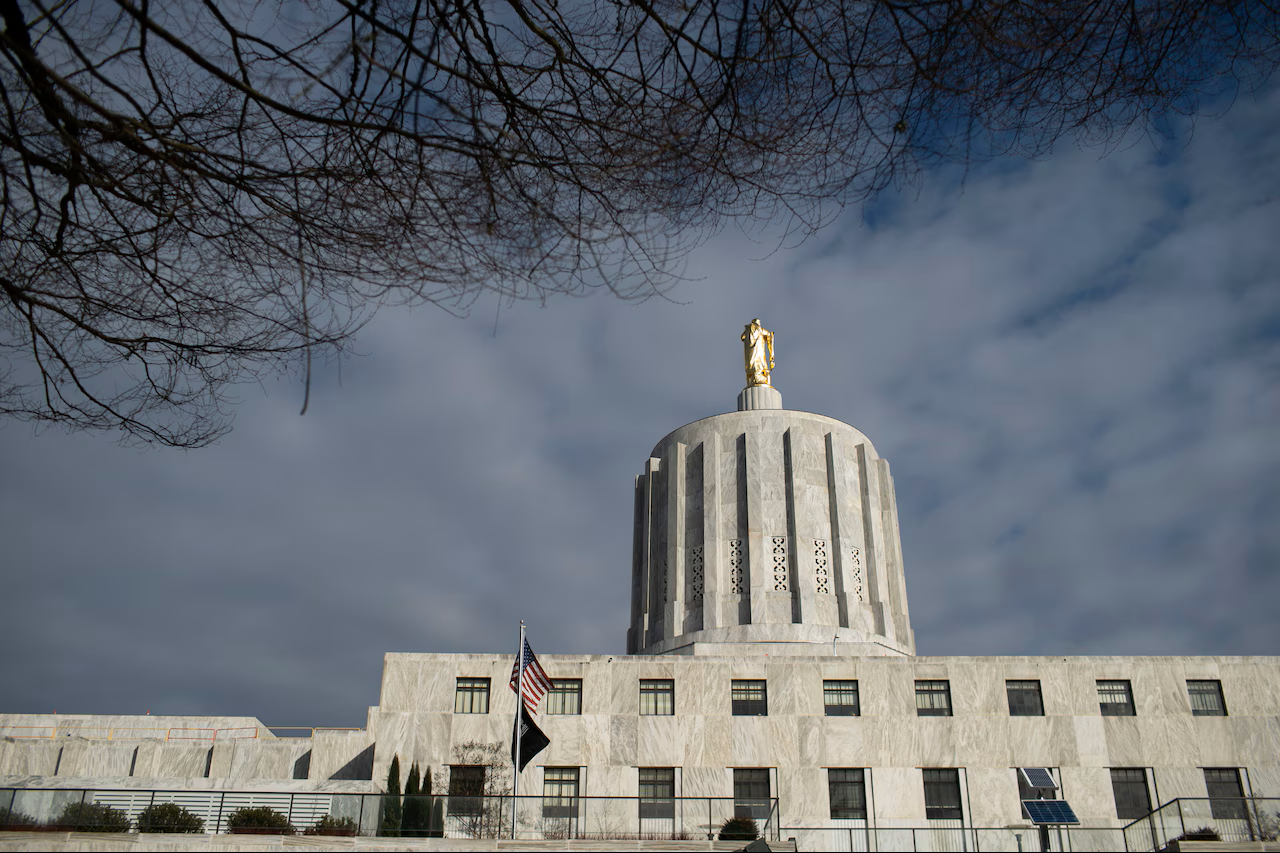
Photo caption: The Oregon State Capitol building in Salem, OR. (Beth Nakamura/The Oregonian/OregonLive/TNS)
_______
©2026 Advance Local Media LLC. Visit oregonlive.com. Distributed by Tribune Content Agency LLC.

Thanks for reading CPA Practice Advisor!
Subscribe Already registered? Log In
Need more information? Read the FAQs